What Is a Forecast? The Basics of Business Performance Prediction and Tips for Better Accuracy
Published:
Last Updated:
Published:
Last Updated:
Authors: Shusaku Yosa
"Where will this quarter's revenue land?"—whether you can answer this question with data-backed confidence determines your marketing department's credibility. In most companies, forecasting is seen as a sales-only activity, yet quantifying how marketing initiatives impact revenue and presenting that to leadership is critical for securing budget and prioritizing initiatives.
This article covers the fundamentals of forecasting and then focuses specifically on how marketing departments should participate in revenue prediction. We cover the differences from sales forecasting, the KPIs needed for marketing-driven forecasts, practical tips for improving accuracy, and how marketing ERPs like Xtrategy can support budget-to-actual management.
A forecast refers to predicting the landing point for revenue or profit—a form of performance target management. In Japanese companies, this is often called "landing prediction" (chakuchi yosoku), abbreviated as "FCST" in English.
The key distinction is that forecasting is not guesswork based on intuition, but a data-driven prediction grounded in historical sales data, current pipeline status, and market conditions. Beyond prediction, the full "forecast management" process involves visualizing the gap between targets and projected landing, then planning and executing countermeasures to close that gap.
There are four main reasons forecasting is essential in business.
First, improving management decision-making. By forecasting revenue and reflecting it in business plans, executives can make rational decisions about fundraising and investments. Using numbers rather than instinct makes internal alignment and external accountability far easier.
Second, optimizing budget allocation. Deciding how much to invest in each business unit or channel requires accurate revenue projections. For marketing departments in particular, forecasts provide the essential evidence for justifying ad spend and tool investments to leadership.
Third, early risk detection and response. When the gap between targets and projected landing is visible early, course corrections can happen before it's too late. Rather than scrambling at quarter-end, mid-period adjustments increase the probability of hitting targets.
Fourth, strengthening cross-departmental alignment. Sharing current status and challenges across sales, marketing, and corporate planning through a common forecast enables all teams to make decisions from the same numbers, improving overall organizational performance.
When people say "forecast," they usually mean the sales team's pipeline-based revenue projection. However, marketing forecasting is fundamentally different in nature.
Sales forecasting is predominantly a bottom-up approach—stacking individual deal win-probability estimates to project period-end revenue. The unit of analysis is individual deals, the cycle is weekly to monthly, and the sales manager typically owns it.
Marketing forecasting, by contrast, predicts how many leads each initiative (ads, content, events) will generate, and how those leads will convert through the pipeline to ultimately contribute revenue. The unit of analysis is initiative or channel, built around investment and expected return. The marketing leader owns it, collaborating with sales to forecast pipeline contribution.
Understanding this distinction is crucial. Sales forecasts alone can't answer "why is the pipeline short?" or "which initiative should we scale to reach our target?" Only by linking marketing forecasts to sales forecasts can you achieve end-to-end prediction from lead creation through closed-won.
For marketing-driven forecasting to work, you need intermediate KPIs that translate initiative output into revenue. Key metrics to track include the following.
Start with lead volume and cost per lead (CPL) by channel (paid search, SEO, webinars, trade shows, etc.). Then track the MQL (Marketing Qualified Lead) conversion rate—the share of leads that meet the criteria for handoff to sales. Next come the MQL-to-SQL (opportunity) conversion rate and the opportunity-to-closed-won rate. Calculate these conversion rates from historical data to build a model: "If we generate X leads this month, we can expect Y closed deals."
Average deal size and average lead time (from lead acquisition to closed-won) are also critical variables. Knowing the average deal size lets you project revenue from expected wins. Knowing the average lead time enables time-axis forecasting—"leads acquired this month will convert to revenue in Q+1."
Managing these KPIs by channel and initiative allows you to forecast: "If we add $X to this channel, when will the resulting revenue materialize and how much will it be?"
Forecast accuracy depends on the quality and volume of underlying data. Gather historical revenue contribution by initiative, channel-level lead volumes and conversion rates, seasonal patterns and market trends, and year-over-year comparisons. For B2B, include sales pipeline data; for B2C, use e-commerce purchase data and ad-attributed revenue.
Using historical analysis, project revenue landing at a future date. The baseline marketing formula is: "Current lead generation pace by channel × historical stage conversion rates × average deal size." Adjust for seasonal factors and the expected impact of planned new initiatives.
Compare your projected landing to the revenue target (or the pipeline contribution target assigned to marketing). The size and direction of this gap determine the priority of your next actions.
Devise concrete initiatives to close the gap. Marketing options include increasing budget on high-performing channels, fixing conversion bottlenecks in the funnel, launching additional initiatives (webinars, co-hosted events), and coordinating with sales for prioritized follow-up on hot leads. Estimate the revenue contribution of each initiative and back-calculate the required action volume.
A forecast is not a one-time exercise—it requires regular updates. Review landing estimates weekly or monthly, analyze variance from actuals, and validate countermeasure effectiveness. When predictions miss, analyze the root cause and feed it back into the model. Forecast accuracy improves with every iteration.
Misalignment between the sales team's deal-stage definitions and marketing's lead-quality assumptions will distort the entire forecast. Co-design MQL definitions and scoring criteria with sales, and recalibrate regularly.
CPL, conversion rates, and lead time differ by channel. Calculating unit economics per channel enables precise predictions: "An extra $10,000 on this channel generates X leads and ultimately Y in revenue."
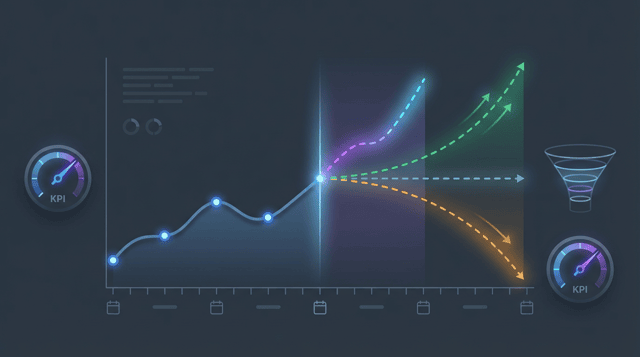
Present forecasts not as a single number but across three scenarios: base case (historical average conversion rates), optimistic (best-case conversion rates), and pessimistic (market downturn). Preparing action plans for each adds credibility when presenting to leadership.
Marketing effects lag—there's a time delay before initiatives translate into booked revenue. In B2B, lead times of several months are standard. Today's lead acquisition may not impact this quarter's revenue. Understanding lead time by initiative enables time-aware forecasting: "This month's campaign feeds next quarter's pipeline; to move this quarter's needle, we must nurture existing pipeline."
Sustained accuracy requires a structured habit of reviewing forecast-to-actual variance. Monthly retrospectives that ask "why did prediction and reality diverge?" and update model parameters create a compounding effect, steadily lifting org-wide forecast precision.
A commonly confused concept is "backcasting." Forecasting projects forward from the present; backcasting starts from an ideal future state and works backward to determine what needs to happen now.
For example, "Next month's revenue will likely be 5% above last month" is a forecast-style statement. "We need to double marketing-sourced revenue by next fiscal year-end—that requires adding 3 lead-gen channels and improving conversion by 1.5x this half" is a backcast-style statement. Use forecasting for short-to-mid-term performance management and backcasting for mid-to-long-term strategic planning to elevate your marketing team's planning capabilities.
Efficient forecast management requires tools that centralize data aggregation, visualization, and initiative management. Xtrategy, a marketing ERP, is purpose-built for this challenge.
Xtrategy's budget-to-actual management feature provides unified visibility from budget planning through actual results tracking. Channel-level KPI monitoring, initiative-level budget consumption, and target-to-landing gaps are available on a single screen, enabling a seamless cycle of forecast updates → gap discovery → countermeasure planning → task assignment → outcome verification.
Traditional forecast management scatters revenue data in SFA, marketing data in MA tools, and budget data in spreadsheets—just reconciling them consumes enormous effort. With an integrated platform like Xtrategy, forecast-relevant data accumulates naturally, and the latest landing estimate is always visible on the dashboard.
Xtrategy also enables everyone to make decisions from the same numbers, allowing marketing and sales forecasts to be discussed on common ground. Being able to show leadership marketing-sourced revenue contribution with data-backed evidence can elevate the marketing department's organizational standing. With upcoming expansions in ROI analysis, resource optimization, and customer data integration, the environment for ever-higher forecast precision continues to mature.
A forecast is a data-driven approach to predicting revenue or profit landing and implementing countermeasures to close gaps to targets. It serves to improve management decisions, optimize budget allocation, detect risks early, and strengthen cross-departmental alignment.
For marketing departments specifically, the requirement differs from sales forecasting—you must predict revenue contribution at the initiative and channel level. Accurately tracking intermediate KPIs like lead volume, MQL conversion rate, opportunity rate, average deal size, and lead time—then forecasting based on channel-level unit economics—is the key to precision.
To achieve high-accuracy forecasts, align win-probability criteria with sales, model multiple scenarios, design time horizons around lead time, and institutionalize forecast-vs.-actual reviews. To run these processes efficiently, adopt a marketing ERP like Xtrategy to unify budget-to-actual management and KPI monitoring—the first step toward a truly data-driven marketing organization.

Marketing progress tracking breaks down when tasks and budget live in separate systems. Learn four steps to tie them tog...

Why web development and advertising estimates are so hard to compare. Which fields to check first, how man-month pricing...

A practical guide to purchase order management: what it means, the six-stage process from quote to payment, the symptoms...


