10 Recommended LPO Tools Compared|How to Choose by Objective and Pricing
Published:
Last Updated:
Category: SEO & Content
Published:
Last Updated:
Category: SEO & Content
Authors: Shusaku Yosa
Many marketers want to improve the conversion rate (CVR) of their landing pages (LPs) but struggle with which LPO tool to choose. LPO tools differ significantly in their strengths and pricing models, and adopting a tool that doesn't fit your goals can lead to rising costs without results.
This article organizes the fundamentals of LPO tools, how to choose one based on your objectives, and a thorough comparison of ten recommended tools. We cover everything from free tools you can try out to full-featured tools for large sites, so use it as a reference for finding the right one for your needs.
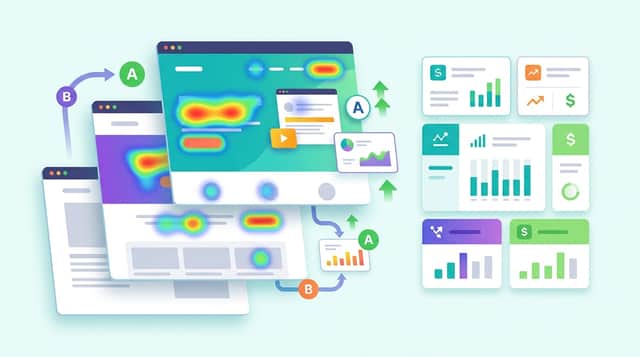
An LPO tool is a general term for tools that support Landing Page Optimization. Based on the behavioral data of users who visit your website, these tools let you quickly and accurately implement UI/UX measures that reduce bounce rates and improve CVR.
Analyzing user behavior, running A/B tests, and personalizing content by hand is far from easy. By using an LPO tool, you can streamline these improvement processes and achieve continuous, data-driven LP improvement.
The greatest benefit of introducing an LPO tool is that it prevents drop-offs, improves CVR, and drives revenue growth. Because you can base improvement measures on visitor behavior data, you gain reproducible LP operations that don't rely on intuition or experience alone. Accelerating the improvement cycle also helps improve the cost-effectiveness of your ad spend.
Since LPO tools each have different strengths, it's important to choose one that matches your objectives. Consider the following four points.
Clarify your objective, such as "prioritize A/B testing," "analyze user behavior," or "mass-produce LPs with no code." The optimal type of tool changes depending on your goal. If analysis is the priority, a tool strong in heatmaps or access analysis suits you; if speed of execution matters, a tool with LP creation features is a better fit.
Check whether the tool includes the features you need, such as A/B testing, multivariate testing, personalization, EFO, and heatmaps. There are all-in-one tools with many features as well as specialized tools focused on specific functions. Too many unused features lower cost-effectiveness, so it's important to identify the features your business actually needs.
LPO tool pricing varies by product, including flat monthly rates, usage-based billing, and quote-on-request. The suitable model differs depending on your monthly page views and traffic scale. If you want to run improvement measures repeatedly, a flat-rate plan with unlimited traffic makes cost management easier. We recommend simulating cost-effectiveness before adoption.
LPO operations sometimes require a certain level of analytical skill. If your organization has little in-house know-how, choosing a tool with strong onboarding and operational support gives peace of mind. Whether the admin interface is available in your language and easy to operate without specialized knowledge is also an important consideration for continued use.
Here we introduce ten representative LPO tools by objective and characteristics. Compare their strengths to find the one that fits your business. Note that pricing and feature details may change, so always check the latest information on each official site before adoption.
DLPO is a domestically developed (Japanese) LPO tool with many deployments centered on major companies' websites. It features a proprietary A/B and multivariate testing engine that can run high-speed tests while automatically factoring in combinations of visuals, buttons, and traffic sources. Its AI personalization feature also enables delivery of creative suited to each user. While it suits full-scale LPO operations on large-traffic sites, mastering it requires a certain level of analytical skill and an operational structure.
Squad beyond is a web advertising platform that combines landing page creation, analysis, reporting, and LPO into one. With its server-equipped editor, you can create unlimited LPs and articles, editing across multiple modes: no-code, low-code, and HTML. With a flat monthly rate offering unlimited domains and traffic, costs are less likely to balloon no matter how many times you run measures. It suits marketers who want to mass-produce and improve LPs via advertising.
SiTest is a domestically developed LPO tool that lets you visually check user behavior such as clicks and scrolling via heatmaps. It's designed so you can grasp improvement points without specialized knowledge, and its admin interface is easy to operate in Japanese. It also includes A/B testing and EFO features, plus pre-adoption demos and post-adoption usage support. It's an easy tool to adopt for companies taking on LPO for the first time or wanting to start with user behavior analysis.
Kaizen UX (Kaizen Platform) is a tool well regarded for its strong analytical capabilities specialized in website improvement. Leveraging know-how gained from abundant project experience, a specialized team provides hands-on support for improvement. It enables measures such as serving different first views for each ad message and using EFO features to raise completion rates among abandoning users. It suits companies that want to advance site improvement with professional support even with limited in-house resources or know-how.
Ptengine is an all-in-one tool that completes heatmap analysis, A/B testing, and personalization on a single platform. Because you can go from visualizing user behavior to executing measures seamlessly, you can run the analysis-and-improvement cycle efficiently. Its ability to start from a free plan is also appealing, making it suitable for companies wanting to start small first.
Optimizely is an experimentation platform widely used around the world for enterprises. It supports advanced A/B testing, multivariate testing, and feature-level experiments (feature flags), enabling large-scale, rigorous experiment design. It suits companies expanding globally or wanting to advance data-driven decision-making across the organization. Adoption and operation require a certain level of specialized knowledge.
VWO (Visual Website Optimizer) is an A/B testing tool widely used around the world. Using its visual editor, you can create test patterns even with little coding knowledge. In addition to A/B testing, it includes heatmaps and survey features, supporting a wide range of improvement measures. It's recommended for companies wanting to start optimization easily, centered on A/B testing.
CVX is an LPO tool that can handle both LP creation and improvement. While building LPs with no code, you can complete A/B testing and improvement measures within the same tool. Because you can proceed without separating creation and optimization, even small teams can run LP operations efficiently. It suits companies wanting to secure LP creation resources and improvement features together.
Mieruca Heatmap is a domestically developed heatmap tool that visualizes where users drop off. You can intuitively grasp scroll-reach rates and click distribution, and quickly identify areas to improve. Simple and easy to adopt, it suits companies wanting to start LP improvement from heatmaps first, or to begin analysis while keeping costs down.
KARTE Blocks is a tool that manages an existing site in blocks, letting you swap content and run A/B tests with no code. Without depending on engineers, staff can lead site improvements quickly. It suits media and e-commerce sites that frequently update and test content, and companies wanting to bring continuous improvement in-house.
An LPO tool isn't a set-it-and-forget-it purchase; results come from continuously running the improvement cycle. Proceeding with the following steps makes failure less likely.
There are a few points to keep in mind when introducing an LPO tool. First, simply introducing a tool will not automatically raise your CVR. Results come only when you have an operational structure that forms hypotheses, verifies them, and continues improving.
Also, without sufficient traffic, A/B test results won't reach statistical significance, making correct judgments difficult. On sites with little traffic, it's important to consider LPO alongside traffic-acquisition measures. Use free trials and demos to determine whether the tool can be reasonably incorporated into your operations before committing fully.
LPO tools are a powerful means of streamlining CVR improvement for landing pages. However, because each product's strengths and pricing models differ, the key to success is choosing based on your objective, starting from "what do I want to improve."
Whether you want to run full-scale A/B or multivariate testing with DLPO or Optimizely, proceed end-to-end from LP creation to improvement with Squad beyond, or start from behavior analysis with SiTest or Mieruca Heatmap, narrow down candidates to match your objective. First confirm the usability with a free plan or trial, then find the LPO tool that best fits your business.

A guide to the initial setup of Google Search Console, following the steps from registration to ownership verification. ...

A practical guide to smartphone LPO from the angle of mobile UI. Covers CTA placement mindful of the thumb zone, tap-fri...

A clear explanation of the difference between MEO and SEO from the angle of what each optimizes and how it works. A prac...


