Career Change to Marketing | Career Paths and Skills You Need, Even Without Experience
Published:
Last Updated:
Published:
Last Updated:
Category: Job Change by Occupation, Career Change for Beginners
Authors: Shusaku Yosa
"I'm interested in marketing, but can I really switch careers without any experience?" Many people share this concern while considering a career change to a marketing role. Marketing positions, which directly impact a company's revenue growth, are highly popular career destinations for those seeking career advancement and higher salaries.
The short answer is: yes, switching to marketing without experience is absolutely possible. However, since many companies seek candidates who can deliver results immediately, strategic preparation is essential.
This article comprehensively covers the types of marketing roles and their responsibilities, the latest trends in the job market, specific career paths for those starting without experience, and the skills you'll need to succeed.
Marketing roles encompass all positions involved in planning and executing strategies that drive product and service sales. These professionals handle a wide range of tasks that contribute to business growth, from market research and target analysis to product planning, promotional strategy development and execution, and performance measurement.
While we use the term "marketing" broadly, the field is actually divided into many specialized areas. To determine the direction you want to pursue, start by understanding the main types of marketing positions.
Marketing roles broadly fall into two categories: in-house marketers at product/service companies, and agency-side marketers at advertising agencies and consulting firms. In-house marketers handle the overall marketing strategy for their company's products and services, while agency-side marketers solve marketing challenges for client companies from an external perspective.
Specific roles include marketing researchers who handle market research and analysis, product planners who develop new products and services, advertising and PR professionals who drive brand awareness through advertising and public relations, and web/digital marketers who leverage websites, social media, and digital advertising.
The web marketing field has expanded rapidly in recent years, with increasing specialization in areas such as SEO, paid search advertising, social media management, content marketing, and email marketing. This domain is also notable for being relatively accessible to career changers, making it a good focus area for those looking to broaden their options.
The marketing job market remains strong, particularly in the digital space. According to research by the Yano Research Institute, Japan's digital marketing market is projected to grow from 282.8 billion yen in 2022 to 415.7 billion yen by 2026, and demand for marketing talent is expected to continue rising alongside this market growth.
Driven by corporate DX initiatives, e-commerce market expansion, and the proliferation of social media marketing, the shift from traditional mass advertising to data-driven digital marketing is accelerating. This trend is further boosting the need for marketers with digital skills.
At the same time, marketing roles are popular among job seekers, so competition is far from low. Many companies prefer candidates who can demonstrate results through numbers, which can be a high barrier for inexperienced candidates. That said, positions with potential-based hiring and openness to inexperienced applicants do exist, and strategic preparation can help you seize these opportunities.
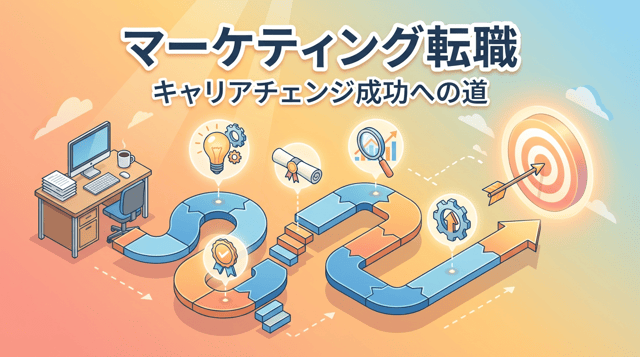
To successfully transition into marketing without experience, a step-by-step career-building approach works better than randomly applying to openings. Here are four representative career paths.
If your current employer has a marketing department, transferring internally is the lowest-risk route. Deliver results in your current role—whether in sales, planning, or customer support—while expressing your interest in moving to marketing. Being internal means you can leverage your existing industry knowledge and company network to get started smoothly, even without marketing experience.
Customer insight, proposal skills, and a numbers-driven mindset developed in sales are highly valued in marketing. Companies where BtoB marketing and inside sales collaboration are crucial increasingly welcome former salespeople transitioning into marketing. If you can articulate how your customer analysis and revenue improvement experience translates to marketing work, it becomes a powerful selling point.
Digital advertising agencies and startups tend to be more open to inexperienced candidates. A common and proven career path is to gain hands-on experience in positions like ad operations assistant or social media manager, develop your skills, and then step up to an in-house marketing role at a larger company.
Building your own marketing track record through freelance social media management, ad operations, or personal blog SEO is another effective approach. Even without formal work experience, compiling results from personal projects into a portfolio dramatically increases your credibility in job interviews. Concrete numbers like "grew blog page views to X per month" or "increased social media followers by X in Y months" serve as clear proof of ability for hiring managers.
Here's an overview of the skills to develop for a successful marketing career change. You don't need to master all of them, but use this as a guide for your preparation.
Marketing effectiveness measurement and optimization are data-driven. Proficiency with analytics tools like Google Analytics, KPI design and tracking, and data aggregation in Excel or spreadsheets are valued across all marketing roles. If you have experience using data for sales analysis or process improvement in your current role, be sure to highlight it.
The ability to identify market or user challenges and develop solutions is a core marketing skill. Professionals who can think from the customer's perspective and run hypothesis-driven test-and-learn cycles are highly valued, even without direct marketing experience. Experience with proposals or process improvements in your current role transfers directly.
Foundational knowledge of SEO, web advertising, social media marketing, and marketing automation (MA) tools is essential for today's marketers. Even without deep operational expertise, understanding the basics of each domain and key metrics (CPA, CTR, CVR, etc.) will help you navigate interview conversations smoothly.
Marketing is inherently collaborative, requiring coordination with development teams, sales teams, and external partners. The ability to logically communicate the intent and results of marketing initiatives is also essential. These are skills that professionals from sales and planning backgrounds often already possess, making them a significant advantage in a career change.
While certifications rarely make or break a marketing hire, for inexperienced candidates they demonstrate learning initiative and foundational knowledge. We recommend using the following certifications and learning resources to build your skills before starting your job search.
Notable certifications include the Marketing Business Proficiency Exam and the Web Analytics Consultant certification. The former provides systematic marketing knowledge, while the latter demonstrates web data analysis skills with strong practical relevance. Additionally, Google Ads certification and HubSpot's Inbound Marketing certification are both free to obtain and serve as excellent learning resources for digital marketing fundamentals.
For learning methods, online courses are highly efficient. Platforms like Udemy and Schoo offer extensive practical courses in SEO, ad operations, and data analysis. Beyond studying, put what you learn into practice by running a personal blog or managing social media accounts, then compile your results into a portfolio to use as interview material.
Finally, here are practical tips to keep in mind as you pursue your marketing career change.
First, clarify your "why." Motivations like "it seems glamorous" or "I want a higher salary" won't hold up under scrutiny. Prepare to articulate in your own words what sparked your interest in marketing and what career vision you want to achieve through it.
Second, translate your existing skills and experience into marketing language. Whether you're from sales (customer insight), planning (strategy development), or administration (data management), every background has strengths that transfer to marketing. Document these with specific episodes and metrics in your resume.
Third, prepare a portfolio or work samples. Blog analytics, social media growth records, Google Ads reports—even small projects count. Having tangible proof that you've taken action can dramatically improve a hiring manager's assessment.
Fourth, deepen your understanding of the target industry and products. Marketing strategies vary significantly by industry and product type. Conduct independent competitive analysis and user research for target companies. Being able to propose specific strategies in an interview is a powerful differentiator.
Fifth, take advantage of opportunities to experience actual workplaces before making the switch. Marketing responsibilities vary widely between companies, making post-hire mismatch a real risk. By participating in casual meet-ups or using services like Otameshi Tenshoku (Trial Job Change) that let you work at a company before committing, you can verify the work content and team culture firsthand, ensuring a career change you can feel confident about.
Marketing is a growth field with an expanding market, especially in the digital space. While it may seem like a tough switch for career changers, leveraging skills from sales, planning, administration, or other fields while building your career step by step makes a successful transition very achievable.
The key is redefining your strengths in a marketing context, building on continuous learning and practice. And by actively utilizing services like Otameshi Tenshoku that let you experience real workplaces, you can pursue a career change free from mismatches.
Otameshi Tenshoku lists openings across various roles, including marketing. If you want to experience the work before committing, check out the available listings today.
A breakdown of remote engineering jobs by role (backend, frontend, SRE, data/ML, QA, internal IT), which roles get true ...

How to become a full-time employee from being a part-time worker (freeter), explained as job-hunting techniques from no ...
A clear guide to marketing administrative roles. Covers duties such as data aggregation and ad operation support, the sk...


