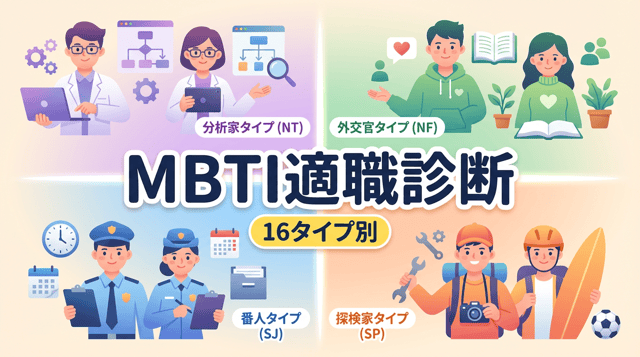
"I don't know what kind of work suits me." "I want to use my MBTI results for my career." — These are common concerns shared by many people.
The MBTI (Myers-Briggs Type Indicator) is a personality assessment based on Jungian psychology that classifies people into 16 types through a combination of four indicators. While it's not a tool for "determining" your ideal career, it's extremely useful for objectively understanding your thinking tendencies and values, and for considering what kind of work environment allows you to perform at your best.
In this article, we provide a detailed breakdown of the ideal careers for each of the 16 MBTI types, examining three key dimensions: personality strengths, work style tendencies, and compatible occupations. We hope it helps you discover a career direction that fits your personality.
MBTI classifies personality using the following four indicators.
Energy direction (E: Extraversion / I: Introversion), information intake (S: Sensing / N: Intuition), decision-making (T: Thinking / F: Feeling), and lifestyle (J: Judging / P: Perceiving). These four axes combine to produce 16 types such as INTJ, ESFP, and ENFJ.
The key to using it as a career assessment is to focus on "working conditions" rather than "job titles." For example, extraverts (E) tend to perform well in collaborative team settings, while introverts (I) tend to produce results in focused, independent environments. Rather than mapping types directly to job titles, use it as a tool for clarifying the conditions under which you work most comfortably.
To apply MBTI results to your career, it's effective to organize your "comfort conditions at work" using these four dimensions.
The first dimension is "communication distance." Extraverts (E) prefer environments with frequent interaction, while introverts (I) concentrate better when they have time for small-group or individual work. Understanding how you recharge will improve the accuracy of your workplace selection.
The second dimension is "information processing style." Sensing types (S) excel at work requiring concrete data and procedures, while intuitive types (N) fit well with work involving big-picture thinking and new concept development.
The third dimension is "decision-making criteria." Thinking types (T) prioritize logic and rationality, making them well-suited for analytical and strategic roles, while feeling types (F) excel at considering people's emotions, giving them strengths in interpersonal support and team building.
The fourth dimension is "work approach." Judging types (J) thrive at planned, methodical work, while perceiving types (P) perform at their best in roles that require flexible, adaptive responses.
Analyst types have a strength in structuring information and designing systems and strategies. With strong intellectual curiosity, they're more motivated by complex problems than simple tasks.
Personality strengths: Strategic thinking ability to envision long-term goals and the planning skills to execute them. Highly independent with the ability to produce results autonomously.
Work style tendencies: Prefers environments with significant autonomy where they can think deeply at their own pace. Tends to feel stressed under micromanagement.
Compatible careers: Strategy consultant, data scientist, software architect, investment analyst, corporate planning, researcher
Personality strengths: The ability to handle abstract concepts and the creativity to find original solutions to unsolved problems. Strongly driven by intellectual curiosity with excellent analytical skills.
Work style tendencies: Fits well in high-freedom environments where they can pursue their interests. May struggle with deadline management and routine tasks.
Compatible careers: AI engineer, R&D, programmer, data analyst, university professor, game designer
Personality strengths: Natural leadership and swift decision-making. Has the drive to set goals and lead teams to achievement.
Work style tendencies: Finds fulfillment in responsible positions overseeing the big picture. Tends to feel frustrated in passive environments or with inefficient processes.
Compatible careers: CEO, project manager, lawyer, management consultant, politician, entrepreneur
Personality strengths: Quick thinking and an innovative spirit that challenges existing frameworks. Excels at idea generation and problem-solving through debate.
Work style tendencies: Thrives in dynamic, fast-paced environments. Tends to find routine work and detailed administrative tasks boring.
Compatible careers: Marketing planner, copywriter, venture capitalist, journalist, product manager, screenwriter
Diplomat types connect deeply with others' feelings and find strong fulfillment in socially meaningful work. With high empathy and communication skills, they excel in careers that support personal growth.
Personality strengths: Deep insight and intuitive understanding of others' true nature. Quietly guides people with a strong sense of mission for social contribution.
Work style tendencies: Performs best when work aligns with personal values. Target-driven environments or conflict-heavy workplaces tend to cause stress.
Compatible careers: Career advisor, psychotherapist, teacher, NPO staff, physician, HR professional
Personality strengths: Rich imagination and delicate sensitivity. With a deep inner world, they demonstrate unique abilities in creative activities and empathetic roles.
Work style tendencies: Seeks work that honors personal values. Shines in purpose-driven roles rather than number-driven, quota-focused environments.
Compatible careers: Writer, UX designer, career consultant, NPO activist, psychotherapist, illustrator
Personality strengths: Charisma and drive. A natural facilitator who inspires and elevates the motivation of entire teams.
Work style tendencies: Finds strong fulfillment in work that involves supporting others' growth. Tends to become drained in environments requiring prolonged solitary work.
Compatible careers: HR manager, training instructor, education coordinator, sales leader, community manager, PR specialist
Personality strengths: Overflowing energy and creativity. Generates new ideas through human connections and has the ability to rally others to bring them to life.
Work style tendencies: Fits well in high-freedom environments with daily variety. Does not thrive in workplaces with monotonous repetitive tasks or rigid rules.
Compatible careers: PR specialist, event planner, content creator, marketing planner, counselor, entrepreneur
Sentinel types excel at steadily building results in environments with clear rules and procedures. With a strong sense of responsibility, they serve as the dependable backbone that keeps organizations and teams stable.
Personality strengths: Accuracy and perseverance. Prefers fact-based and data-driven decisions with high reliability in completing assigned tasks.
Work style tendencies: Performs consistently in environments with clear standards and rules. Vague instructions and frequent policy changes tend to cause stress.
Compatible careers: Accountant, civil servant, legal affairs, quality control, systems operations engineer, auditor
Personality strengths: Attentive care and dedication. The type who supports others quietly with the patience to persevere, earning deep trust from those around them.
Work style tendencies: Motivation increases in environments where gratitude is felt. May lose a sense of purpose without the feeling of being helpful to others.
Compatible careers: Nurse, customer support, administrative staff, care worker, librarian, school administrator
Personality strengths: Execution ability and leadership to efficiently organize teams. Skilled at setting clear standards and leading teams to deliver results.
Work style tendencies: Performs best in environments with clear roles and responsibilities. Tends to feel dissatisfied in organizations with ambiguous authority or slow decision-making.
Compatible careers: Management positions, project leader, banker, property manager, military or law enforcement, plant manager
Personality strengths: Sociability and hospitality. Has the ability to smooth interpersonal relationships and is an indispensable presence for creating team atmosphere.
Work style tendencies: Achieves high satisfaction in jobs with frequent human interaction and direct appreciation. Tends to become drained in conflict-heavy work environments.
Compatible careers: Medical office staff, school teacher, hospitality, executive assistant, sales support, bridal coordinator
Explorer types excel at adapting on the fly in flexible environments. With strong on-the-ground response skills, they perform best in work that engages the senses and hands-on action.
Personality strengths: Cool analytical ability and practical problem-solving skills. A craftsman type who understands the mechanisms of tools and systems and produces results with hands-on action.
Work style tendencies: Fits well in environments allowing trial and error at their own pace. Does not thrive in workplaces with excessive monitoring or frequent formal meetings.
Compatible careers: Engineer/mechanic, programmer, pilot, architect, surgeon, firefighter
Personality strengths: A fusion of aesthetic sense and practical skills. Has creative expression through the senses and the ability to reflect their personal worldview in work and services.
Work style tendencies: Seeks calm environments where they can be authentic. Tends to feel stressed in competitive atmospheres or strict hierarchies.
Compatible careers: Illustrator, hairstylist, florist, chef/pastry chef, photographer, fashion designer
Personality strengths: Split-second judgment and action. Has an innate business sense that embraces risk while seizing opportunities.
Work style tendencies: Demonstrates true value in fast-paced, on-the-ground environments. Tends to get bored with desk-heavy work or long-term planning.
Compatible careers: Sales professional, entrepreneur, sports-related roles, real estate sales, emergency medicine, event management
Personality strengths: Vibrant energy and approachability. Highly improvisational with natural communication skills that shine in people-facing environments.
Work style tendencies: Prefers variety over daily repetition. Struggles with solitary work or monotonous data entry tasks.
Compatible careers: Performer/actor, tour guide, fitness trainer, childcare worker, retail/customer service, wedding planner
To effectively use your MBTI results in job hunting or career changes, it's important not to take them at face value but to use them as a self-analysis framework.
Start by writing down your type's "strengths" and "challenging situations." Then, compare them with past experiences (part-time jobs, academics, projects, etc.) and link specific episodes like "I definitely performed well in this setting" or "I felt stressed in that environment." This also becomes valuable material for interview self-presentations.
Additionally, combining MBTI with other assessment tools (such as StrengthsFinder or aptitude tests) allows for a more multidimensional self-understanding. Deepening your self-analysis from multiple perspectives will significantly improve the accuracy of your career decisions.
MBTI is an excellent tool for self-understanding, but there are several important points to keep in mind when using it.
First, MBTI is not a "definitive career aptitude test." It's a tool for organizing personality tendencies, and making career decisions based solely on results carries risk. Real work is also significantly influenced by skills, experience, relationships, and company culture beyond personality.
Second, free online assessments differ from the official MBTI. Services like 16Personalities that are widely used online are inspired by the MBTI framework but are not the same as the official MBTI assessment, which is administered by certified professionals for more accurate results.
Third, your results can change. Depending on your physical condition or mental state, results may fluctuate. Rather than treating a single result as absolute truth, it's important to maintain an attitude of regularly reflecting on yourself.
We've covered the personality strengths, work style tendencies, and compatible careers for all 16 MBTI types.
The key to finding your ideal career is not simply matching a type name to a job title, but rather using your personality tendencies to think about "what conditions allow me to perform at my best." MBTI is an extremely effective starting point for that exploration.
Every type has unique strengths, and there is always a place where those strengths can thrive. We hope this article helps you gain a deeper understanding of your personality and guides you toward a career choice you can feel confident about.

An in-depth guide to MBTI compatibility focused on workplace relationships. Learn boss-type strategies, high-compatibili...

A comprehensive guide to the best-fit jobs for each of the 16 MBTI personality types. Discover your strengths, weaknesse...

Comprehensive analysis of optimal career change timing by age group, season/month, and tenure length. Covers strategies ...