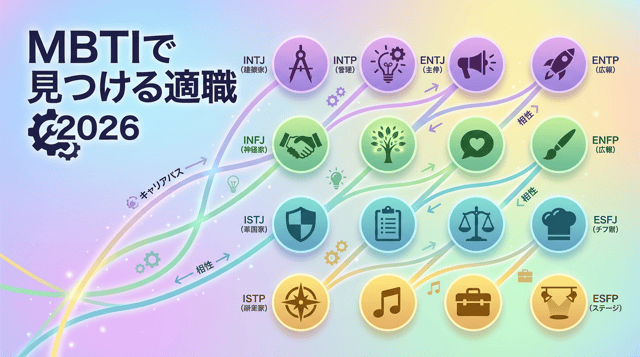
"My current job just doesn't feel right." "I want to change careers, but I have no idea what suits me." — Does this sound familiar?
In recent years, the MBTI (Myers-Briggs Type Indicator) has gained significant attention as a tool for understanding your personality type. By combining four indicators, it classifies people into 16 types and helps organize thinking patterns and behavioral tendencies, making it widely used as a guide for career decisions.
In this article, we explain the "best-fit jobs," "strengths and weaknesses," and "career change tips" for each of the 16 MBTI types. Use it as a reference for finding a career that matches your type.
MBTI is a personality assessment developed based on the theories of psychologist Carl Jung. It classifies personality using four indicators:
Energy direction (E: Extraversion / I: Introversion), information processing (S: Sensing / N: Intuition), decision-making (T: Thinking / F: Feeling), and approach to the outside world (J: Judging / P: Perceiving). Combining these four axes produces 16 types such as INTJ, ESFP, and ENFJ.
MBTI is not a tool that declares "this is your ideal job." However, because it helps you objectively organize your thinking patterns and values, it provides valuable clues for considering what kind of environment allows you to perform at your best and what work style suits you.
To leverage your MBTI results in a career change, it's important to think beyond just your type name and consider these three perspectives.
First, "think in terms of roles rather than job titles." Even within the same sales position, the traits required for new business development versus existing client management differ greatly. Don't judge by job title alone — compare the specific tasks with your personal traits.
Second, "prioritize compatibility with work style and environment." The elements that make up a job are diverse — degree of autonomy, team collaboration intensity, visibility of results, and more. Being conscious of the environmental conditions where your type thrives helps prevent mismatches.
Third, "use your results as a starting point for self-analysis." MBTI results are not absolute and can change depending on your current state. Rather than taking results at face value, use them in conjunction with your actual experiences and feelings.
The Analyst group excels at understanding things structurally and logically, with strengths in system design and strategic planning. They have strong intellectual curiosity and the ability to find unique solutions to complex problems.
Characterized by strategic thinking and high independence. Excels at envisioning long-term goals and executing plans methodically. However, teamwork and emotional communication can sometimes be challenging.
Best-fit jobs: Management consultant, IT architect, researcher, project manager, data scientist
An inventor type combining logical thinking and creativity, constantly generating new ideas. Prefers deepening knowledge and performs best in environments where they can pursue their interests. However, they tend to struggle with project completion and schedule management.
Best-fit jobs: Software engineer, data analyst, web designer, marketer, academic researcher
A natural leader with outstanding decisiveness and organizational skills. Values efficiency and has the ability to mobilize others toward goal achievement. While fearless in positions of responsibility, they can sometimes overlook others' opinions.
Best-fit jobs: Executive, manager, lawyer, business consultant, entrepreneur
A quick-witted intellectual adventurer who excels at finding new possibilities. Particularly shines in debates and brainstorming sessions. While routine work and detailed tasks tend to bore them, they deliver high performance in dynamic environments.
Best-fit jobs: Marketer, copywriter, planning and development, journalist, venture capitalist
The Diplomat group possesses deep empathy and idealism, with a strong interest in personal growth and social contribution. The feeling of "making a difference for someone" is their core source of motivation.
Possesses deep insight and empathy, finding joy in unlocking others' potential. Idealistic and dedicated in their support, they sometimes push themselves beyond their limits.
Best-fit jobs: Counselor, teacher, physician, HR professional, social worker
Rich in imagination and sensitivity, this type values their personal principles. With high empathy and acceptance of diverse viewpoints, they thrive in creative work or roles that connect with people's hearts.
Best-fit jobs: Writer, career consultant, NPO staff, UX designer, psychotherapist
A leader type combining charisma and action, rallying others toward goals. Finds deep fulfillment in supporting others' growth. However, they tend to prioritize others over themselves and neglect self-care.
Best-fit jobs: HR manager, education coordinator, sales leader, training instructor, community manager
Curious and energetic, this type values human connections. They have the creativity to bring ideas to life and communication skills that engage others. On the other hand, their interests shift quickly, and consistency can be a challenge.
Best-fit jobs: PR specialist, event planner, content creator, counselor, marketing planner
The Sentinel group thrives in environments with clear roles and rules. With a strong sense of responsibility, they excel at building results steadily. They serve as the backbone that keeps organizations and teams stable.
Sincere and responsible, this type faithfully follows established rules and procedures. They excel in accuracy and perseverance, preferring decisions based on data and facts. Environments with frequent change or ambiguity tend to cause stress.
Best-fit jobs: Accountant, civil servant, legal affairs, quality control, systems operations engineer
Caring and supportive, this type works behind the scenes to hold teams together. Their attention to detail and patience earn deep trust from colleagues. Being modest about self-promotion, their contributions can sometimes go unnoticed.
Best-fit jobs: Nurse, administrative staff, librarian, customer support, care worker
A highly effective leader in organizational management, setting clear standards and efficiently guiding teams. While their strong sense of justice is admirable, they can sometimes lack flexibility.
Best-fit jobs: Management positions, project leader, banker, property manager, military or law enforcement
Sociable and caring, this type values team harmony. Skilled at building relationships and hospitality, they achieve high satisfaction in people-facing roles. They tend to avoid conflict, which can lead to internalized stress when disagreements arise.
Best-fit jobs: Medical office staff, school teacher, hospitality, executive assistant, sales support
The Explorer group prefers work where they can act on their own initiative in a flexible environment. Their high adaptability and on-the-ground problem-solving skills allow them to handle changing situations with ease.
Cool-headed and hands-on, this craftsman type solves problems through action. Skilled with tools and machinery, they respond immediately with practical skills. They prefer working at their own pace and fit best in jobs free from micromanagement.
Best-fit jobs: Mechanical engineer, pilot, programmer, construction technician, sports trainer
An artistic type with rich sensibility and aesthetic sense. Faithful to their values, they excel in work that engages the senses. They prefer calm, authentic workplaces over competitive environments.
Best-fit jobs: Graphic designer, photographer, florist, chef, physical therapist
Exceptionally action-oriented, this type seizes opportunities without fear of risk. Strong in on-the-spot judgment and communication, they perform best in fast-paced environments. Long-term planning and desk-heavy work tend to feel tedious.
Best-fit jobs: Sales professional, event planner, startup founder, marketer, sports-related roles
Bright and energetic, the life of the party. Loves engaging with people and shines when in the spotlight. Their improvisational skills and people skills are powerful assets, though they may struggle with planning and repetitive tasks.
Best-fit jobs: Retail and customer service, tour guide, entertainment industry, hairstylist, wedding planner
Each of the 16 types has its strengths, but there are also tendencies in how they approach the job search process. Here are key tips for each of the four groups.
Analyst (NT) types excel at articulating their achievements and skills logically. In interviews, presenting specific numbers and results adds credibility. However, don't forget to add a personal touch to your motivation statement.
Diplomat (NF) types are skilled at conveying passion and vision. In self-introductions, the story of "why you want this job" becomes a powerful asset. On the other hand, they tend to delay salary and benefit negotiations, so prepare your desired conditions in advance.
Sentinel (SJ) types can approach job hunting methodically. They excel at document preparation and scheduling, so highlight that precision as a strength. While they may hesitate to venture into new industries, their existing experience is highly transferable.
Explorer (SP) types bring strong communication and quick-response skills to interviews. Leverage your action-oriented nature for active information gathering and company visits. Just be sure not to decide on impulse alone — also verify the work environment and culture after joining.
While MBTI is a useful tool, it's not infallible. Here are important caveats to keep in mind.
First, MBTI is not a career aptitude test. It's a tool for visualizing personality tendencies, not for recommending specific occupations. Avoid the trap of thinking "this is the only job for me" based solely on your type.
Second, your results can change. Depending on your physical condition, mental state, and current environment, your answers may vary. We recommend periodically revisiting your type and checking whether it still feels like an accurate fit.
Finally, consider not just the job title but also the workplace environment. Even within the same role, company culture and team dynamics can dramatically affect your experience. Research companies thoroughly to find an environment that truly fits you.
We've covered the best-fit jobs for all 16 MBTI personality types. The key takeaway is not to treat your results as the "right answer," but to use them as a starting point for organizing your strengths and values.
Every type has unique strengths, and there is always a place where those strengths can shine. If you feel your current job isn't the right fit, start by understanding your type and exploring what environments and roles allow you to perform at your best. We hope this article helps guide your career change journey.

An in-depth guide to MBTI compatibility focused on workplace relationships. Learn boss-type strategies, high-compatibili...

A detailed guide to ideal careers for each of the 16 MBTI personality types. Explore personality strengths, work style t...

Comprehensive analysis of optimal career change timing by age group, season/month, and tenure length. Covers strategies ...