How to Choose a Part-Time Job: A Self-Check and 16-Type Ideas
Published:
Last Updated:
Category: Side Jobs
Authors: Shusaku Yosa
Published:
Last Updated:
Category: Side Jobs
Authors: Shusaku Yosa
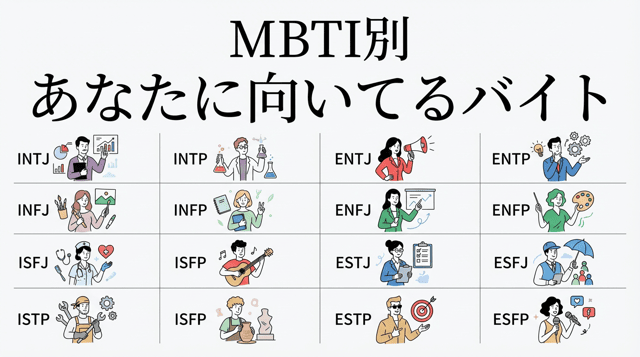
A suitable part-time job depends on the work you enjoy, the skills you can use or learn, and the hours and conditions you can sustain. A personality result can prompt ideas, but it cannot identify a guaranteed match.
Start with the self-check below, then use the type table to generate possibilities. This is a comparison guide, not a diagnostic test or a scored aptitude assessment.
Question | What to write down |
|---|---|
When can you reliably work? | Available days, start and finish times, and travel limits |
How much interaction suits you? | Short customer exchanges, longer conversations or mostly task-focused work |
What pace is manageable? | Predictable routines, varied tasks or frequent urgent requests |
What physical conditions fit? | Standing, lifting, outdoor work and the need for breaks |
What skills can you offer? | Concrete examples, such as accurate entry, language skills or food preparation |
What support do you need? | Training, written instructions, supervision and a way to ask questions |
Turn vague preferences into observable conditions. “A quiet job” might mean fewer interruptions, a small team or no customer phone calls; those are different requirements.
These are exploratory prompts based on common type descriptions, not tested matches. Every job still requires checking the actual duties and employer's expectations.
Type | An interest to test | Roles or tasks to investigate |
|---|---|---|
ISTJ | Accuracy and clear procedures | Stock records, administrative support or routine quality checks |
ISFJ | Practical help and reliable service | Reception support, customer assistance or school administration support |
INFJ | Explaining and supporting learning | Tutoring support, writing assistance or community-program support |
INTJ | Planning and improving a process | Research assistance, data organization or technical support tasks |
Roles involving regulated duties, specialist instruction, machinery or care can require qualifications and supervision. An “assistant” title does not remove those requirements. Review the specific listing.
16Personalities and official MBTI are different systems. The Japan MBTI Association explains the distinction and notes that MBTI does not measure vocational aptitude.
Read beyond the headline. Two café jobs can differ in peak-hour volume, kitchen duties, shift flexibility and training. Two data-entry jobs can differ in phone work, checking requirements and confidentiality.
For each option, record pay, guaranteed or expected hours, travel time, shift rules, main tasks and training. Distinguish employed part-time work from an independent contract: payment terms and responsibilities differ.
A specific answer helps more than a description such as “friendly workplace” or “perfect for beginners.”
Use school, volunteer or personal-project examples honestly. Describe what you did, what standard you met and what you learned. Do not claim paid experience you do not have.
If permitted, try a small realistic task or discuss a typical scenario during recruitment. Confirm the terms of any work trial, including duties and payment, rather than assuming that a “trial” is automatically informal or unpaid.
A job can match your interests but still conflict with study, another job or caregiving. Include travel, preparation and recovery time in your availability. Be clear about the hours you can sustain instead of promising flexibility that you cannot provide.
Only if the actual tasks and conditions also fit. Use the table to generate options, not to eliminate everything outside your row.
Introversion alone cannot answer that. Consider the length and intensity of interactions, recovery time, training and your own experience.
You can use the practical self-check without taking a personality test. Your availability, skills and observed preferences are enough to begin comparing roles.

What it takes to run a side job while working fully remote. Covers the aggregation of working hours under employment con...

How to find employers that genuinely allow side jobs. Covers the four levels of side job policy from prior approval to f...
How to file a tax return when you have a side job as temp staff. Covers the staffing agency's year-end adjustment, the 2...
ISTP
Hands-on troubleshooting |
Equipment support, assembly or repair assistance under suitable supervision |
ISFP | Making and refining something tangible | Display preparation, creative production support or food preparation |
INFP | Meaningful communication | Writing support, editing assistance or learner support |
INTP | Investigating how something works | Testing, technical documentation or research support |
ESTP | Responding to practical situations | Events, active retail work or venue operations |
ESFP | Interaction and shared experiences | Hospitality, event assistance or customer-facing retail |
ENFP | Ideas and varied communication | Content assistance, promotional events or community support |
ENTP | Exploring options and solving problems | Research, project support or product-feedback tasks |
ESTJ | Coordinating people and tasks | Shift support, scheduling assistance or inventory operations |
ESFJ | Helping people navigate a service | Reception, hospitality or customer support |
ENFJ | Explaining and organizing with people | Training assistance, tutoring or event coordination |
ENTJ | Planning toward an outcome | Project administration, sales support or operations assistance |


