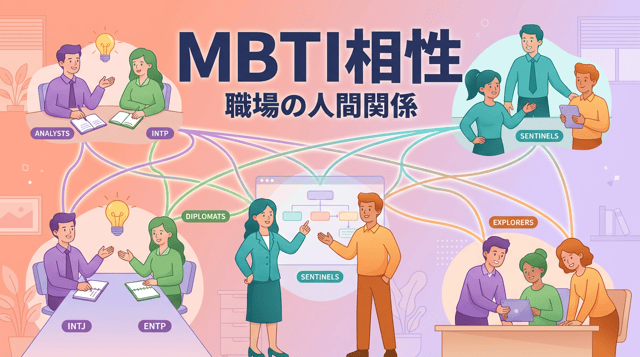
"I just can't get along with my boss." "Communication with my colleagues always feels awkward." — When workplace relationships become stressful, the root cause may not be a matter of ability or effort, but of personality type compatibility.
The MBTI (Myers-Briggs Type Indicator) is a personality classification tool based on Jungian psychology that categorizes people into 16 types by combining four indicators. While it's often discussed in the context of romantic or friendship compatibility, it's also highly effective as a tool for improving workplace relationships.
In this article, we explore MBTI compatibility with a specific focus on workplace relationships. We cover compatibility patterns between bosses, subordinates, and colleagues, along with communication strategies that leverage personality type differences. Use it as a reference for choosing the right workplace or building better teams.
At work, we spend hours every day with the same people. Because team members with different work styles and decision-making approaches must collaborate, personality type differences easily become sources of stress and friction.
Understanding MBTI compatibility offers three key benefits. First, you can "predict others' behavioral patterns." Why does your boss constantly check on progress? Why does your colleague love debates? When these behaviors can be explained by type differences, emotional conflicts decrease.
Second, you can "adjust your communication style." Simply choosing a reporting method or proposal approach that matches the other person's type can dramatically smooth out workflows. Third, you can "apply it when choosing a workplace." You become better at identifying team cultures and management styles where your type thrives before you even join.
When considering MBTI compatibility in the workplace, the following four opposing axes have the greatest impact. Understanding the friction each axis can create between different types is essential.
Extraverts gain energy through frequent dialogue and meetings, while introverts need time to focus alone. When an extraverted boss repeatedly says "Got a minute?", it disrupts an introverted employee's concentration. Conversely, an introverted boss's preference for email updates may make an extraverted employee feel neglected. Simply understanding each other's recharging methods can significantly improve daily communication.
Sensing types value concrete data and procedures, while intuitive types prioritize the big picture and concepts. In project discussions, when an intuitive type suggests "Let's decide the direction first," a sensing type thinks "Shouldn't we start with concrete numbers?" This difference isn't about who's right — it's simply a difference in approach. Having both types on a team creates a balance of vision and execution.
Thinking types prioritize logic and efficiency in their decisions, while feeling types weigh the impact on people and personal values. For example, during team restructuring, a thinking-type boss who decides purely based on performance data may seem to a feeling-type member as "ignoring people's feelings." Conversely, a feeling-type boss who seeks consensus from everyone may frustrate a thinking-type member with "slow decision-making." Both are valid criteria, and incorporating both perspectives elevates team decision quality.
Judging types prefer sticking to plans and strongly value meeting deadlines. Perceiving types, on the other hand, value flexibility and are comfortable adjusting plans as situations change. Under a judging-type boss, a perceiving-type employee may face the complaint "Why don't they follow the plan?", while under a perceiving-type boss, a judging-type employee may feel anxious that "the direction keeps changing."
Your relationship with your boss directly impacts job satisfaction and career development. Here are tips for working effectively with different boss types.
INTJ, INTP, ENTJ, and ENTP bosses value logical explanations and efficiency. When reporting or proposing, lead with conclusions and support them with data. Avoid emotional arguments or vague expressions, and clearly articulate the "why." ENTJ bosses especially prefer quick decisions, so presenting options with a recommended choice works well. INTP bosses value deep reflection, so setting aside time for thorough discussion helps build trust.
INFJ, INFP, ENFJ, and ENFP bosses value team member growth and team harmony. When reporting, share not only results but also "what you learned" and "how you contributed to the team" to earn high marks. ENFJ bosses tend to prefer one-on-one meetings, so value regular dialogue. INFP bosses prioritize work aligned with their values, so sharing the project's significance and social impact is key to earning their buy-in.
ISTJ, ISFJ, ESTJ, and ESFJ bosses are stability-oriented and value rules and procedures. Strictly follow established formats and deadlines for reports, emphasizing accuracy. Rather than surprise proposals, a gradual, consensus-building approach works best. ESTJ bosses want clear results and efficiency, so developing a habit of showing progress through numbers builds trust. ISFJ bosses value team harmony, so demonstrating consideration for others is key.
ISTP, ISFP, ESTP, and ESFP bosses value flexibility and hands-on results. Rather than lengthy meeting documents, they prefer to see actual outcomes. ESTP bosses prioritize speed, so an approach of acting first and reporting results tends to work well. ISFP bosses value individuality and originality, so creative approaches beyond the manual are often welcomed.
Compatibility with colleagues significantly affects daily productivity and workplace comfort. Knowing not only which pairings work well together but also which tend to create friction helps you prepare countermeasures.
ENTJ x ISFJ: A combination of a commanding leader and a meticulous supporter. The ENTJ develops strategy while the ISFJ reliably handles execution, resulting in stable project management. An ideal pairing where each person's strengths complement the other.
INTP x ENFJ: A combination of logical analytical power and engaging communication skills. The ENFJ effectively communicates the INTP's ideas to the team, driving innovative projects forward.
ISTJ x ENTP: Precision meets creative thinking. While seemingly opposite, the ISTJ adds realistic grounding to the ENTP's ideas, producing outcomes with high feasibility.
ESTJ x INFP: The efficiency-focused ESTJ and the values-driven INFP. The ESTJ's direct instructions can feel oppressive to the INFP, while the INFP's free-form approach may seem unplanned to the ESTJ. The solution is acknowledging each other's different decision-making criteria — the ESTJ should add "reasons" to instructions, and the INFP should be mindful of deadlines and formats.
ENTJ x ISFP: The results-driven ENTJ and the careful, pace-conscious ISFP. ENTJ pressure can lower ISFP motivation, while ISFP caution may seem "slow" to the ENTJ. Building more buffer into deadlines and having the ISFP provide frequent progress updates can improve the relationship.
ENTP x ISTJ: The change-loving ENTP and the stability-loving ISTJ. The ENTP's desire to try new methods clashes with the ISTJ's belief that "proven methods are sufficient." The solution is for the ENTP to include past data and examples when proposing new ideas, and for the ISTJ to stay open to "room for improvement." Meeting in the middle allows for both innovation and reliability.
Knowledge of MBTI compatibility is also valuable when evaluating workplace environments during job hunting. By forming a mental picture of the organizational culture and management styles that suit your type, you can prevent post-hire mismatches.
For instance, an introverted (I) perceiving (P) person joining an organization that demands frequent meetings and strict schedule management is likely to experience chronic stress. By asking about "team communication frequency," "degree of work autonomy," and "decision-making speed" during interviews, you can gauge compatibility to a certain extent.
It's also effective to ask "What is your manager's management style?" Whether they're a hands-on type or a delegator can significantly impact your performance. With MBTI knowledge, you can infer a manager's type tendencies from their answers and assess your compatibility.
MBTI compatibility is a useful reference, but there are important points to keep in mind.
First, MBTI was not originally designed as a "compatibility assessment" tool. While you can infer compatibility from personality type tendencies, it's not absolute. Even people of the same type can have vastly different communication styles depending on their experience and maturity. Avoid judging that "I can't work with this person" based on type alone.
Second, free online assessments and the official MBTI are different things. Services like 16Personalities that are widely used on social media reference the MBTI framework but differ from the official MBTI assessment. Treat results as reference points and verify them against your real-life experiences.
Finally, even pairings considered "incompatible" can build great relationships with effort. Type differences can be a "source of conflict," but they are simultaneously a "strength for complementing each other's weaknesses." With mutual recognition and willingness to meet halfway, any combination can maximize team potential.
We've explored MBTI compatibility from the perspective of workplace relationships with bosses and colleagues. While personality type differences can easily lead to conflict, simply understanding how they work can significantly reduce interpersonal stress.
What matters most is not using types to label people, but using them as clues to understand "why this person behaves this way." Knowing someone's type can transform frustration into understanding, and the right communication approach becomes clear.
Leverage the differences between your type and others' to build relationships that bring out each other's strengths. With MBTI compatibility as your ally, workplace relationships can transform from a "source of stress" into your "greatest asset."

A detailed guide to ideal careers for each of the 16 MBTI personality types. Explore personality strengths, work style t...

A comprehensive guide to the best-fit jobs for each of the 16 MBTI personality types. Discover your strengths, weaknesse...

Comprehensive analysis of optimal career change timing by age group, season/month, and tenure length. Covers strategies ...