Published:
Last Updated:
Category: Media Strategy
Authors: Shusaku Yosa
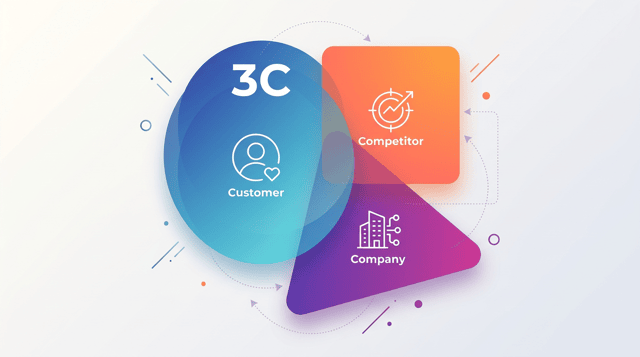
"3C analysis" is the foundational framework you should master first when building a marketing strategy. By organizing your external environment and your company's position from three perspectives—Customer (market and customers), Competitor (competition), and Company (yourself)—it lays the groundwork for deciding "where to compete" and "how to win."
This article systematically covers what 3C analysis is, the key issues to address in each component, how it differs from and complements other frameworks like 4P, 4C, SWOT, and PEST, a practical 5-step process, copy-paste templates, industry-specific examples, and common pitfalls with countermeasures. Use it as a hands-on guide for strategy development, new business planning, and marketing-plan formulation.
3C analysis is a framework that organizes the business environment from three perspectives—Customer (market and customers), Competitor (competition), and Company (yourself)—to set the direction of business and marketing strategy. By placing Customer and Competitor (the external environment) alongside Company (the internal environment), you can answer the core strategic question: "What value does the market want, that competitors fail to provide, and that we can deliver?"
The purpose of 3C analysis is to design business moves grounded in objective facts rather than gut feel or individual judgment. By examining market size, needs, competitor moves, and your own resources in parallel, you can identify a winning position and prioritize where to invest your limited resources.
3C analysis was systematized by management consultant Kenichi Ohmae in his 1980s book "The Mind of the Strategist," and from there it spread globally. It rests on the idea that the heart of corporate strategy lies in the relationships among three actors: customers, competitors, and the company itself.
Earlier strategy theory tended to focus heavily on internal analysis, but Ohmae anchored strategy in market reality by starting from "what customers truly need" and "the relative gap with competitors." Because it is simple yet captures the essentials, it remains a standard tool today in marketing, new business development, and corporate planning.
In today's mature markets, where customers have an explosion of choices, you cannot win them over by deciding moves based solely on your own convenience. 3C analysis serves as a thinking checklist that grounds your judgments not only in your own capabilities but also in customer needs and the gap with competitors—helping you avoid self-centered strategies.
Each of the three Cs has its own set of representative issues to address. Below, we explain why "Customer → Competitor → Company" is the standard order of analysis and walk through what each component contains.
Customer is the section where you understand the demand-side structure—market size, growth rate, customer needs, buying behavior, and so on. The reason to analyze it first within the 3Cs is that without defining "the market your business should serve," you cannot give meaning to either competitors or your own strengths.
The main issues to consider for Customer are as follows.
For Customer, what matters is grasping "the facts of the actual market" rather than "the customer image you want to see." Build your evidence by combining multiple primary and secondary sources—government statistics, industry reports, interviews with existing customers, surveys, and web behavior data.
Competitor is the section where you analyze how other companies serving the same customer problem in the same market are behaving. By understanding competitors' strategies, strengths, and weaknesses, you can see "the arena where you can win" and "the head-on fights to avoid."
The issues to consider in competitor analysis are as follows.
The essence of competitor analysis is capturing, without omission, "all parties competing for the same customer's wallet and time." If you only watch direct industry peers, you miss new entrants from other industries and disruption from substitute technologies. Reverse-engineer from the customer's problem and treat "every option that can solve that problem" as a competitor.
Company is the section where you evaluate how your firm can compete within the market structure described by Customer and Competitor. The key is to relativize your strengths and weaknesses—not as absolutes, but in relation to "market needs" and "competitors."
The issues to consider in Company analysis are as follows.
Avoid abstract statements like "our strength is quality." Define strengths through the lens of others—customers and competitors—for example: "On the △△ dimension that customers in the ○○ segment value most, we deliver around ◯× the precision of competitors A and B."
3C analysis isn't meant to stand alone. Combining it with other frameworks dramatically increases the resolution of your strategy. Below we sort out the differences from frameworks that are often confused with 3C and how to combine them in practice.
3C analysis is "environmental analysis to set the direction of the business," while 4P and 4C analysis are "marketing mixes for designing concrete tactics." They sit at different layers.
In practice, the standard flow is: "use 3C to set strategic direction → narrow targets with STP → translate into specific tactics with 4P/4C."
SWOT analysis—Strengths, Weaknesses, Opportunities, Threats—fits neatly as a downstream step that integrates the results of 3C analysis to derive strategy.
A clean handoff is to extract Opportunities and Threats from SWOT out of the Customer/Competitor sections of 3C, and Strengths and Weaknesses out of the Company section. From there, you can move directly into cross-SWOT (strengths × opportunities = offensive strategy; weaknesses × threats = defensive strategy).
PEST analysis captures the macro environment along four axes: Politics, Economy, Society, and Technology. Running PEST before the Customer step of 3C helps you grasp the structural drivers that change markets and customer behavior.
A two-stage approach—using PEST to read the broader currents and 3C to analyze "the market, competitors, and self that you face"—gives you a robust strategy that combines short-term and long-term, and micro and macro perspectives.
5C analysis is an expanded version of 3C that adds Co-operator (partners) and Climate (the macro environment), and it shines for complex businesses with many stakeholders—B2B and global expansion in particular. The practical rule of thumb: when 3C falls short on information, switch to 5C; when speed of decision-making matters most, 3C is enough.
STP analysis (Segmentation, Targeting, Positioning) is the framework for slicing the market and deciding "which customers to target and how to be perceived." The most common strategy-formulation flow is: use 3C to grasp the structure of the market and competition, then narrow to "the customer to target and the way to win" with STP, and finally translate that into tactics with 4P/4C.
Anyone can fill in the boxes of a 3C analysis, but to use it as a strategic tool, the order and the design of the questions matter. Below is a 5-step process you can repeat reliably in practice.
The first thing to do is articulate, in a single sentence, "why we are doing this 3C analysis." Whether it is a decision to enter a new business, a review of an existing one, or new-product strategy formulation, the relevant scope of market, competitors, and self changes dramatically.
Specifically, decide the following:
If you start gathering information without clear purpose and scope, the more data you collect, the blurrier the conclusion becomes. Deciding upfront "what we want to decide based on this 3C" is what determines the quality of the eventual strategy.
Next is Customer analysis. Combine macro information—such as market size and growth rate—with micro information—such as the needs and buying behavior of your target customers.
Top-down macro data alone won't generate on-the-ground tactics. Always dig into the voices and behaviors of real customers, and probe down to "what specific challenges they have, and where the existing options leave them stuck."
List the competitors operating in the market you defined in Customer analysis, and compare strategies, strengths, and weaknesses. The trick is to capture not only direct competitors but also "any alternative means that solve the same customer problem."
Evaluate each competitor's strengths and weaknesses not from your own viewpoint but from "how target customers see them." Rather than "they are #1 in the industry, so they are strong," concretize down to "they are superior on the ○○ dimension that target customers prioritize." That level of specificity gives you the raw material to judge "where we can win" in the next step.
Once you can see the structure of market and competition, relativize and evaluate your own company. The point here is not to list "the things we are good at," but to judge "what resonates—and what doesn't—against the needs of the market."
Splitting your strengths into "areas where we are already winning" and "areas where, with sharpening, we can win" makes the strategic moves more concrete. Always back each strength claim with evidence (customer evaluations, track record, patents, technical scores, financial indicators, etc.).
Finally, integrate the three Cs to derive a KSF (Key Success Factor). A KSF is "the decisive point that your company must own to win in this market," and reaching it is the goal of 3C analysis.
The framing for extracting a KSF is:
Once the KSF is visible, translate it into concrete strategy, tactics, and KPIs. Connect it to downstream steps: target narrowing (STP), value-proposition definition, tactical design via 4P/4C, and KPI design. Only when you go this far does 3C analysis become a "design document for strategy" rather than a "report."
Building a 3C from scratch takes time. Here are two templates you can copy directly into a document or spreadsheet.
Use this as a quick-start version. It's designed for narrowing each C to 5–7 items and building a skeleton in one or two hours.
【Customer (Market and Customers)】
【Competitor (Competition)】
【Company (Yourself)】
This is an extended version that flows directly from 3C results into a SWOT analysis. It works well when preparing materials for executive or board-level discussions.
The point of a template isn't to "fill in the boxes." Always ask whether what you've written in each box ultimately connects to your KSF and action plan.
Because 3C is highly abstract, examples accelerate understanding dramatically. Below are example fills for three typical business types. Use whichever is closest to your situation as a base, then adjust.
Customer (Market and Customers)
Competitor (Competition)
Company (Yourself)
KSF: "design that engages deeply with Japanese measurement challenges" plus "operational ability to surface ROI quickly within a PoC." Build the strategy on direct proposals to mid-market CMOs and trust-building through case-study content.
Customer (Market and Customers)
Competitor (Competition)
Company (Yourself)
KSF: combine "specialized formulation expertise that works for sensitive skin" with "product design that operationalizes sustainability plus fan-community management." Don't rely on ads alone for awareness—reinforce credibility with UGC and expert content.
Customer (Market and Customers)
Competitor (Competition)
Company (Yourself)
KSF: combine "the absence of menu fatigue from local-sourced rotating dishes" with "flexible seating that works for both families and singles." Absorb demand swings with takeout and delivery, and aim to build repeat customers via inflow design rooted in Google Maps and local search.
Because 3C is a simple framework, the pitfall of "filling it out for show without ever connecting it to strategy" is common. Below are four representative failure modes, each with countermeasures.
A 3C built from a one-hour internal brainstorm is essentially a transcript of the participants' impressions—it doesn't ensure objectivity. If your perception of market and competitors is off, every strategic move stacked on top will be off.
The countermeasure is to require an "evidence source" for each item. Make it a rule to fill the boxes citing industry reports, statistics, customer interviews, log data, competitor IR materials, and so on. This separates fact from hypothesis and lifts the quality of the discussion.
Cases where Company strengths are listed as "long history," "high engineering skill," or other self-evaluations are very common. But unless customers perceive these as value, they aren't strategic strengths.
The countermeasure is to phrase strengths along "the evaluation axes the target customer cares about × comparison with competitors." If you can write "On the △△ dimension that the ○○ segment values, we are clearly superior to competitors A and B," it passes. If you can't, it's likely a strength only the company believes in.
Another typical failure is filling out the three Cs and stopping there—leaving "what we will decide based on this" vague. The real value of 3C analysis lies in Step 5: extracting the KSF and connecting it to action.
The countermeasure is to define the final 3C output not as a "3C summary table" but as a set: KSF + 3–5 strategic hypotheses + actions, owners, and KPIs for the next 3–6 months. Locking in the output format upfront keeps analysis and decisions from being severed.
Markets, competitors, and your own company can change significantly within six to twelve months. Yet in many organizations, a 3C analysis is built once at a new business launch or mid-term plan kick-off and then sits dormant in a file.
The countermeasure is to put "moments to refresh the 3C" on the calendar—half-year reviews or annual strategy meetings—and run a light update of only the items that have changed. Tying the 3C to data that moves daily and weekly (analytics, ad reports, CRM data) lets you spot market and competitor shifts faster and keeps the strategy fresh.
3C analysis is often discussed in the language of corporate strategy, but it's also highly effective in day-to-day advertising and marketing. In fact, the disconnection between the tactical layer and the 3C results is often why teams complain that "tactics don't move the needle and improvement ideas are shallow."
Particularly important is connecting the strategic hypotheses extracted in 3C with your measurement framework. Combining attribution analysis with marketing mix modeling (MMM) lets you continuously verify "whether budget is being allocated as the 3C strategy intended, and whether revenue impact is in line with the assumption." Connecting the strategy framework and the measurement infrastructure in the same language is the shortcut to repeatable marketing.
3C analysis is the framework that organizes the business environment into Customer, Competitor, and Company, and forms the foundation for deciding "where to compete" and "how to win." Finally, here are the key takeaways.
Start by writing a 3C for your main business using the simple template in this article. Don't aim for completeness—what matters most is finishing one full pass. Share what you've written internally, fill in the missing data, and refine it through a customer and competitor lens. That cycle itself is what raises the resolution of your strategy.
Find more of our articles on Google

A guide to web marketing strategy through the role division and combination of channels (the channel mix)—SEO, web adver...
Organizes the purpose of an owned media into three—"customer acquisition / lead generation," "branding," and "recruitmen...

Web marketing is the activity of using the web to attract customers and drive outcomes. This article explains, in a begi...


