The Complete Guide to Marketing Campaign Management: A Plan-Execute-Review Framework
Published:
Last Updated:
Category:
Published:
Last Updated:
Category:
Authors: Shusaku Yosa
Product launches, seasonal promotions, lead generation initiatives, brand awareness drives—the number of campaigns a marketing department runs simultaneously keeps growing. Yet the more campaigns you run, the more likely it becomes that "who does what by when" gets muddled, leading to gaps in execution and superficial post-campaign reviews.
This article provides a comprehensive overview of marketing campaign management, organized into three phases—Plan, Execute, and Review—along with the key considerations and practical frameworks for each phase. Whether you are looking to build a solid foundation for campaign management or rethink your existing processes, use this as a practical guide.
Campaign management refers to the entire process of controlling marketing initiatives end-to-end—from goal setting to performance measurement. It is not simply about individual operations like running ads or sending emails; it encompasses designing initiatives based on strategy, allocating resources, monitoring execution, and feeding results back into future actions.
The scope covers digital advertising, content marketing, email marketing, social media, events and webinars, and offline initiatives. While channels differ, the campaign management framework applies universally.
Without proper campaign management, several typical problems emerge: launching initiatives without clear objectives or KPIs, running multichannel campaigns with inconsistent messaging, delays caused by cumbersome approval workflows, and repeating the same mistakes because post-campaign reviews are neglected.
Conversely, well-structured campaign management maximizes results from limited budgets and resources while accelerating organizational learning. Campaign management is not administrative overhead—it is the strategic foundation that determines marketing outcomes.
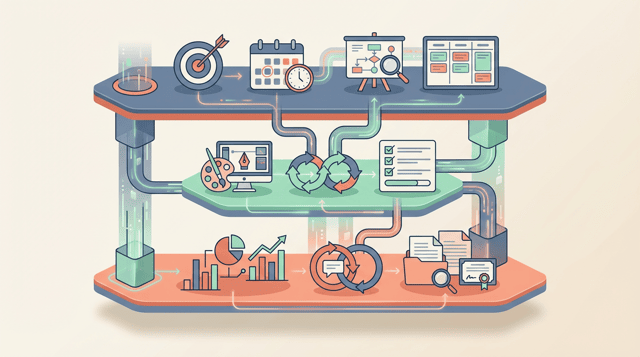
Campaign management consists of three major phases: Plan, Execute (Do), and Review. While this mirrors the PDCA cycle, adding marketing-specific elements yields the following structure.
The Planning phase covers confirming business objectives, defining target personas, designing channel mix and messaging, setting KPIs, allocating budget, and building the schedule. The Execution phase handles creative production and approvals, task and progress management, delivery and launch operations, and real-time monitoring with mid-course adjustments. The Review phase involves aggregating and analyzing KPI results, extracting success factors and issues, defining next actions, and accumulating and sharing knowledge.
The essence of campaign management is running these three phases as a continuous cycle. The following sections explore each phase in detail.
Planning starts by articulating why you are running this campaign and linking it to a business objective. Whether the aim is to expand awareness, generate leads, or drive upsells among existing customers, the design direction changes entirely based on the purpose.
A common failure is when "running a campaign" itself becomes the goal. When the purpose is vague, KPIs become vague too, and at the review stage you cannot determine whether the campaign was a success. Every campaign brief should state which part of the business KGI the campaign aims to impact.
Clearly defining your campaign audience improves the precision of channel selection and messaging. For B2B, define industry, company size, job title, and pain-point stage. For B2C, define demographics, life stage, and purchasing behavior patterns.
If you can extract target segments from existing CRM and web behavioral data, you can build data-backed personas rather than fictional ideals. Personas should be designed as representative customer profiles grounded in real data—that is the key to driving results.
Once targets are set, design which channels to use, what messages to deliver, and in what sequence. If the campaign objective is upper-funnel awareness, social and display ads take center stage. For lower-funnel lead generation, search ads, content SEO, and email nurturing are more effective.
In multichannel campaigns, maintaining message consistency across channels is critical. When the value propositions on your landing page, ad banners, emails, and social posts diverge, the user experience fragments. The standard approach is to define one core message for the campaign and then optimize the expression for each channel.
Define KPIs and their target values upfront as the criteria for judging campaign success. For awareness campaigns, select impressions or reach; for lead generation, CV count or CPA; for revenue goals, ROAS or revenue amount. Targets should be set at achievable yet ambitious levels, informed by past campaign performance and industry benchmarks. Keep primary KPIs to three or fewer to maintain focus, and manage the rest as secondary metrics.
Once objectives, targets, channels, and KPIs are defined, allocate budget and resources. Identify ad spend, production costs (creatives, landing pages, videos), tool subscriptions, outsourced partner fees, and internal headcount (effort hours) to clarify total campaign investment.
Ideally, budget allocation is determined by working backward from KPI targets—for example, target CPA multiplied by target conversions equals required ad spend. When resources are constrained, concentrating investment on the highest-impact channel to maximize results from a limited budget is also a valid option.
Break the overall campaign schedule into phases—planning, production, approval, launch, monitoring, and review—and set milestones for each. It is especially important to build sufficient buffer for creative production and approvals. Delayed approvals pushing back the launch date is one of the most common pitfalls in campaign management.
Using Gantt charts or project management tools to visualize owners, deadlines, and dependencies enables early detection of schedule slippage.
The first activity in the execution phase is creative production. Ad banners, landing pages, email templates, and social media assets are produced in alignment with the core message and brand guidelines defined during planning.
The approval workflow should define in advance who reviews what at which stage. Establish clear steps such as copy check, design review, legal review, and final sign-off, along with revision rules. Starting without clear approvers risks last-minute changes from unexpected stakeholders, which can derail the entire schedule.
Since campaigns involve multiple channels and team members working in parallel, mechanisms to prevent task slip-throughs are essential. Assign each task an owner, deadline, and status (not started, in progress, in review, completed), and check progress regularly.
Use weekly status meetings or daily standups to surface at-risk tasks early and make resource reallocations or scope adjustments. The larger the campaign, the more effective project management tools like Asana or Notion become.
Once creatives are approved, it is time for launch. Submit ads, configure email sends, schedule social posts, and publish landing pages. The key here is to prepare a pre-launch checklist.
Are UTM parameters set correctly? Do LP forms function? Are conversion tags firing? Are ad targeting settings accurate? Is the delivery schedule on track? Simply checking these items one by one drastically reduces basic errors.
After launch, monitor KPIs in real time and make mid-course adjustments as needed. For ad campaigns in particular, if early CTR or CVR numbers fall significantly below expectations, creative swaps, targeting revisions, or bid adjustments may be necessary.
Common checkpoints are 3 days after launch, 1 week after launch, and the campaign midpoint. Establishing rules in advance—such as "swap ad creatives if KPIs are below 70% of target"—eliminates gut-feel decisions and accelerates team decision-making.
After the campaign ends, start by aggregating KPI results. Compare targets set during planning with actuals to calculate achievement rates. Breaking down the data by channel, target segment, and creative reveals where impact occurred and where bottlenecks existed.
The analysis should go beyond whether numbers were good or bad to explore the causal factors behind the results. Why did high-CTR ads outperform? What element of the low-CVR landing page was problematic? Form hypotheses and extract actionable insights for the next campaign.
Based on KPI analysis, organize findings into Keep (what worked), Problem (what needs improvement), and Try (what to test next) using the KPT format. It is important to also clarify success factors—not just failures. Focusing only on failure analysis lowers team morale and prevents the accumulation of repeatable success patterns.
Beyond initiative outcomes, reviewing the process itself is equally important. Were approval workflows efficient? Was the schedule appropriate? Was cross-team collaboration smooth? Process improvements elevate the overall productivity of every future campaign.
The final deliverable of the review phase is a set of next actions. List specific improvement measures with assigned owners and deadlines. Instead of vague statements like "rethink targeting next time," be specific: "For the next campaign, change the lookalike audience source to purchasers from the past 180 days and target a CTR of 1.5% or higher (Owner: Tanaka, Deadline: next campaign planning stage)."
Record and share review outcomes in a location accessible to the entire team. Standardizing campaign report templates and maintaining a searchable, cross-campaign archive lets you instantly reference past data and learnings when planning similar campaigns.
Converting tacit knowledge into explicit knowledge is the key to building organizational marketing capability. Build a reproducible campaign management system that does not depend on any single individual's experience.
When too many initiatives pile up, resources per campaign thin out and every campaign delivers mediocre results. The remedy is to prioritize campaigns each quarter and explicitly decide what not to do. Score initiatives on two axes—expected impact and execution effort—and start with the highest-ROI campaigns.
Campaigns involve not only marketing but also sales, product, design, and legal. Insufficient information sharing between departments leads to situations like "sales didn't know about the campaign" or "legal review couldn't be completed in time." Share the campaign brief with all stakeholders and always hold a kickoff meeting to align on objectives, roles, and schedule.
In busy teams, the next initiative often starts immediately after one ends, and reviews get skipped. Prevent this by building a review session into the campaign schedule from the start. Position review time as a mandatory step rather than optional, and provide a report template so that a high-quality review can be completed with minimal effort.
When campaign data is scattered across ad platforms, MA tools, GA4, CRM, and social media insights, cross-initiative evaluation becomes difficult. The ideal solution is to centralize data using a BI tool and build a dashboard that provides a bird's-eye view of results at the campaign level. If full integration is too ambitious, start by standardizing the campaign ID naming convention as a first step.
Tools that streamline campaign management fall into three categories. The first is project management tools such as Asana, Monday.com, and Notion, which handle task assignment, progress tracking, and scheduling. The second is marketing automation (MA) tools like HubSpot, Marketo, and Pardot, which automate email delivery, scoring, and nurturing flows during the execution phase. The third is analytics and reporting tools such as Looker Studio, Tableau, and Datorama, which support data integration and visualization during the review phase.
When selecting tools, first identify where the bottleneck lies in your campaign management process, then introduce the tool that resolves that bottleneck. Be careful not to let tool adoption become the goal in itself.
Marketing campaign management is a process of continuously cycling through three phases: Plan, Execute, and Review. The Planning phase covers goal alignment, targeting, channel design, KPI definition, budget allocation, and scheduling. The Execution phase handles creative production and approvals, task management, delivery operations, and real-time monitoring. The Review phase covers KPI analysis, extraction of success factors and issues, next-action planning, and knowledge accumulation.
Improving the quality of your campaign management delivers a larger impact than improving individual initiatives—because one framework improvement cascades across every campaign. Use the framework presented in this article as a starting point to audit your campaign management process and begin strengthening it where it matters most.
A beginner-friendly guide to shinchoku (progress): its meaning in business, common phrases and example sentences, polite...
A beginner-friendly guide to the five reasons to-do lists never get finished and how to build one you can complete: sort...
A beginner's guide to to-do lists and how they differ from task lists. Covers a five-step way to use one, examples of cl...


