A category focused on driving digital transformation in marketing. Topics include adopting and leveraging marketing automation (MA) tools, building data analytics infrastructure, automating workflows through ad-CRM-MA integration, and using technology to improve both the productivity and precision of marketing operations. Whether you're a practitioner evaluating tools or a manager leading a DX initiative, this category offers broadly applicable, practical insights.
Showing 19–36 of 77 posts
What a person-day means and how to convert it. Covers why one person-day is not always eight hours, the conversion table...

What a PMO does and how it differs from a PM, organised around who holds responsibility. Covers the supportive, controll...

The six earned value management metrics explained by meaning and how to read them. Covers PV, EV, and AC, the variances ...

How PMP, Japan's national Project Manager Examination, and P2M differ, organised by the nature of each scheme. Covers wh...

A five-step method for mapping a business process, plus the three things that create key-person dependency, how to inter...

Two Japanese words are both read kotei and both mean something close to "process": 工程 and 行程. This guide explains the di...

What a project manager actually does, broken down by phase from initiation to closure. Covers how the role differs from ...

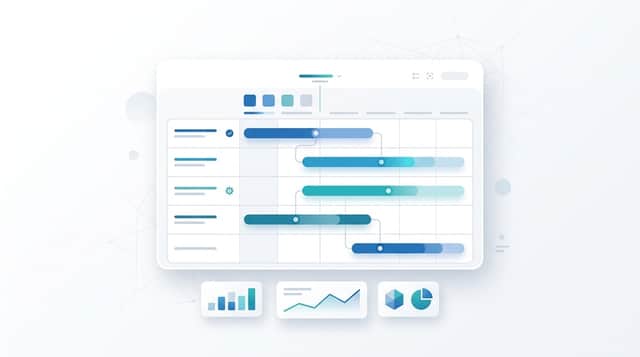
How to make a project schedule readable, centred on the progress line. Covers the five steps for drawing it from the sta...

Flowchart symbols explained along JIS X 0121. Covers the meaning of the symbols used in practice — terminator, process, ...

What task management is, explained through how it differs from a to-do list. Covers the three elements of deadline, owne...

Seven criteria for choosing a task management tool as a team: entry effort, permission granularity, what counts as a bil...

How to write a requirements definition document, with a seven-chapter template you can use as-is. Covers turning vague w...

Time management for teams. Separates "we have no time" into four distinct symptoms — too much volume, fragmentation, wai...

The fundamentals of scheduling, plus the four reasons plans fall apart: optimistic estimates, other people's time, datin...

The fundamentals of workload management, plus the five reasons estimates and actuals diverge: missing work in the defini...

How to prioritize tasks using four frameworks: the Eisenhower Matrix, MoSCoW, impact vs. effort, and dependency-first. C...

Seven habits shared by people who are good at task management: never using your head as storage, putting work on the cal...