What Is a Corporation in Japan | Differences from Sole Proprietors, Types, and Benefits of Incorporation
Published:
Last Updated:
Published:
Last Updated:
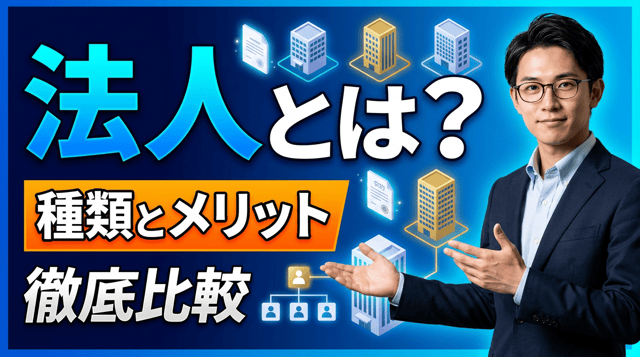
Category: Work Styles
Authors: Shusaku Yosa
"My freelance income is growing — should I think about incorporating?" "What's actually different between a sole proprietor and a corporation?" Anyone moving toward independent work or a serious side business eventually ends up looking up "what is a corporation?" in earnest.
This article walks through the meaning of a corporation in Japan, the differences from a sole proprietor, the five main types of corporate entity, the advantages and disadvantages of incorporation, when it makes sense to move, and the actual setup process. Numbers and clear comparisons are used throughout, so you can decide in one read whether incorporation makes sense for your career.
The word "corporation" (法人 / hojin in Japanese) gets used in everyday conversation, but few people can define it precisely. Let's start with the legal definition and the role corporations play in society.
A corporation is an organization, other than a natural person, that the law recognizes as a subject of rights and obligations. Through statutes such as the Civil Code and the Companies Act, it is granted "legal personhood," giving it the capacity to enter contracts, own property, and bring lawsuits. Put more simply, a corporation is "an organization that can be treated like a person."
We individuals are "natural persons" and have legal personhood from birth. A corporation, by contrast, only acquires personhood by going through a legal incorporation process. While natural persons gain rights through birth, a corporation is born through registration and dissolves only through formal dissolution and liquidation procedures — a fundamental structural difference.
The deepest reason the corporate system exists is to provide a way to run a business continuously. Individuals have a finite lifespan and can't be the long-term anchor of every venture. With a corporation, even if the founder retires or dies, the business persists as a legal entity, and relationships with employees, suppliers, and customers continue. Separating personal and business liability through incorporation also lowers the psychological barrier to taking risks.
When weighing incorporation, you need to understand how it compares to staying as a sole proprietor. Here's a side-by-side across five dimensions: setup, taxes, credibility, liability, and social insurance.
A sole proprietor in Japan can begin operating simply by submitting a "Notice of Business Opening" (kaigyo todoke) to the tax office, with effectively no cost. A corporation, on the other hand, requires drafting articles of incorporation, notarization by a public notary, and filing for registration with the Legal Affairs Bureau — running roughly JPY 200,000–250,000 for a kabushiki kaisha (stock company) and JPY 60,000–100,000 for a godo kaisha (LLC). On effort and cost, the sole proprietor wins easily.
A sole proprietor's earnings are subject to personal income tax (5–45%, progressive) and resident tax (10%). Corporate earnings are taxed under corporate tax (15–23.2% for SMEs), plus local corporate tax, corporate inhabitant tax, and corporate enterprise tax. Above a certain income, the non-progressive corporate rate becomes more favorable than personal income tax — a "crossover point" where incorporation starts to save tax. That's why incorporating after profits grow tends to drive tax savings.
Some counterparties have a policy of not contracting with individuals. Whether you're seeking bank financing, working with large enterprises, or hiring talent, the corporate form tends to carry more credibility. If your goal is to expand the scale of the business or move upmarket with clients, the credibility advantages of incorporation are real and meaningful.
A sole proprietor bears "unlimited liability" — any business debt is repaid out of personal assets in full. Investors in a kabushiki kaisha or godo kaisha bear only "limited liability," capped at the amount they invested. If you want to avoid the prospect of losing your home or savings if the business fails, a limited-liability corporate form is a meaningful psychological safety net.
A sole proprietor is typically enrolled in National Health Insurance and the National Pension. When you incorporate, even a one-person company is required to enroll in employee health insurance and the welfare pension system (shakai hoken). Premiums go up, but you also gain stronger benefits, including a higher future pension and access to the sickness/injury allowance. The flip side is that the employer's share is a heavy fixed cost, so you should be cautious about timing while revenue is still volatile.
"Corporation" is a broad term — there are several distinct types. Below are the five most relevant for ordinary business, with different setup costs, liability structures, and governance. Pick the one that best fits your business plan.
Capital is raised from shareholders and management runs the business — the form adopted by the vast majority of Japanese companies. Investors have limited liability, and shares can be transferred to raise capital or pass on the business. Stricter rules — mandatory financial disclosure (kessan koukoku), term limits on directors — mean operating costs are somewhat higher. It's the form to choose if you're planning to go public or raise external capital.
Introduced under the 2006 Companies Act, this is a relatively new form. All members have limited liability and are also the operators of the business. Setup costs are lower than a KK (around JPY 60,000–100,000), and there's no obligation to publish financial statements. Decision-making is fast and operational flexibility is high, making it a popular choice for former freelancers and small partnership businesses. Apple Japan and Amazon Japan are also godo kaisha — credibility concerns are no longer the issue they once were.
A partnership-type company that requires both unlimited and limited liability members. It still appears in some traditional industries, but new registrations have been declining year over year because of the risk borne by unlimited liability members. Outside of unusual circumstances, godo kaisha or kabushiki kaisha tend to be chosen instead.
Every member bears unlimited liability. Historically used in family businesses and tight-knit partnerships, it offers high trust on one hand but also exposes every member's personal assets on the other. In modern practice, it's rarely chosen.
For non-profit activities or specific social missions, options include the general incorporated association (ippan shadan hojin), general incorporated foundation, and NPO. There are also professional corporations — tax accountant corporations, law firms, medical corporations — available only to qualified professionals. Given the fit with for-profit activity, it's safer to consult a specialist before deciding on the form.
The benefits of incorporation aren't limited to tax savings — there are deeper advantages tied to business stability and growth velocity. Here are the five core ones.
Personal income tax in Japan tops out at 45% under the progressive system, while corporate tax sits at a relatively flat 15–23.2% for SMEs. You can also expense the founder's salary (yakuin houshu), pay retirement bonuses, and deduct part of life-insurance premiums — savings tools simply not available to a sole proprietor. As a rough guide, once taxable income passes JPY 9 million, the tax savings from incorporation tend to outweigh sole-proprietor advantages.
Because corporate registration data is public, third parties can verify your existence, which raises perceived credibility. Some large enterprises and government agencies will only contract with corporations. Bank financing also tends to be easier to secure as a corporation, and borrowing limits are typically higher.
As a corporation, beyond bank loans you gain access to share issuance to bring in equity investors, bond issuance, and a broader set of subsidies and grants. For startups and growth-oriented businesses, choosing a kabushiki kaisha becomes nearly mandatory once equity fundraising enters the picture.
In a KK or godo kaisha, investor liability is capped at the invested amount. Even if the business fails badly, personal assets are typically out of reach (with the notable exception of debts the founder has personally guaranteed). Lowering the psychological barrier to taking on risk is one of the quieter but more important benefits of incorporation.
For a sole proprietor, the trade name and customer relationships are fused with the individual, making succession or sale difficult. A corporation, by contrast, can be transferred as a package via share or membership-interest transfer. Family succession, M&A, and IPO — the range of exit options is one of the corporation's defining advantages.
Looking only at the advantages and incorporating on momentum can lead to regret. Here are four disadvantages worth understanding up front.
As noted, incorporation alone runs around JPY 200,000 in initial costs. On top of that, registration changes incur registration tax and shihou shoshi (judicial scrivener) fees, and annual closing/filing is typically outsourced to a tax accountant at JPY 200,000–500,000 per year. Compared to a sole proprietor's tax return, operating costs are unmistakably higher.
A corporation is required to keep strict double-entry books, and producing financial statements and corporate tax returns is more complex. Hiring employees triggers social insurance and labor insurance procedures. Compared to a sole proprietor's blue-form filing (aoiro shinkoku), specialist support from a tax accountant or labor consultant becomes effectively mandatory, and the time and money cost of administration is real.
Even with zero profit, a corporation faces the per-capita portion of corporate inhabitant tax every year — typically a minimum of around JPY 70,000 (varies with capital and headcount). A sole proprietor in the red has a near-zero tax bill, but a corporation always carries some fixed tax cost. Worth keeping in mind.
A corporation is, in principle, required to enroll in social insurance (employee health insurance and the welfare pension) even if there's only one director. Premiums are split between employee and employer, but the employer's share runs around 15% of compensation — a meaningful monthly cash-flow item. In the unstable early days of a business, it can squeeze operations, so run cash-flow scenarios before incorporating.
Given the trade-offs, not every sole proprietor should incorporate. Here are three axes to help you assess seriously when the time has come.
Looking purely at tax, the rule of thumb is to consider incorporating once taxable income passes JPY 8–9 million. Above this, the burden of progressive personal income tax begins to outweigh corporate tax, and the gap widens. Note that this is taxable income — profit after expenses — not gross revenue.
When you start hearing things like "we can't contract with individuals" or "if you incorporate, we'd like to keep awarding work," the case for incorporation is clear even before tax considerations. In B2B expansion, corporate credibility is a meaningful tailwind.
When you want to hire employees, raise outside capital, or run multiple business lines in parallel, governance and clear lines of responsibility make incorporation almost necessary. Sole proprietors struggle to handle complex employment and investment contracts, slowing the pace of organizational growth.
The procedure differs slightly between kabushiki kaisha and godo kaisha, but at a high level it follows these seven steps. Allow roughly 2–4 weeks end to end.
Online services like freee Company Setup and Money Forward Company Setup have dramatically simplified document creation and filing. You can also outsource entirely to a shihou shoshi (judicial scrivener) for near-zero hands-on work, though that adds JPY 50,000–100,000 in fees.
Common questions from people considering incorporation, in Q&A format.
Yes. There's no legal restriction on a salaried employee setting up a corporation as a side business. Watch out, though, for your employer's work rules — some prohibit side businesses or holding directorships elsewhere — so check first. Because the income isn't combined with your day-job income, incorporation can yield tax savings, but there are side-business-specific issues like double social insurance enrollment and added administrative complexity.
If you'll run the business solo or with a few people and don't plan on outside capital or an IPO, godo kaisha is typically enough. Setup costs are lower, operational flexibility is higher, and it's a common choice for former freelancers. If you do anticipate raising from investors down the road, eyeing an IPO, or working with counterparties that only accept kabushiki kaisha, go with kabushiki kaisha.
Inventory, equipment, and fixed assets you held as a sole proprietor can be transferred at fair value through sale or contribution-in-kind to the corporation. The trade name, customer relationships, and contracts each require their own handover steps. Asset transfers can trigger consumption tax and income tax issues, so it's best to work with a tax accountant.
Yes. Both kabushiki kaisha and godo kaisha can be set up with a single member as both investor and director (the so-called "hitori shacho" or one-person company). In practice, one-person corporations make up the vast majority and are a common destination for former freelancers.
Technically yes, but the liquidation procedure or business transfer involves real complexity and cost. Treat incorporation as a long-term commitment to the business, and weigh carefully whether you actually need it before pulling the trigger.
A corporation is an organization to which the law has granted personhood, allowing it to be a subject of rights and obligations independently of any individual. Here's the recap.
Once you understand what a corporation is, hold the question "do I actually need to incorporate?" up against your business stage and career direction, and decide calmly. For the final details of accounting and tax, working with a tax accountant or other specialist is strongly recommended. We share more on side-business incorporation, freelance work styles, and related topics in the "Work Style" and "Side Job" categories — feel free to explore further.
Find more of our articles on Google
What psychological safety means at work, signs of a low-safety environment, ways to improve it, and points for deciding ...
How many days before must you apply for paid leave in Japan? This article explains law vs. work rules, same-day requests...
Is a medical certificate required to return to work in Japan? This article explains what to ask your doctor to write, ty...