What Is "CPC" in Advertising? Differences from CPM/CPA and How to Use Each
Published:
Last Updated:
Category:
Published:
Last Updated:
Category:
Authors: Shusaku Yosa
When you start running web ads, the term you'll inevitably encounter is "CPC." On top of that, similar-looking acronyms like CPM and CPA show up one after another, and many people end up starting their campaigns without understanding the differences. This article organizes what CPC is—from the basics—along with the differences from the easily confused CPM and CPA, and how to use each one depending on your purpose.
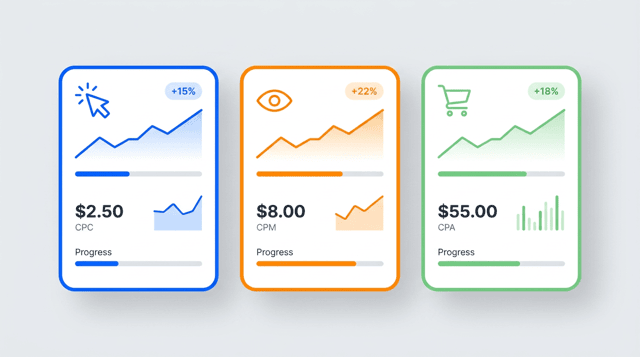
CPC stands for "Cost Per Click" and refers to the cost incurred each time an ad is clicked once. Also called "cost per click" in plain terms, it is used in many web ads that involve clicks, such as listing ads (search-linked ads), display ads, and SNS ads.
A click means you were able to guide a user to your own site. In other words, CPC can also be seen as "the cost of drawing a user to your site." The defining feature is that you are not charged merely for the ad being displayed; the cost is incurred only once it is actually clicked.
CPC is calculated as "ad cost / number of clicks." For example, if you spend 200,000 yen in ad cost and obtain 2,000 clicks, the CPC is 100 yen. The lower this figure, the more users you are drawing to your site with the same budget, which can be evaluated as a cost-effective ad.
Note that in listing ads, the going rate for CPC fluctuates according to the search volume of the keyword and the intensity of the competition. The more popular the keyword, the fiercer the bidding competition, and the more the cost per click tends to rise.
CPM stands for "Cost Per Mille," and Mille means 1,000 in Latin. In other words, CPM refers to the cost incurred each time an ad is displayed 1,000 times (impressions). Whereas CPC is charged on "clicks," the biggest difference is that CPM is charged on "displays."
Because the cost is determined by the number of times it reaches users' eyes regardless of whether it is clicked, it suits branding-purpose ads where you want to spread awareness to a wide audience. On the other hand, since being displayed without being clicked produces no guidance to the site, it does not guarantee a specific action by the user.
CPA stands for "Cost Per Acquisition" and refers to the cost incurred per "result (conversion)"—such as a product purchase or membership registration. Whereas CPC looks up to the "click (guidance to the site)," CPA is an indicator that looks at the "actual result" beyond that.
For example, even if the cost per click (CPC) is cheap, if those clicks never lead to purchases, the CPA will be high. Conversely, even if the CPC is somewhat high, if you can gather high-quality clicks that connect directly to purchases, the CPA can be kept low. In other words, CPA is the closest to a business's ultimate cost-effectiveness.
Let's organize the three indicators so far by "what is charged" and "main purpose."
It is easier to understand if you think of CPM, CPC, and CPA as corresponding in order to the flow of user behavior: display -> click -> result. As you move from the top of the funnel (awareness) to the bottom (harvesting), the indicator to focus on shifts from CPM -> CPC -> CPA.
These indicators are not about "which is the best," but are used differently depending on the ad's purpose. Let's look at representative cases.
If your purpose is launching a new product or raising brand awareness, what matters first is reaching the eyes of many people. In this phase, where you want to rack up display counts rather than worrying about whether it's clicked, using CPM as your indicator is appropriate.
When you want to increase visits to a landing page, or connect to document requests or inquiries, CPC—which is charged on users who actually click and visit—is effective. Without spending cost on wasteful displays, you can concentrate your budget on "people who came to the site."
At the stage where you want to harvest users whose needs are already apparent and connect to actual sales or registrations, you should use CPA—which represents the cost per result—as your indicator. Because it is directly tied to the final revenue, it can be called the most important indicator when considering the ROI of the business.
CPC, CPM, and CPA are all generally considered indicators where "cheaper is better than more expensive." However, pursuing only cheapness is dangerous. For example, if you try to push CPC down to the limit and end up gathering only low-quality clicks, they won't lead to purchases even though they come to the site, and as a result CPA can worsen.
What matters is not looking at a single indicator alone, but evaluating multiple indicators in combination in light of the ad's purpose. Lowering CPC while maintaining the conversion rate, and as a result optimizing CPA—this kind of multifaceted perspective decides the success of your operations.
CPC is the "cost per click" and is the indicator used in situations where you emphasize traffic to your site. CPM, charged on displays, suits awareness expansion, and CPA, charged on results, suits the harvesting of purchases and registrations.
The iron rule for deciding which indicator to place at the center is to work backward from the purpose: "what do I want to achieve with this ad?" First, clarify the goal of your own ad, and try measuring effectiveness with the indicator that matches it. Correctly understanding the meaning of the indicators is the first step toward waste-free ad operations.
Find more of our articles on Google
Managing ad trafficking work through scheduling and checks. Covers working back from the launch date, allowing for revie...

How to allocate an advertising budget, accounting for the constraints of auction-based media. Covers splitting into capt...

A clear explanation of what a brand lift survey is. Covers metrics such as awareness and favorability, survey type vs. s...


