What Does "Default" Mean? How It's Used in Business, IT, and Finance
Published:
Last Updated:
Category:
Published:
Last Updated:
Category:
Authors: Shusaku Yosa
"You can leave the settings on default," "that country fell into default"—the same word "default" is used with completely different meanings in the IT field and in financial news. It has permeated everyday life as a loanword, but mistaking the context can easily derail a conversation.
This article organizes the origin and basic meaning of "default," then explains how it is used across three settings—IT, finance, and business (everyday conversation)—with examples. Let's learn to use it correctly according to the audience and situation.
Default is a loanword taken directly from the English word "default." The English word originally carried meanings such as failure to fulfill an obligation or debt, neglect, and absence or no-show.
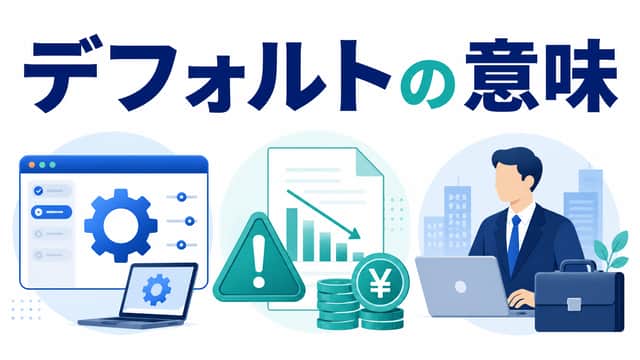
From this original meaning, Japanese uses it broadly in the following three senses. The greatest characteristic of this word is that its meaning changes depending on the industry and situation.
In Japanese, it was first adopted as an economic term meaning "debt default," and later the computing sense of "initial settings" spread. Furthermore, derived from that IT usage, the colloquial use meaning "ordinary" or "as usual" spread.
In the IT, PC, and smartphone fields, default refers to the "initial settings" or "initial state"—the pre-prepared state that the user has not changed. It is also sometimes called the prescribed value or initial value.
An initial value is a value pre-entered in an input field; if the user does not specify otherwise, that value is adopted. From here, it also came to refer broadly to the state of an app or device that is unchanged from its factory-shipped condition.
Usage examples in the IT field are as follows.
In the fields of finance and economics, default means "debt default." This is close to the original meaning of the English word and is the usage carrying the heaviest connotation, most often seen in the news.
Debt default refers to failing to fulfill a contractual obligation (a debt). For example, it is a situation where a borrower cannot repay by the due date or cannot pay interest. The lender holds the right to be repaid (the claim), and the borrower holds the obligation to repay (the debt). The state in which this obligation is not fulfilled is default.
When "default" is reported prominently in the news, it is usually the case of a nation falling into debt default. A country issues government bonds to borrow money from investors and other nations, but when it can no longer pay interest or redeem bonds due to fiscal difficulties, it becomes a national default. In the past, Argentina, Greece, Lebanon, and others have fallen into default, greatly affecting economies and markets.
Usage examples in finance and economics are as follows.
Derived from the IT sense of "initial settings," in business settings and everyday conversation it is also used to mean standard, ordinary, staple, or as usual. It carries the nuance of a state that has been that way from the start, without any special change.
In casual settings it is also sometimes abbreviated as "defo." Let's look at the usage examples.
However, this "ordinary/standard" usage is a relatively casual expression. In formal settings with clients or superiors, it is safer to avoid overusing it and to replace it with words such as "as standard" or "usually."
Default is a word whose meaning shifts depending on the audience's industry and position. Even with the same word, an IT person might think of "initial settings," while a finance person might think of "debt default." To prevent misunderstanding, keep the following in mind.
Related to "default," let's also grasp terms you will come across in business settings.
"Default," starting from the English meaning of failure or nonfulfillment, is a polysemous word used in Japanese in three senses: the IT field's initial settings, finance's debt default, and the everyday standard or ordinary.
The key is that the meaning changes greatly depending on the situation and the audience's industry. If you organize it as "initial settings" in IT, "debt default" in finance, and "as usual" in everyday conversation, you will not have to worry about misinterpreting it. Understanding loanwords correctly also connects to smooth communication and to your business fundamentals when changing jobs or job hunting.
A certificate of resignation in Japan must be issued by your employer on request, and is distinct from the separation no...
Under Japanese civil law, employment with no fixed term ends two weeks after you give notice, regardless of whether you ...
Japanese resident tax is charged on the previous year's income and deducted from June to May. Leaving between January an...


