The Complete Guide to In-House Marketing | From Team Building to Tool Selection
Published:
Last Updated:
Published:
Last Updated:
Category: Marketing Strategy, Marketing DX
Authors: Shusaku Yosa
"We want to build a team that can run marketing in-house, but don't know where to start." "Relying on agencies isn't giving us the speed we need."—These growing concerns are driving increased interest in in-house marketing. In-house marketing refers to the practice of managing marketing activities—such as ad operations, SEO, content production, and data analysis—within your own team, rather than depending on external agencies or vendors.
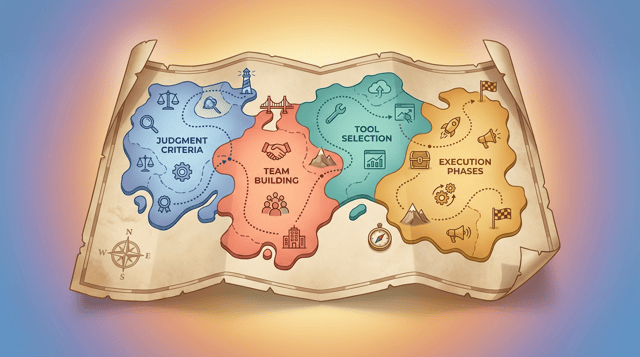
However, doing everything in-house isn't always the right answer. This article provides a comprehensive guide covering the criteria for deciding whether to bring marketing in-house, the talent and organizational structure you'll need, and how to select the right tools. This is a strategic guide to building an in-house marketing operation—not a rush to insource everything.
In-house marketing means completing the entire marketing process—strategy development, execution, performance measurement, and optimization—within your own organization. The opposite is outsourcing, where tasks are delegated to external partners such as advertising agencies or production companies.
In practice, however, it's rarely a binary choice between fully in-house and fully outsourced. Most companies adopt a hybrid model—handling core functions like strategy and data analysis internally while outsourcing specialized creative production or platform-specific operations. The key is making strategic decisions about which areas to bring in-house based on your resources and strengths.
When considering the transition to in-house marketing, you need clear criteria for determining whether it's truly the right move for your company. Evaluate from the following five perspectives.
Quantitatively compare your current outsourcing costs (agency fees, production outsourcing fees, etc.) with the costs of going in-house (personnel, tools, training). If your agency ad management fees exceed ¥1 million per month, hiring a dedicated specialist and subscribing to tools may prove more cost-effective. However, the decision should factor in the value of speed and knowledge accumulation, not just raw cost comparisons.
The more a task demands rapid iteration and optimization, the greater the benefit of in-housing. For example, search ad bid adjustments and creative swaps require daily or hourly attention. Working through an agency introduces multi-day delays, making these areas strong candidates for in-housing. On the other hand, creative production for large-scale campaigns that happen only a few times a year is often more efficiently handled by external specialists.
Another criterion is whether accumulating expertise in a particular area creates competitive advantage. Marketing knowledge deeply tied to your product and market—such as target audience insights and effective messaging angles—should be built internally rather than left with an agency. Conversely, generic operational expertise like platform-specific bid optimization may be more advanced at agencies that serve many clients.
As first-party data utilization grows, the risks of sharing customer data externally cannot be ignored. This is especially true in industries with strict privacy regulations or when you want to strengthen CRM-driven marketing. In such cases, the advantage of an in-house setup that keeps data under internal control becomes significant.
No matter how compelling the benefits of in-housing are, it's impossible without the right talent. Consider hiring difficulty in the market, the potential for reskilling existing team members, and the feasibility of using contractors or freelancers. Whether you can realistically build a talent acquisition plan is a key factor in the decision.
Proper role definition and team composition are essential for in-house marketing to function effectively. Let's outline the key positions and their responsibilities.
The Marketing Manager serves as the team's commander, responsible for overall strategy, KGI/KPI design, budget allocation, and cross-departmental coordination. This is the most critical position when launching an in-house team, and ideally should be filled by someone with hands-on digital marketing experience.
The Ad Operations Specialist handles day-to-day bid management, creative optimization, and budget management for search ads, social ads, and display ads. The larger your ad spend, the greater the cost and speed benefits of in-housing this role. While platform certifications are preferred, motivated candidates without prior experience can be trained.
The SEO/Content Specialist manages content planning based on keyword research, writing or directing freelance writers, rewriting existing content, and producing whitepapers and newsletters. A hybrid approach—where an in-house team member who understands the business handles planning while freelancers handle writing—is also effective.
The Data Analyst is responsible for data analysis, reporting, and dashboard development using GA4 and BI tools. Their primary mission is to verify campaign effectiveness and propose improvements—essentially serving as the engine that drives the PDCA cycle.
The MA/CRM Specialist designs and executes lead nurturing scenarios, email distribution strategies, and lead scoring operations. This role bridges marketing and sales, making it ideal for someone who understands both departments.
You don't need to fill all these positions from the start. A realistic approach is to begin with a team of two or three, where the Marketing Manager handles both strategy and data analysis, and another member manages ad operations and content. As results materialize, you can transition to dedicated roles and expand the team.
Building the right tool environment is essential for an in-house team to operate efficiently. Here are recommended tools organized by function.
For keyword research and competitive analysis, Ahrefs or SEMrush are strong choices. They provide essential data for content planning, including search volume, competitor keyword rankings, and backlink analysis. In the early stages when budgets are tight, start with Google Keyword Planner and Google Search Console, then add paid tools as your analytical skills grow. WordPress is the most widely used content publishing platform. For more flexible content delivery, headless CMS options like Payload CMS are worth considering.
For ad operations, the basics involve directly managing Google Ads and Meta Ads Manager dashboards. When you need cross-platform reporting, building dashboards in Looker Studio is efficient. Canva is valuable for ad A/B testing and creative production—even without design expertise, you can quickly create professional banners and social media creatives using templates.
For B2B companies starting with in-house marketing, HubSpot is the optimal first choice. It's an integrated platform covering CRM, MA, CMS, and sales—you can start with the free CRM and scale as your business grows. If you're already using Salesforce, integrating with Marketing Cloud Account Engagement (formerly Pardot) is a natural fit. For dedicated email delivery, SendGrid and Mailchimp are available at low cost.
GA4 is essential as the foundation for web analytics, offering free access to conversion tracking, user behavior analysis, and attribution analysis. For deeper user behavior insights, Microsoft Clarity provides heatmaps and session recording capabilities, also for free. For BI tools, Looker Studio is the ideal first choice due to its easy integration with Google data and zero cost. When more advanced analysis is needed, consider Tableau or Power BI.
Notion is highly recommended as the operational backbone for in-house teams. It consolidates editorial calendars, task management, knowledge bases, and document creation into a single platform, preventing tool sprawl. Managing retrospective reports and operational manuals in Notion also helps prevent knowledge silos. Asana and Backlog are alternatives for task management, but for small teams, consolidating everything in Notion is simpler.
Building an in-house marketing operation is most effective when approached in four phases.
Audit your current marketing operations and determine which areas to prioritize for in-housing. Evaluate each function using the five criteria described earlier. Secure executive alignment at this stage, clearly defining the first-year investment scope and expected outcomes.
Secure core talent and set up the necessary tool environment. Ideally, hire one person with digital marketing experience and build the team around them. Start with a minimal toolset. For example, a starter kit of GA4 + Google Search Console + Google Ads + Notion + Looker Studio—all free tools—keeps initial tool costs near zero.
Establish a period where the agency and in-house team operate in parallel. The in-house team learns on the job while gradually taking over primary responsibilities. Critical during this phase is ensuring the proper transfer of ad account ownership and historical performance data from the agency. Performance may temporarily dip post-transition, so communicate this "learning cost period" to leadership in advance.
Once the in-house team can operate independently, focus on systematizing operations and continuous improvement. Plan for process standardization, operational manual documentation, weekly/monthly retrospective meetings, and ongoing skill development investments (certifications, conference attendance, etc.). Team expansion should also be considered at this phase, adding dedicated positions as needed.
Let's review the common failure patterns when pursuing in-house marketing.
First, focusing solely on cost reduction. If the only goal is cutting agency fees, campaign quality may decline and actually worsen results. The purpose of in-housing should be improving marketing quality and speed, not just reducing costs.
Second, underestimating the risk of key-person dependency. Starting with a small team means skills tend to concentrate in specific individuals. If that person leaves, institutional knowledge is lost and operations stall. Build documentation practices, cross-training, and knowledge-sharing systems from the very beginning.
Third, introducing too many tools at once. Deploying multiple sophisticated tools simultaneously creates overwhelming learning curves and operational breakdowns. Start with free tools and expand gradually as the team's proficiency grows.
Fourth, allowing data silos to persist. When each team member selects tools independently, data becomes fragmented and cross-channel analysis becomes impossible. Prioritize data integration during tool selection and build an environment where multi-channel data can be centrally managed and visualized.
Fifth, completely severing relationships with external partners. Even after going in-house, a hybrid approach that collaborates with external specialists for certain areas—such as video production, large-scale campaign creatives, or PR—is more realistic. Maintaining connections with external consultants and communities is also important for staying current with industry trends and best practices.
In-house marketing is a critical business decision that fundamentally strengthens your marketing capabilities. The key to success lies not in rushing to insource everything, but in strategically defining scope based on clear criteria, assembling the right talent and tools, and transitioning incrementally.
Evaluate the viability of in-housing across five dimensions (cost, PDCA speed, knowledge accumulation, data governance, talent acquisition). Understand the required positions and start with a small team. Select appropriate tools by function and begin operations with a minimal set. Build your organization incrementally across four phases, preparing for risks of key-person dependency and data silos.
The goal of in-house marketing isn't to do everything yourself—it's to create a state where your company drives marketing through its own decision-making. Start by auditing your current situation and deciding which area to bring in-house first.
Find more of our articles on Google
A beginner's guide to to-do lists and how they differ from task lists. Covers a five-step way to use one, examples of cl...
What a Gantt chart is and the elements it is made of, with a four-step way to read one. Covers how it differs from a WBS...

The basics of project management, built around the three things you trade off and the two main ways of working. Covers s...


