Job Interview Dress Code Guide | What to Wear by Gender & Industry, Plus Common Mistakes
Published:
Last Updated:
Category:
Published:
Last Updated:
Category:
Authors: Shusaku Yosa
Have you ever agonized over what to wear to a job interview? Unlike fresh-graduate recruiting, the expected dress code for mid-career interviews varies significantly by industry and company culture. Some industries demand a full suit; others welcome smart-casual. The fact that there's no single right answer is what makes interview attire so tricky.
This article is a thorough guide to job-interview dress code: basic rules for men and women, industry-specific recommendations, seasonal tips, common mistakes, and more. Get your outfit sorted so you can focus entirely on the interview itself. For advice on answering interview questions, see our companion article "50 Common Job Interview Questions and Sample Answers."
First impressions are said to form within seconds. Hiring managers evaluate not just what you say but whether your appearance signals professionalism and cultural fit. Even the best-prepared answers can be undermined if your outfit is off the mark.
Mid-career candidates, in particular, are expected to show the judgment of an experienced professional. Demonstrating that you understand the target industry and company culture through your clothing is itself a display of business sense. In other words, choosing what to wear is not just grooming—it's an opportunity to showcase your research.
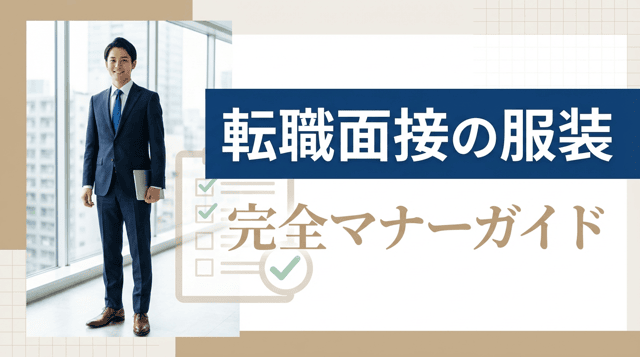
A suit is the default for men. Unlike entry-level recruiting, there's no need to wear a "recruit suit"—opt for a mature, polished business suit instead.
Navy or dark gray are the safest choices and make a good impression in any industry. Black is acceptable but use fabric texture and silhouette to distinguish it from a generic recruit suit. Stick to solid colors or subtle shadow stripes. Fit is critical: shoulders should sit cleanly, shirt cuffs should show about 1–1.5 cm below the jacket sleeve, and trousers should have a single break.
A plain white shirt is the safest bet. Light blue or sax also project a clean image. A regular or semi-spread collar works for any setting. Button-down collars read as casual, so avoid them for conservative industries like finance. Always iron or dry-clean your shirt—wrinkles are a non-starter.
Your tie can set the tone for the whole interview. Navy, burgundy, and dark blue convey reliability. Regimental stripes and small patterns are classic choices; small dots work too. Choose a standard 7–8 cm width—skip skinny ties and knit ties, which look too casual. Tie a four-in-hand or half-Windsor knot and add a dimple for polish.
Black cap-toe Oxfords or plain-toe shoes are the most formal option. Brown shoes pair nicely with navy or gray suits for a polished look, but are best avoided in conservative sectors. Polish your shoes the night before. Match your belt color to your shoes. Wear a simple watch—nothing flashy. Carry a structured briefcase that holds A4 documents and stands upright on the floor.
Women have more options than men, which can make the decision harder. A suit is the baseline, though smart office-casual may be fine depending on the industry.
Navy, dark gray, and black are standard. Beige and light gray work well in spring and summer but are more advanced choices. Both pant suits and skirt suits are fine—pant suits project energy, skirt suits a softer image. Match your choice to the role you're applying for. Skirts should hit the knee. Jacket sleeves should show a bit of wrist, and shoulders should fit cleanly. Collarless jackets are popular for a feminine touch, but collared versions are safer in conservative industries.
White or pastel blouses and cut-sew tops are standard. Keep designs simple and necklines modest. Subtle ruffles or bows are fine, but avoid anything that reads as flashy. Check in a mirror that your top isn't see-through.
Closed-toe pumps with a 3–5 cm heel are the go-to. Black is safest; beige and navy also pair well with suits. Stilettos, peep-toes, sandals, and mules are all off-limits. If heels aren't your thing, low-heel pumps or flats are fine—just keep them polished. Carry a simple tote or handbag that fits A4 documents. Keep jewelry minimal: small studs, a simple necklace, and a plain watch.
Natural makeup is the rule. Use foundation to even out your skin tone and keep eye and lip color understated. Going bare-faced can be seen as unprofessional, so a polished but minimal look is ideal. Style your hair so it doesn't fall over your face; tie back or pin longer hair. Stick to darker hair tones—very light colors can work against you in certain industries. Consider toning down before the interview.
The hardest part of interview attire is calibrating the right level of formality for each industry. Here's a breakdown.
These are the most formal industries. Men should wear a dark suit, white shirt, and regimental tie—skip brown shoes and button-downs. Women should also opt for a dark suit with minimal accessories. "Looking put-together" is the top priority here.
Not quite as strict as finance, but a business suit is still expected. A clean, understated appearance is valued. You can be slightly more adventurous with tie color and pattern. Women may get away with polished office-casual in some cases—when in doubt, wear a suit.
This sector has the widest range. Business casual—a jacket over chinos, a collared shirt with slacks—is broadly accepted. But even when told "casual is fine," showing up in full streetwear is risky. When in doubt, throw on a blazer with a shirt and slacks for a smart-casual look. Even at companies where T-shirts and jeans are the office norm, one step up in formality is usually the expected interview standard.
Taste and personality are part of the evaluation. Rather than a rigid suit, a clean outfit that expresses individuality tends to be preferred—but don't go too avant-garde. A business-casual base with personality in accessories or color accents is the sweet spot. For fashion companies, dressing in line with the brand's image is a strong move.
Even when an interview invitation says "dress freely" or "casual attire is fine," don't take it at face value. In most cases this means "you don't need a suit, but please dress appropriately for a business setting." Smart office-casual—blazer, collared shirt, slacks or neat trousers—is the right answer. The exception is creative or fashion companies that explicitly say "show us your personal style"; there, they may genuinely be assessing your taste, so dress in a way that reflects the company's culture.
Interviews happen year-round. Here's what to keep in mind each season.
Always bring your jacket, even in summer. You can carry it during transit, but put it on before entering the building. Even companies that practice cool-biz expect you to wear a jacket for interviews. Pack a handkerchief and cooling sheets, and arrive early to let the sweat dry. Men should wear an undershirt to prevent their dress shirt from going see-through. Women can use moisture-wicking innerwear to stay comfortable without compromising appearance.
Remove your coat before reception and carry it into the room. Drape it over the back of your chair or fold it on top of your bag. Choose a coat color that complements your suit. Puffer jackets are too casual—go with a topcoat or chesterfield instead. Remove scarves and gloves before entering the building. If you layer for warmth, choose thin thermal innerwear that won't disrupt your silhouette.
Rain can ruin shoes, so consider bringing a spare pair or waterproofing your shoes in advance. Carry a compact umbrella along with a small towel to wipe drips. If you bring a wet coat or umbrella into the interview room, place them in a plastic bag to prevent dripping. These small courtesies demonstrate professionalism.
Here are frequently overlooked missteps that can quietly cost you points. Check for these before interview day.
Ill-fitting clothing is the number-one issue. An oversized suit looks sloppy; one that's too tight looks uncomfortable. If your body has changed, try your suit on before the interview and get it tailored if needed. Pay special attention to jacket shoulders, sleeve length, and trouser hem. A well-fitted suit instantly elevates your overall impression.
Dandruff on a jacket, a yellowed shirt collar, scuffed shoes—these details are invisible to you but obvious to the interviewer. Lint-roll or brush your suit the day before, inspect your collar, and polish your shoes the night before. Don't forget to check your nails and facial hair either.
Interviews often take place in enclosed rooms where scents are amplified. As a rule, skip perfume. Choose unscented or lightly scented laundry detergent and fabric softener. Sensitivity to fragrance varies widely, so "just a little" is still a gamble.
Additional pitfalls include mismatched sock color (white socks with a suit is a no-go), belt and shoe color mismatch, a bag that doesn't stand upright, and overstuffed pockets that ruin your silhouette. Do a full-length mirror check the night before, and if possible, ask a friend or family member for a second opinion.
Online interviews are now commonplace in mid-career hiring. Being on camera introduces its own considerations.
Dress as you would for an in-person interview—top to bottom. Wearing pajama pants below the frame "because the camera only shows my top half" is a risk you don't need. A white shirt brightens your face on screen and is a solid default. Avoid fine stripes or checks, which can create a moire effect on camera; solid colors film best. Adjust your background and lighting so your face is well-lit from the front.
Run through these checks the evening before so you're not scrambling on the day.
Inspect your suit or jacket for wrinkles and stains; brush or iron as needed. Iron your shirt or blouse, paying extra attention to the collar. Polish your shoes and check the heels for wear. Assemble your accessories—tie, belt, bag, watch, handkerchief, etc. Do a full-length mirror check for fit and overall balance.
Once your outfit is sorted, you can give all your attention to the interview content. For tips on self-introductions and motivation statements, check out our articles "Interview Self-Introduction: The Complete Guide" and "How to Write a Motivation Statement for Career Changes | 20 Examples by Industry." If you're worried about explaining your reasons for leaving, see "How to Talk About Resignation Reasons in Interviews."
The right interview outfit depends on the industry and company culture. Finance and trading demand maximum formality, while IT and web companies welcome business casual. What matters most is researching what your target company expects and dressing accordingly.
Three principles apply to everyone: cleanliness, proper fit, and appropriateness for the setting. A well-groomed, well-fitted outfit—not necessarily expensive—makes the strongest impression. Prepare the night before so you can walk into the interview without a wardrobe worry and focus on what you have to say.
Once your first impression is locked in through your attire, the rest is all about your answers. Pair your polished look with thorough preparation for interview questions, and step into the process with confidence.
Find more of our articles on Google

A certificate of resignation in Japan must be issued by your employer on request, and is distinct from the separation no...

Under Japanese civil law, employment with no fixed term ends two weeks after you give notice, regardless of whether you ...

Japanese resident tax is charged on the previous year's income and deducted from June to May. Leaving between January an...


