What Are PPC Search Ads? How They Work, Cost Benchmarks, and Tips for Beginners
Published:
Last Updated:
Category: Ad Operations
Published:
Last Updated:
Category: Ad Operations
Authors: Shusaku Yosa
"I want to start PPC ads but have no idea how much they cost." "I don’t understand the mechanics well enough to take the plunge." — These are the most common concerns when businesses first consider paid search advertising.
This article provides a beginner-friendly, end-to-end guide covering how PPC (pay-per-click) search ads work, realistic cost benchmarks, and practical tips for maximizing ROI. Drawing on hands-on experience managing campaigns across Google Ads, Yahoo! Ads, and other platforms, we share what actually matters on the ground.
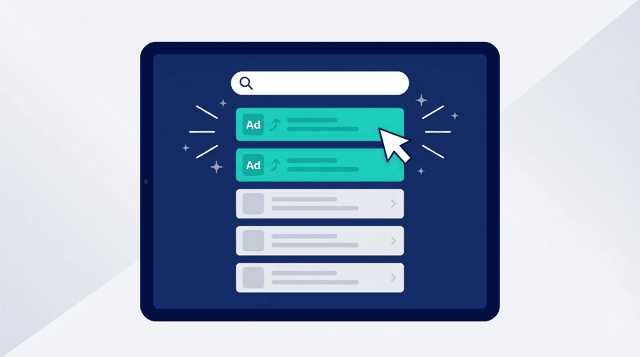
PPC search ads (also known as paid search or search engine marketing) are text-based advertisements that appear at the top and bottom of search engine results pages (SERPs) on platforms like Google and Yahoo!, triggered by the keywords users type in.
For example, a user searching for "movers Tokyo" sees ads from Tokyo-based moving companies, while someone searching for "diet supplements" sees supplement ads. Because you can reach users at the exact moment they express intent through search, PPC ads are exceptionally effective at targeting high-intent "in-market" audiences.
As of February 2026, search engine market share in Japan is approximately 72% Google, 18% Bing, and 8% Yahoo!. If budget is limited, starting with Google Ads is the standard approach.
PPC ads use a cost-per-click (CPC) pricing model. No fees are charged when the ad is merely displayed in search results; you only pay when a user actually clicks your ad. In other words, you are charged only for visits from interested users. The formula is straightforward: CPC × Number of Clicks = Ad Spend. For example, if your CPC is $1 and you receive 500 clicks per month, your monthly ad spend is $500.
Ad placement is determined by a real-time auction that runs every time a user searches. However, the highest bidder does not automatically win the top spot. Google Ads uses a metric called Ad Rank, calculated from your bid amount, ad quality (estimated click-through rate, relevance, landing page experience), and contextual factors. This means that even with a lower bid, a higher-quality ad can appear above competitors — a significant advantage for small and mid-sized businesses that cannot compete on budget alone.
There is no minimum spend requirement for PPC ads — in theory, you can start from as little as one cent. However, effective optimization and PDCA cycling require a minimum volume of data. Most businesses launching PPC for the first time start with a monthly budget of roughly $1,500 to $3,500 (approximately ¥20–¥50 in Japan). Current Google Ads rely heavily on AI-based auto-optimization, which requires a critical mass of clicks and conversion data each month. Budgets under roughly $700/month may not generate enough data for the AI to learn effectively, potentially worsening rather than improving ROI.
CPC varies dramatically by industry and keyword. The general range is a few tens of cents to a few dollars, but industries dealing in high-value products — such as real estate, insurance, and staffing — can see CPCs exceeding $10. In niche or everyday consumer markets, CPCs often stay under $1. CPC levels are closely tied to product margins: the higher the profit per conversion, the more advertisers are willing to bid, intensifying auction competition and driving up CPCs. It is rational to set budgets by working backward from an acceptable CPA based on your product's LTV.
If you outsource PPC management to an agency, expect a management fee of 15–25% of ad spend, with 20% being the most common rate. For example, on a $2,000 monthly ad spend, the management fee would be $400, bringing the total to $2,400. Some agencies also charge setup fees or reporting fees separately, so confirm the full fee structure upfront.
The biggest advantage is pinpoint access to high-intent users who are actively searching. Because ads appear at the moment users express intent, conversion rates tend to be higher than other ad formats. Speed is another strength: while SEO can take months to rank, PPC campaigns can launch within days. You also get real-time flexibility to toggle campaigns on/off and adjust budgets, and every metric — clicks, conversions, CPA — is transparently tracked.
On the other hand, when you stop paying, traffic stops immediately — there is no residual asset value like SEO. Competitive keywords can lead to soaring CPCs and rapid budget depletion. Text-only formats limit visual storytelling, and non-searching audiences cannot be reached, making display or social ads a necessary complement for awareness campaigns.
Both PPC and SEO target traffic from search results, but they differ fundamentally. PPC delivers instant visibility with controllable positioning, yet traffic vanishes when you stop spending. SEO builds long-term organic traffic through quality content, but takes time and is subject to algorithm changes. In practice, the ideal strategy combines both: PPC for short-term acquisition and SEO for long-term asset building. Using PPC conversion data (which keywords convert best) to inform SEO content strategy creates a powerful synergy.
The single most important step is defining your target CPA — the maximum you can pay per acquisition while remaining profitable. Once set, your required monthly budget is simply Target CPA × Target Conversions. Use logic, not intuition, to plan your budget.
Broad keywords like "movers" attract high volume but also fierce competition and high CPCs. Beginners should start with long-tail keywords like "affordable movers Tokyo" to reach high-intent users at lower CPCs and stronger conversion rates.
Showing ads for irrelevant search queries wastes budget. Regularly review your search terms report and aggressively add negative keywords such as "jobs," "free," and "comparison only." Negative keyword management is the most fundamental and effective lever for improving ROI.
Ad copy should directly answer the user's search query. When the search term appears in the headline, ad relevance increases, boosting both click-through rate and Quality Score. A higher Quality Score means better ad positions at the same bid, effectively reducing CPC.
Driving quality clicks is meaningless if visitors bounce on the landing page. Ensure consistency between ad messaging and LP content, optimize page load speed and CTA button placement. Even a 1% improvement in LP conversion rate can dramatically lower CPA.
Maximize results on a lean budget by refining targeting. Restrict geography to your service area, concentrate BtoB ads during business hours, and increase mobile bid adjustments if mobile leads dominate. Let data guide your targeting decisions.
Google recommends broad match for machine-learning optimization, but on small budgets the data may be insufficient, causing ads to appear for irrelevant queries. Start with phrase or exact match to maintain control, then expand to broad match once enough conversion data has accumulated.
Launch follows a straightforward flow: create an account in Google Ads or Yahoo! Ads, build a campaign and set its objective (conversions, clicks, etc.), register target keywords, create ad groups with ad copy, set a daily budget cap, and go live. After review approval, your ads start showing. Post-launch, continuously review search terms reports and conversion data, add and exclude keywords, adjust bids, A/B test ad copy, and refine your landing page — this ongoing PDCA is the key to scaling results.
Accurate conversion tracking is essential. Define conversions that match your business goals — form submissions, purchases, phone taps — and ensure tracking is set up via Google Ads tags and GA4.
Beyond evaluating PPC in isolation, a holistic view that includes SEO, social ads, and offline channels is critical. Marketing mix modeling (MMM) tools like NeX-Ray enable integrated cross-channel attribution analysis, allowing you to allocate PPC budgets with greater precision.
PPC search advertising is a fast, flexible, and ROI-friendly channel that puts you in front of high-intent audiences. The CPC model minimizes waste, and the ability to start small and scale makes it ideal for beginners.
While typical starting budgets range from $1,500 to $3,500 per month, what matters most is not matching an industry average but reverse-engineering your budget from your target CPA and target conversions. Keyword selection, negative keyword management, ad copy optimization, LP improvement, and targeting refinement — running this PDCA continuously will steadily improve your cost efficiency.
Start small, iterate based on data, and let each small win compound. That is the first step toward effective PPC management.

A guide to the setup and mechanism of Google Ads enhanced conversions (for web). Covers how they complement the basic co...

A guide to setting up a conversion tag, following the steps in the Google Ads dashboard. Covers the mechanism of the Goo...

A clear guide to placement advertising: its meaning, manual vs. automatic types, how to set it up in Google, Yahoo!, and...


