What Is a Marketing Automation (MA) Tool?
Published:
Last Updated:
Category: Marketing DX, Marketing Glossary
Published:
Last Updated:
Category: Marketing DX, Marketing Glossary
Authors: Shusaku Yosa
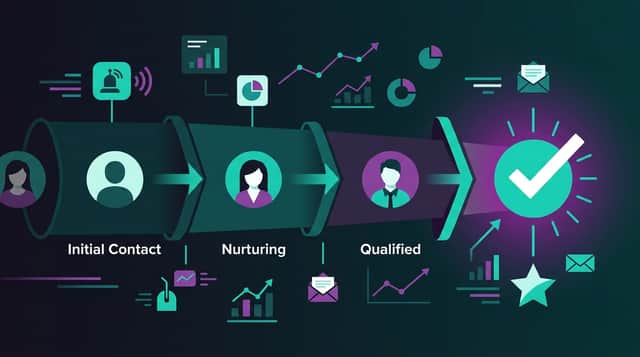
An MA (Marketing Automation) tool is software for automating and streamlining marketing activities—from acquiring prospects to nurturing and qualifying them. Because it can handle a volume of customer data that people cannot keep up with manually and deliver communication tailored to each individual automatically, adoption is advancing at many companies. This article explains, in beginner-friendly terms, the basic meaning and main features of MA tools, the benefits and how to choose one, and even applications such as cultivating brand ambassadors.
An MA tool is software for realizing Marketing Automation—a mechanism that automates and streamlines a series of marketing activities such as acquiring, nurturing, and qualifying prospects (leads).
By automating the email delivery, recording of customer behavior, and evaluation of purchase readiness that staff previously did by hand, even a limited team can continuously deliver approaches tailored to each individual. "Automatically nurturing a prospect who has just begun to show interest until they are close to purchasing"—this is the central role of an MA tool.
Behind the spread of MA tools lies a change in the environment surrounding marketing.
MA tools come with a variety of features that support marketing activities. Here are the representative ones.
A common point of confusion is the difference from CRM and SFA. Roughly speaking, an MA tool is for "nurturing prospects and connecting them to sales opportunities," SFA (sales force automation) is for "managing everything from the opportunity to the order," and CRM (customer relationship management) is for "maintaining and deepening relationships with customers after the order." Because each handles a different area, linking them lets you manage the entire span from acquisition to post-purchase seamlessly.
Introducing an MA tool can be expected to bring the following effects.
There are many MA tool products, and choosing the one that fits your company is the key to success. Compare them from the following perspectives.
MA tools demonstrate their power not only with new prospects but also in cultivating existing fans into "brand ambassadors."
A brand ambassador is someone who actively supports a company or brand and voluntarily recommends and spreads its value to those around them. Celebrities or influencers are sometimes used, but in recent years "ambassador marketing," in which enthusiastic fans or loyal customers take on the role, has been drawing attention. Because empathy spreads through the recommendation of trusted third parties rather than advertising, it is said to be highly cost-effective.
The foundation of this ambassador marketing is correctly grasping "who your enthusiastic fans are." This is where an MA tool helps.
In other words, an MA tool is not only a way to turn prospects into customers, but also a presence that supports the whole flow of elevating customers into fans and fans into brand ambassadors. Being able to run new acquisition and the nurturing of existing fans as two wheels is a great value of MA tools.
Finally, here is the basic flow for introducing an MA tool.
An MA (Marketing Automation) tool is software for automating the acquisition, nurturing, and qualification of prospects and achieving results with limited resources. Through features such as lead management, scoring, and scenario delivery, you can continuously deliver communication tailored to each individual, leading to higher conversion rates and greater operational efficiency. It also shines in cultivating loyal customers into brand ambassadors, letting you balance new acquisition with the nurturing of existing fans. Start by defining your purpose and KPIs, and by beginning small and repeating improvements, kick off your use of an MA tool.
A beginner-friendly guide to shinchoku (progress): its meaning in business, common phrases and example sentences, polite...
A beginner-friendly guide to the five reasons to-do lists never get finished and how to build one you can complete: sort...
A beginner's guide to to-do lists and how they differ from task lists. Covers a five-step way to use one, examples of cl...


