What Is Referral Marketing? How It Works and Success Stories
Published:
Last Updated:
Category: Marketing Glossary
Published:
Last Updated:
Category: Marketing Glossary
Authors: Shusaku Yosa
"We spend money on advertising, but it rarely leads to conversions"—this is a common frustration among marketing professionals, and it's why referral marketing is drawing renewed attention. This approach, which acquires new customers through introductions from friends and acquaintances, is highly appealing because it lets you gather quality customers at low cost. This article organizes, from a practical standpoint, the meaning and mechanics of referral marketing, why it's gaining attention, its benefits and drawbacks, how it differs from easily confused methods, and success stories from companies such as Dropbox and Uber.
"Referral" is an English word meaning "introduction" or "recommendation." Referral marketing refers to a marketing method that acquires new customers by having existing customers introduce friends and acquaintances. In Japanese it is sometimes called "introduction marketing."
It may be easiest to picture a "friend referral campaign." A customer who is satisfied with a product or service recommends it to people around them, saying "this was great," and the person who receives the introduction then makes a new purchase or registration. Referral marketing intentionally promotes this natural flow of word of mouth by designing incentives (rewards).
Its greatest feature lies in its high level of trust. Consumers tend to trust recommendations from friends and family far more than corporate advertising. As a result, information delivered through an introduction is more readily accepted, which in turn makes it more likely to lead to a conversion.
Referral marketing itself is by no means a new concept. The act of "recommending good things to others" has existed for ages. There are several reasons it is now drawing renewed attention.
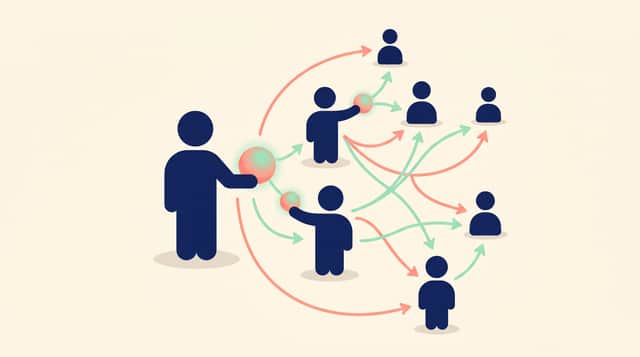
Referral marketing broadly works through the following flow. At its center are the "referrer" and the "referred party (the person introduced)," along with the "incentive" that motivates them both.
The key is to design it as a "win-win" that benefits both the referrer and the referred party. A system where only the referring side gains makes the referred party reluctant to act, and vice versa. By preparing rewards that both can feel good about, a chain of referrals is more likely to emerge.
What determines the success or failure of referral marketing is the design of the incentives. Let's organize the representative types.
Referral marketing tends to be confused with similar methods. Let's clarify the differences.
Difference from viral marketing
Viral marketing aims for an interesting video or campaign to spread "like a virus" to an unspecified large audience. While the reach is broad, there is not necessarily a strong relationship of trust between the referrer and the recipient. By contrast, referral marketing assumes introductions to people close to the customer and differs in that it designs incentives to encourage referral behavior.
Difference from affiliate marketing
Affiliate marketing is a method in which a third party, such as a blogger or media operator, introduces a product for the purpose of a reward. The referrer is not necessarily a user of that product. Referral marketing, on the other hand, differs greatly in that the starting point of the introduction is an "existing customer" who has actually used and been satisfied with the service.
Difference from influencer marketing
Influencer marketing leverages the influence of a creator with many followers. Reach is its weapon, but it differs in nature from referral marketing's recommendations based on a "close, one-to-one relationship of trust."
Referral marketing offers benefits across every dimension—cost, quality, and revenue.
On the other hand, there are also points to keep in mind when introducing it.
To deepen your understanding, let's look at some representative success stories.
Dropbox
Cloud storage provider Dropbox is widely known as a representative example of referral marketing. It introduced a system in which "when you invite a friend and they register, both the referrer and the referred party are granted free storage capacity." Rather than cash or discounts, it was innovative in making the reward the "value of the service itself"—something users genuinely want—and is said to have grown its user count dramatically while spending almost nothing on advertising.
Uber
Ride-hailing service Uber is also cited as a company that grew rapidly through a referral program. By preparing rewards both the referrer and the referred party could use toward rides, a strong motivation arose for users to send invitations to friends and family themselves. A design in which the more the service spreads, the higher the value for existing users, helped drive growth.
Starbucks
Starbucks ran a campaign in which posting a photo of a product on social media gave a chance to win a reward in a drawing. The fact that it was an appealing product people wanted to post photos of in the first place, combined with accurately grasping "what kind of reward customers find attractive," led to natural diffusion and success.
Use in domestic services and stores
Such methods are not only for large enterprises. In store-based businesses like cram schools, beauty salons, and bridal services, cases of steadily generating referrals are increasing by organizing the referral flow digitally and systematizing reward guidance and granting. The ingenuity of guiding referrals at the moment customer satisfaction is highest (such as right after a service is provided) greatly influences the results.
Let's organize the elements common to success stories as points to reproduce in practice.
Referral marketing is a method of acquiring new customers by having existing customers introduce friends and acquaintances, and its greatest strength is the ability to harness the power of "introductions," which are more easily trusted than advertising. While it lets you gather quality customers at low cost, it takes time before results appear, and product and service quality and incentive design greatly determine success or failure. As the Dropbox and Uber examples show, the keys are "rewards customers genuinely welcome," an "easy-to-refer path," and "continuous improvement." Start by reviewing your own service from the customer's perspective, and begin building a structure where referrals arise naturally.

A creative brief tells agencies and production studios your background, objective, and constraints. How it differs from ...

What vendor management means, why a hands-off approach fails, the four areas to manage, five things to settle before eng...

What an RFP is, how it differs from an RFI and a quote request, the 11 sections to include, and how to write one that le...


