The Relationship Between ROI and Cost-Effectiveness: Calculation and Evaluation Points
Published:
Last Updated:
Category:
Published:
Last Updated:
Category:
Authors: Shusaku Yosa
"Cost-effectiveness" and "ROI" are both used daily in business as terms expressing "how much result was obtained for the cost spent." While they are often used as near-synonyms, strictly speaking the two are not the same. They are related such that ROI, a concrete calculation metric, is contained within the broader idea of cost-effectiveness. This article organizes the relationship between ROI and cost-effectiveness, then explains how to calculate ROI and the points for evaluating the results correctly.
To state the conclusion first, the relationship is that "cost-effectiveness" is a concept, while "ROI" is one metric that quantifies that concept. In other words, the two are not opposing, separate things; it becomes clearer if you see ROI as a concrete yardstick for measuring the idea of cost-effectiveness.
Cost-effectiveness (cost performance) is the idea of evaluating whether a given initiative or investment delivers results worth the cost spent. In English it is also expressed as "Cost-Effectiveness." The "effect" here is a broad concept that includes not only things measurable in money, such as revenue and profit, but also things not necessarily easy to convert into money, such as "improved awareness," "reduced work time," and "better customer satisfaction."
ROI, on the other hand, stands for "Return On Investment" and is translated into Japanese as "return on investment" or "investment profit ratio." It is a metric that expresses, as a percentage, how much profit (return) was generated relative to the amount invested. You could say ROI takes the concept of cost-effectiveness, which tends to be vague, and distills it into a clear formula: "profit / investment." The difference from the broader cost-effectiveness is that ROI handles effects that can be measured in money.
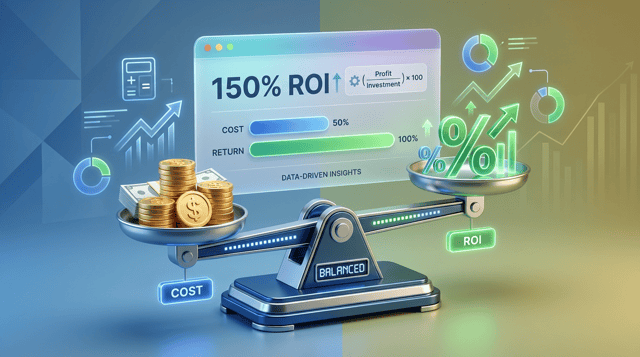
Therefore, the role of ROI is to back up a qualitative judgment like "this initiative has high cost-effectiveness" with a quantitative statement like "ROI was 150%." Because you can speak in numbers rather than gut feeling, it is powerful for investment decisions and reporting to management.
ROI is calculated by dividing the profit obtained from an investment by the amount invested. The basic formula is as follows.
ROI (%) = Profit / Investment x 100
Note that the "profit" here is not revenue itself but "profit after subtracting cost of goods and other costs from revenue." Written more carefully, it is "(revenue obtained - costs including the investment) / investment x 100." If ROI exceeds 100%, you are generating profit beyond the investment; if it is below 100%, you can judge that you have not fully recovered the investment.
For example, suppose you invest 1 million yen in an advertising initiative and that initiative generates 2.5 million yen in revenue. If the cost of goods and other costs for this revenue were 1 million yen, the profit is "2.5 million yen - 1 million yen (cost of goods) - 1 million yen (ad spend) = 0.5 million yen." Applying this to the ROI formula gives "0.5 million yen / 1 million yen x 100 = 50%," showing you have recovered only half of the investment.
On the other hand, if the same 1 million yen investment generated 1.5 million yen in profit, ROI would be "1.5 million yen / 1 million yen x 100 = 150%." Comparing with numbers lets you objectively judge which initiative generates profit more efficiently.
ROI is not the only metric for measuring cost-effectiveness. Let's also note the differences from metrics that are easy to confuse.
Even when ROAS is high, ROI can be low if the cost-of-goods ratio is high. To avoid a situation where "revenue is growing but no profit remains," it is important to look not only at revenue-based ROAS but also at profit-based ROI.
ROI is a powerful metric, but taking the numbers at face value can lead to wrong judgments. To evaluate cost-effectiveness correctly, keep the following four perspectives in mind.
ROI changes greatly depending on the measurement period. In particular, initiatives such as branding, awareness expansion, and building content assets take time to show effects, so they tend to look low if cut over a short period. It is important to evaluate ROI over an appropriate period according to the nature of the initiative.
Because ROI measures in monetary profit, qualitative effects such as "improved brand favorability" and "strengthened customer loyalty" do not appear in the formula. Even when the ROI number is low, some initiatives generate long-term asset value. If you look from the broad perspective of cost-effectiveness, you need the stance of evaluating separately the effects ROI can measure and those it cannot.
In calculating ROI, results differ depending on whether you count only ad spend as the investment or also include labor and tool costs. When comparing initiatives, you cannot compare correctly unless you align the scope of costs. Establishing a rule in advance for "what to include in the investment" ensures the reliability of the evaluation.
ROI is ultimately a "ratio (percentage)." Even when ROI is high, if the investment is small, the absolute profit obtained is limited. Conversely, even when ROI is somewhat low, some initiatives generate a large profit amount through a large investment. Judge the contribution to the business as a whole from both the ratio and the absolute amount.
Because the ROI formula is "profit / investment," there are broadly two directions for improvement: increase the "profit" in the numerator, or reduce the "investment (cost)" in the denominator.
In practice, the basic approach is a focused allocation that "stops low-performing initiatives and shifts budget to high-ROI ones." To do that, it is essential to measure ROI per initiative and run a cycle of regular review.
Cost-effectiveness is the idea of "whether results match the cost," and ROI is the metric that quantifies it as the ratio "profit / investment x 100." ROI is a representative yardstick for speaking about cost-effectiveness in numbers, but you need to evaluate it while accounting for the measurement period, effects that cannot be monetized, the scope of costs, and the investment scale.
Start by calculating ROI for your company's main initiatives with the scope of costs aligned. Once you can visualize cost-effectiveness in numbers, it leads to investment decisions that don't rely on gut feeling and to optimized budget allocation.
Find more of our articles on Google

Marketing progress tracking breaks down when tasks and budget live in separate systems. Learn four steps to tie them tog...

A creative brief tells agencies and production studios your background, objective, and constraints. How it differs from ...

Why web development and advertising estimates are so hard to compare. Which fields to check first, how man-month pricing...


