What Is Web Marketing? Types, How to Start, and Skills You Need, Explained Simply
Published:
Last Updated:
Category: Media Strategy
Authors: Shusaku Yosa
Published:
Last Updated:
Category: Media Strategy
Authors: Shusaku Yosa

If we put "what is web marketing" in one phrase, it is the activity of building a system that sells products and services by leveraging the web. Methods are wide-ranging—SEO, ads, SNS, and more—so the big picture can be hard to grasp for first-time learners. This article organizes and explains, in a beginner-friendly way, everything from the meaning of web marketing to its main types, how to get started, and the skills you need.
Web marketing refers to the series of activities that use websites and various media on the internet to attract prospective customers and lead them to outcomes (conversions) such as purchasing a product/service or making an inquiry. Its characteristic is connecting with users through search engines, web ads, SNS, email, and so on, and designing the journey from awareness to purchase to repeat.
Unlike traditional mass advertising such as TV commercials and flyers, a major strength of web marketing is that you can measure user behavior data. Because you can grasp who came, from where, which pages they viewed, and where they left, you can evaluate the effect of measures numerically and repeat improvements.
A very similar term is "digital marketing." Digital marketing is a broad concept that includes measures using digital technology in general—not limited to the web—such as apps, digital signage, and IoT. It's easier to organize if you consider web marketing as the part within it that refers mainly to activities on websites and browsers.
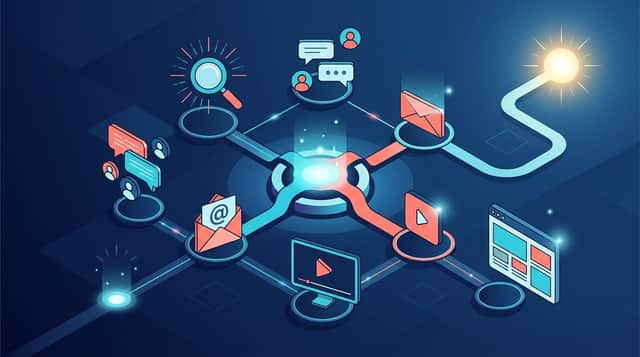
Web marketing measures can be broadly divided into "acquisition measures" for attracting new customers, and "nurturing/engagement measures" for deepening relationships with prospects and existing customers. Let's look at the representative methods.
A measure to display your site higher in search engines and increase traffic from organic search. While it can be expected to bring continuous traffic without ad spend, it takes time to produce results, so you work on it as a mid-to-long-term asset.
A method to attract customers in a short period at a cost by placing search-linked ads (listing ads), display ads, SNS ads, and so on. Because you can quickly serve optimal ads in response to user behavior, it offers high immediacy, and combining it with SEO achieves well-balanced acquisition.
A measure to create your own accounts on Instagram, X, Facebook, YouTube, TikTok, and so on, and build relationships with followers through posts and replies. If you can raise engagement, spread and word-of-mouth arise, helping to drive brand recall and traffic to your site. Because user demographics differ by platform, choosing media that fits your target is important.
A method to attract prospects through useful content such as blog articles, white papers, and videos, building trust to lead to outcomes. It has high affinity with SEO and becomes a long-term acquisition asset.
A measure to maintain continuous contact with prospects and existing customers via newsletters and step emails, encouraging purchases and repeats. Using an MA (marketing automation) tool, you can automate delivery according to user behavior.
There are many measures you can start easily, but proceeding without a plan won't yield sufficient results. Solidify the foundation with the following steps before moving to execution.
The essence of web marketing is not "execute and done," but continuing to cycle through measurement and improvement. Rather than aiming for perfection from the start, the attitude of starting small and verifying is the shortcut to results.
A web marketer is required to have not only specialized knowledge but also the comprehensive ability to handle data and collaborate with people. The representative skills are as follows.
These cannot be acquired all at once. It is realistic to use books, seminars, online schools, and so on, deepening one measure first and gradually widening your scope through practical work. Using a qualification you can study from scratch, such as the IMA certification, as a learning guidepost is also effective.
If you're starting to learn, rather than trying to cover all measures at once, it's recommended to begin with an area close to your own or your company's goals. For example, if you want to attract customers while keeping costs down, then SEO or content; if you want results in the short term, then ad operation—deciding the order of learning by working backward from your goal makes it easier not to give up.
And above all, actually moving your hands and looking at the numbers is the key to improvement. Even with a small site or SNS account, experiencing the cycle of running a measure and checking results in GA4 will suddenly make your knowledge feel real.
Web marketing is the activity of building a system that attracts customers through the web and leads to outcomes. There are diverse measures such as SEO, ads, SNS, content, and email, which you use selectively according to your goal and target. When starting, it's important to grasp the flow of goal setting, persona design, measure execution, and measurement/improvement, while honing your data analysis and logical thinking. Start small from measures close to your goal, and while repeating measurement and improvement, steadily accumulate skills and results.
A guide to web marketing strategy through the role division and combination of channels (the channel mix)—SEO, web adver...

Organizes the purpose of an owned media into three—"customer acquisition / lead generation," "branding," and "recruitmen...

From whether you need an SEO certification to the types, difficulty, cost, and benefits of major SEO certifications like...


