What Is AISAS? Differences from AIDMA and Strategy Design for the 5 Phases, Explained with Examples
Published:
Last Updated:
Category: Marketing Glossary
Published:
Last Updated:
Category: Marketing Glossary
Authors: Shusaku Yosa
"I keep hearing about the AISAS marketing model, but I can't quite pin down how it differs from AIDMA." "I want to map our marketing initiatives onto AISAS phases, but I can't picture what we should actually do at the Search and Share stages." "I know the framework, but I can't translate it into concrete strategy designs that reflect today's SNS and search behavior." For marketing managers and business leaders, AISAS is one of the most representative frameworks for re-capturing modern consumer behavior, yet it is also a concept that often gets used with vague practical translation — both in terms of how it differs from AIDMA and what should be designed at each phase. This article systematically explains, at a level of granularity you can actually put into action: the basic definition of AISAS, its structural differences from AIDMA, its relationships with derivative models like AISCEAS, DECAX, and the 5A model, the strategy design for each of the Attention, Interest, Search, Action, and Share phases, real-world application patterns for BtoC and BtoB, and the common pitfalls to avoid.
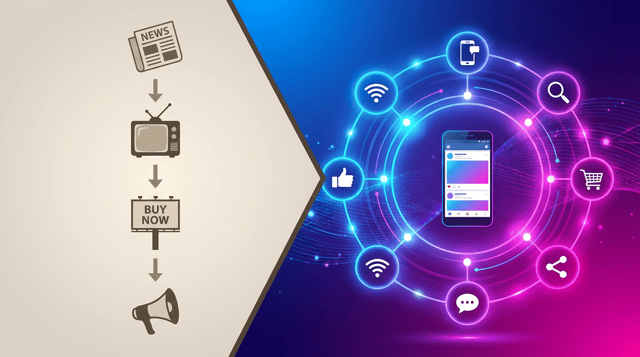
AISAS is a marketing model that captures the consumer's behavioral process — from encountering a product or service to purchase and recommendation — in five stages: Attention → Interest → Search → Action → Share. Proposed in 2004 by the Japanese advertising agency Dentsu, it has been widely adopted as a framework representing consumer behavior in the internet era, positioned as an evolved version of AIDMA (Attention → Interest → Desire → Memory → Action). The defining feature of AISAS is its explicit incorporation of "Search" before purchase and "Share" after purchase into the behavioral process, systematizing — as a strategic framework — the modern consumer behavior of actively gathering information through Google search, SNS, and review sites, and then broadcasting their experience via SNS and reviews after purchase.
The five AISAS phases each correspond to different consumer cognitive states and behaviors. Attention is the stage of "becoming aware" of a product or brand, Interest is the stage of "developing interest," Search is the stage of "actively researching and comparing," Action is the stage of "taking concrete action such as purchasing or signing up," and Share is the stage of "communicating the experience to others." Whereas traditional mass-media-centric purchase models captured the consumer as a passive recipient who absorbs corporate messaging in a one-way structure on the way to purchase, AISAS assumes "the consumer as an information producer" — one who actively searches and broadcasts — and thus expands the scope of corporate marketing design to include not just one-way messaging but also responses to search behavior and the encouragement of sharing behavior.
AISAS has gained widespread adoption across industries — both BtoC and BtoB — against the backdrop of the digitalization of purchase behavior and the fragmentation of information touchpoints. As shown in surveys such as Japan's Ministry of Internal Affairs and Communications usage trend study, the habits of searching on smartphones when considering products, checking reviews and comparison articles before purchase, and sharing reviews on SNS or e-commerce sites after purchase have moved beyond being the behavior of a niche segment and are now firmly established across a broad consumer base. Whether you can build marketing on the premise of search and sharing behavior has become the starting point for correctly capturing the modern purchase process, and AISAS is widely referenced in practice as the conceptual foundation for that thinking.
AISAS is often confused with adjacent purchase behavior models such as AIDMA, AISCEAS, DECAX, and the 5A model (Five A's). Correctly understanding the differences between these models makes it easier to decide how to position AISAS within your own marketing design, and how to combine it with other models when appropriate.
AIDMA is a classic purchase behavior model, said to have been proposed by American practitioner Samuel Roland Hall in the 1920s, which captures the consumer's psychological process in five stages: Attention → Interest → Desire → Memory → Action. AIDMA is a psychological model premised on "reaching purchase through psychological stages," built for an era when television, newspapers, and radio dominated, and repeated advertising was used to reinforce memory and drive purchase. The biggest difference between AISAS and AIDMA is that AISAS replaces Desire and Memory with Search and Share, formally positioning the consumer's active information gathering and post-purchase broadcasting within the behavioral process.
Another major difference lies in the assumed media environment. In AIDMA, "showing and making memorable" through mass advertising sits at the center of strategy, and the path from corporate messaging to consumer purchase is depicted as a one-way structure. AISAS, by contrast, places at the core of strategy design not only messaging in the Attention and Interest stages, but also search engine optimization, comparison site management, and review management in the Search stage, conversion design on EC sites and landing pages in the Action stage, and SNS-based promotion of experience posting in the Share stage — all of which are responses to active consumer behavior. AIDMA is not entirely obsolete — the importance of brand recall and the memory stage still remains — but for capturing modern consumer behavior, AISAS is more widely adopted as the framework that more closely reflects reality.
In practical terms, the distinction works like this: for new product launches where the goal is to rapidly build brand awareness through mass advertising, or in situations involving high-involvement products where reinforcement at the memory stage drives results, AIDMA-style thinking remains effective. On the other hand, for products where digital touchpoints dominate and search and word-of-mouth directly drive purchase, products where SNS amplification determines awareness, or products where the broadcasts of repeat customers and advocates lead to the next wave of new customer acquisition, designing the entire strategy around AISAS becomes the standard approach.
AISCEAS is a derivative model that further refines AISAS, capturing consumer behavior in seven stages: Attention → Interest → Search → Comparison → Examination → Action → Share. The difference is the addition, after the Search stage, of a "Comparison" phase where multiple candidates are weighed in parallel, and an "Examination" phase where the final decision is scrutinized. For high-priced products, BtoB products, and products involving long consideration cycles — where comparison tables, review scores, and case studies are scrutinized over time within the Search stage — AISCEAS depicts consumer behavior at a resolution closer to reality. On the other hand, for everyday consumer goods or low-priced e-commerce products where the path from search to purchase is short, AISAS provides sufficient granularity for strategy design, making it a practical approach to use them differently depending on product characteristics.
DECAX is a consumer behavior model for the content marketing era, proposed by Dentsu in 2015, consisting of five stages: Discovery → Engage → Check → Action → Experience (sharing). The major difference from AISAS is that DECAX places the first touchpoint not at corporate advertising but at "the consumer's discovery of content," and explicitly incorporates the relationship-building between sender and receiver into the pre-purchase process. For business models built on owned-media or video channels — where consumers discover value-driven content, build trust, and arrive at purchase — designing strategy through the DECAX lens better matches reality. AISAS is a comprehensive framework that encompasses advertising, search, and SNS as a whole, while DECAX can be regarded as a complementary model specialized in content-driven touchpoint design.
The 5A model (Five A's), proposed by Philip Kotler in "Marketing 4.0," consists of five stages: Aware → Appeal → Ask → Act → Advocate. Its structure closely resembles AISAS: Aware and Appeal correspond to Attention and Interest, Ask to Search, Act to Action, and Advocate to Share. The defining feature of the 5A is that it positions the final stage not as mere "Share" but as "Advocate," emphasizing the circular structure of an "advocate economy" in which loyal customers generate awareness and appeal for new customers. In international, practitioner-oriented discussions of digital-era consumer behavior, the 5A is more commonly used, while AISAS is more widely embedded in Japanese practice — so the two are essentially expressions of the same underlying idea, used in parallel.
AISAS has become a central theme in modern marketing and management because three changes have advanced simultaneously — the digitalization of purchase behavior, the fragmentation of information touchpoints, and the expansion of broadcasting agents via SNS — making it impossible for companies to reach consumers through one-way messaging alone. The larger the marketing investment — companies spending tens of millions to hundreds of millions of yen annually — the more whether they can organize initiatives along the AISAS phase structure, and invest with the right balance across phases, becomes the management challenge of continuously accumulating outcomes from awareness through advocacy.
The first benefit is the ability to organize initiatives along the consumer's actual purchase process. Using AISAS as the basis, you can inventory your current marketing initiatives across five columns — Attention, Interest, Search, Action, Share — making structural problems such as "which phases are over-invested" and "which phases are under-resourced" immediately visible. For example, if you're allocating budget to mass advertising and search ads but have zero countermeasures for the reviews, comparison articles, and recommendation content that consumers compare in the Search stage, or no mechanism whatsoever to encourage broadcasting by repeat customers in the Share stage — identifying such "phase imbalances" reveals significant room for improvement simply by rebalancing investment allocation.
The second benefit is that it becomes easier to build role allocation and collaboration design across teams. By organizing responsibilities along AISAS phases — the brand and advertising team primarily handling Attention and Interest, the SEO/content/review management team handling Search, the EC/LP/sales team handling Action, and the community/customer success team handling Share — cross-organizational marketing design can be discussed on a shared vocabulary. When reporting to leadership or requesting budget, presenting the balance of outcomes and investment across the five AISAS phases makes it easier to communicate "the overall health of marketing," which is difficult to explain through individual initiative accumulations alone.
The third benefit is that by formally embedding the Share stage, you can place "customer-generated new customer acquisition" — through advocacy, word-of-mouth, and UGC — at the center of strategy. New customer acquisition that depends solely on advertising spend carries the risk of cost structure suddenly deteriorating due to rising media unit prices or platform algorithm changes; however, if you can build a structure where new awareness emerges naturally from existing customers' Share behavior, you can achieve sustained growth while reducing advertising dependence. AISAS provides the conceptual foothold for incorporating this "Share-driven growth engine" into strategy design, which is another reason it carries high managerial value in modern marketing.
What matters when actually applying AISAS in practice is concretely designing — for each phase — which metrics to track, which initiatives to deploy, and what to improve. Simply listing the framework will not deliver outcomes; you need to carefully build out the initiatives, KPIs, and improvement loops phase by phase. Below, we explain the strategy design for each phase in sequence.
The purpose of the Attention phase is to be seen by potential customers who do not yet know your company or product, and to create the starting point of awareness. Major initiatives include mass advertising such as television commercials, newspapers, and magazines; digital display advertising and video advertising (YouTube, TikTok); SNS advertising (Instagram, X, Facebook); out-of-home (OOH) advertising; PR (press releases and media coverage); and influencer marketing. The core design task at this phase is combining media with high reach efficiency, matched to the target's disposable time and the media they engage with.
Key KPIs for the Attention phase include reach (number of users reached), impressions (display count), video views, branded search volume, and brand awareness from brand lift surveys. Evaluating based on conversions alone tends to misread the true contribution of these initiatives, so it's important to evaluate outcomes using metrics suited to the awareness stage — metrics that measure "how broadly the message reached." A representative pattern: combining television commercials with TikTok ads at the time of a new product launch, using the TVC to build broad awareness and TikTok to show concrete usage, elevating viewers to the status of "interested prospects" — an awareness design that leverages the characteristics of each medium.
The purpose of the Interest phase is to draw out interest — "I want to know more" or "this looks good" — toward a product or brand that has already entered awareness, and to drive the transition to Search behavior. Major initiatives include branded SNS account operation, owned media articles, video content (YouTube, Instagram Reels, TikTok), email newsletters, brand site storytelling, events, experience sessions, pop-up stores, and empathy generation through UGC.
Unlike Attention, the Interest phase requires design that "communicates carefully" the product's functionality, value, and worldview. Key KPIs include SNS follower count, engagement rate, site dwell time, page-through rate, newsletter sign-ups, and growth in branded search. If a prospect enters Search with thin Interest, they will likely remain at "I sort of know it but don't intend to buy" at the point of searching, and conversion will not follow. Investing in value messaging and worldview-building at the Interest phase lifts both search appetite at the Search stage and purchase intent at the Action stage — positioning Interest as the investment area that decides the efficiency of all downstream phases is the practical mindset.
The purpose of the Search phase is to shape an information environment favorable to your company during the stage when interested consumers actively gather information and compare options, maximizing the probability of progression to the next Action stage. Major initiatives include SEO (owned media, product pages, FAQs), search advertising, comparison site and review site management, review acquisition campaigns, encouraging third-party reviews on YouTube and SNS, and management of reviews on platforms like price comparison sites and major e-commerce marketplaces.
A frequently overlooked aspect of Search phase design is responding to both "branded search" and "generic search." For branded search (queries containing the brand or product name), you need design that elevates your official site to top rankings and resolves doubts through Q&As and usage guides. For generic search (queries about categories or problems), you need initiatives — SEO articles and comparison content — that position your offering within information presented from a third-party perspective. Key KPIs include your site's ranking in search results, branded search volume, comparison site scores, review ratings, site traffic, and conversion rate. If negative reviews or misinformation are left unaddressed at the Search stage, the investment made at the Attention and Interest stages goes to waste, so embedding social listening and review management into operations becomes the prerequisite for Search-stage initiatives.
The purpose of the Action phase is to lead consumers who are sufficiently convinced at the Search stage to actual action — purchase, application, or inquiry — at the buying touchpoint, whether that's an e-commerce site, landing page, physical store, or sales meeting. Major initiatives include landing page optimization, cart abandonment countermeasures, purchase flow improvements, clear inventory and shipping fee display, payment method diversification, refund guarantees, embedded product reviews, chat support, and in-store customer experience design. For BtoB, this includes whitepaper downloads, free consultation bookings, free trials, sales meetings, quote provision, and contract flow optimization.
Key KPIs for the Action phase include conversion rate (CVR), average order value (AOV), cart abandonment rate, bounce rate, and for BtoB, meeting-conversion rate, win rate, and average deal size. Even with significant investment in the Attention, Interest, and Search phases, poor conversion flow design at the Action phase will lose customers in the final click. In practice, a 1-point improvement in CVR at the Action stage often delivers impact equivalent to a 10%+ reduction in upstream advertising spend, making the elimination of "missed opportunities among customers who already intend to buy" the investment area that most powerfully moves AISAS-wide ROI.
The purpose of the Share phase is to create a cycle in which customers who have purchased and used the product broadcast their experience to others, naturally generating Attention, Interest, and Search among new potential customers. Major initiatives include post-purchase thank-you emails, review submission requests, SNS hashtag campaigns, UGC introductions by the corporate account, referral programs (referral incentives), community operations, customer success experience design, and advocate programs (ambassador and official fan systems).
What matters in Share phase design is embedding "a worth-posting experience" into the product or service itself. Even if you launch a hashtag campaign after the fact, if the product experience itself lacks something worth talking about, photogenic appeal, or surprise, Share will not occur. Re-examining product development, packaging, in-store experience, and first-time-use onboarding through the lens of "does a moment that makes someone want to post on SNS arise naturally?" is what creates the most sustainable Share-driven growth engine. Key KPIs include UGC post count, branded hashtag usage, review count, NPS (Net Promoter Score), referral-derived new customer count, and sustained growth in branded search. Because Share-stage KPIs are difficult to move in the short term, positioning them as mid-to-long-term indicators tracked over quarterly-to-annual trends is the appropriate approach.
AISAS is applied across diverse contexts — BtoC, BtoB, and product development. Here we introduce three representative application patterns widely observed across industries. Use the pattern closest to your business type as a reference and build out the direction of your phase-by-phase strategy design.
When a BtoC cosmetics brand launches a new product, integrating initiatives that correspond to each AISAS phase is the standard approach. At the Attention stage, short-form video product visual messaging is delivered via TikTok and Instagram ads, and third-party broadcasting is triggered through gifting (product seeding) to beauty influencers. At the Interest stage, the brand's official accounts continuously broadcast worldview content, usage videos, and ingredient explanations, building a prospect list through newsletter sign-ups and adding the brand on LINE. At the Search stage, for keywords like "[product name] + review," "[product name] + ingredient," and "[category] + recommendation," a favorable information environment is built through the official site, owned media articles, and review sites such as @cosme. At the Action stage, inventory, shipping, and reviews are optimized on both the company's own EC site and Amazon, with first-purchase incentives nudging conversion. At the Share stage, hashtag campaigns for buyers, UGC features, and an official fan community are used to continuously encourage broadcasting. By combining initiatives that correspond to all five phases, marketing as a whole can be integrated not as per-medium optimization but as "the design of a coherent experience aligned with consumer behavior" — and this is the practical value of AISAS.
In BtoB SaaS, the Search phase often stretches over a long period and involves multiple decision-makers, so cases that require AISCEAS-style refinement of the comparison and examination stages are common — but the basic structure can still be organized through AISAS. At the Attention stage, awareness is built through article contributions to industry-specific media, LinkedIn ads, conference speaking, and YouTube channels. At the Interest stage, interest is deepened through whitepapers, case studies, expert interviews, and webinars, and a prospect list is acquired. At the Search stage, for queries like "[category] + recommendations," "[category] + comparison," and "[competitor product] + difference," position as "a chosen candidate" is established through SEO articles, comparison articles, ratings on third-party review sites, and logos of customer companies. At the Action stage, free trials, free consultations, sales meetings, and customer success implementation support flows are organized to maximize meeting conversion and deals. At the Share stage, customer case studies, speaking collaboration at conferences, and inter-user information exchange within the community are encouraged, building a cycle in which existing customers' broadcasts generate new Attention and Interest. Particularly in BtoB, the quality of the Share stage determines the next wave of meetings, so positioning customer success as "the upstream initiative for new customer acquisition" becomes a critical management mindset for supporting sustained growth.
AISAS can be applied not only to organizing promotional initiatives but also to the upstream stages of product development. At the planning stage of a new product, asking "how does this product perform at each AISAS stage?" — embedding from the product specification and packaging stages the eye-catching feature for Attention, the worth-talking-about value for Interest, the search keywords and comparison axes for Search, the accessible price and purchase flow for Action, and the postable experience for Share — structurally raises the efficiency of all marketing activities after launch. Particularly when product development is re-examined starting from Share, "packaging that makes people want to post on SNS," "a first-time experience worth recommending to friends," and "surprise worth writing about in reviews" become embedded in product design, weaving in a flow of naturally generated new awareness that does not depend on advertising spend. Treating AISAS not as a framework confined to the marketing department, but as a cross-organizational design language spanning product development, in-store experience, and customer success, is the most strategic way to use AISAS in modern management.
AISAS is a powerful framework, but mistakes in design and operation can lead to failures such as "just lining up the framework," "interpretations divorced from modern purchase behavior," and "connections between phases that aren't designed." Internalize the representative pitfalls and consciously avoid them in practice.
The first pitfall is treating the five AISAS phases as a mere checklist and designing initiatives at each phase independently. The essence of AISAS lies in the premise that "the phases form a continuous, connected process" — the impression created at Attention generates Interest, the deepened interest at Interest triggers Search, the conviction acquired at Search drives Action, and the satisfying experience at Action connects to Share. Unless this chain becomes the design target, AISAS loses meaning. A marketing plan that simply lists what to do at each phase without designing the bridges between phases ends up as a "collection of disjointed initiatives by phase" — divorced from real consumer behavior.
The second pitfall is over-investing only at the Attention and Interest stages while leaving Search, Action, and Share thinly resourced. Many companies fall into this imbalance: they allocate budget to mass advertising and SNS ads for awareness, but invest nothing in reviews and ratings encountered when the brand is searched, leave their landing pages and EC site conversion design outdated, and have no mechanism whatsoever to encourage Share after purchase. Visualizing each AISAS phase as a five-column current-state inventory and inspecting "which phases are over-invested and which are empty" reveals significant room for improvement simply by rebalancing investment allocation.
The third pitfall is leaving negative information and reviews unaddressed in the Search stage. Even if you draw in consumers through advertising at the Attention and Interest stages, if the search results for your product name are dominated by low-ratings reviews, misinformation, or competitor attacks, purchase intent rapidly chills. Regularly monitoring review sites, SNS, and YouTube reviews, having the official channel publish facts to counter misinformation, and addressing improvement requests on the product side — these operations are the prerequisite for Search-stage initiatives. Increasing only advertising budget while leaving the Search-stage information environment unattended is the textbook failure pattern of leaking upstream investment downstream.
The fourth pitfall is treating Share as "a bonus after the sale" and excluding it from the design scope. Share is "an upstream initiative that triggers the next Attention" — if you can build a structure where new customers emerge naturally from the broadcasts of existing customers, you embed a growth engine that does not depend on advertising spend. Embedding Share-encouraging experience design, UGC-eliciting mechanisms, and advocate programs into the product and service, and positioning customer success as "upstream for new customer acquisition," is the prerequisite for AISAS to function at full power.
The fifth pitfall is applying AISAS uniformly to all product categories and failing to use frameworks differently based on product characteristics. For high-priced products, BtoB products, and long-consideration products, AISCEAS better matches reality, and for content-driven business models, DECAX may be more suitable for organizing initiatives. AISAS is not a universal solution; it is a framework that demonstrates particular power for products whose purchase process clearly incorporates "Search" and "Share." Considering your product characteristics, using AISAS, AIDMA, AISCEAS, DECAX, and the 5A model differently — and combining them when appropriate — is the flexibility that enables reality-based, not framework-dependent, marketing design.
The sixth pitfall is dismissing AISAS as "outdated" or "not suited to the SNS or AI era" and failing to apply the framework at all. In recent years, derivative models that reflect the SNS era — AISCEAS, the 5A model, and the SIPS model (Sympathize → Identify → Participate → Share & Spread) — have emerged, yet the underlying idea AISAS proposed — embedding "Search" and "Share" into consumer behavior — has not faded. Without being swayed excessively by framework novelty or trends, anchoring on AISAS while incorporating elements of derivative models as needed, based on your business context — this "practical use of frameworks" is the approach that delivers results in the field.
AISAS is a marketing model that captures consumer behavior in five stages — Attention, Interest, Search, Action, and Share. Whereas AIDMA depicted the psychological process of the mass-advertising era, AISAS is a framework that systematizes — as a behavioral process — the digital-era purchase behavior in which consumers actively search and broadcast after purchase. Distinguishing the roles of derivative models such as AISCEAS, DECAX, and the 5A, and using them differently based on product characteristics and touchpoint structure, is the practical prerequisite for modern marketing design.
The true value of AISAS lies in three dimensions: organizing initiatives along the consumer's actual purchase process, creating shared vocabulary across organizational divisions, and building a sustained growth engine that incorporates the Share stage. By steadily accumulating phase-by-phase strategy design — awareness at Attention, interest generation at Interest, search and comparison response at Search, conversion design at Action, and advocacy cycle at Share — and applying it in contexts such as integrated BtoC marketing, the BtoB consideration process, and product development, AISAS functions as the strategic starting point for modern marketing departments. By avoiding the six pitfalls — phase-independent design, upstream over-investment, neglecting the Search-stage information environment, underestimating Share, ignoring product characteristics, and dismissing the framework itself — and by anchoring on AISAS while flexibly incorporating elements of derivative models, AISAS continues to function as a core managerial activity of modern marketing — one that designs the full journey from awareness to advocacy, sustained over the long term.

Twelve decisions to settle in a marketing leader's first 90 days, organised by period. Days 1–30 for understanding the c...

How to allocate a marketing budget and track it against actuals, built around a quarterly reallocation cycle. Covers spl...

What a CMO decides in the age of AI, split into decisions that can be automated and decisions that cannot. Covers the di...


