10 High-Impact CRM Campaigns | Segment-Based Approach Examples
Published:
Last Updated:
Published:
Last Updated:
Category: CRM, LTV & Customer Management
Authors: Shusaku Yosa
You've implemented a CRM, but you're not sure what specific campaigns to run—sound familiar? The key to successful CRM campaigns is choosing the right approach for each customer segment. In this article, we've curated 10 high-impact CRM campaign patterns organized by customer segment, with detailed guidance on the objective, execution method, and tips for driving results.
CRM campaigns are specific marketing actions that leverage customer data stored in your CRM to build and strengthen customer relationships. They encompass a wide range of activities beyond email sends and campaign design—including personalized customer interactions, churn prevention, and upsell/cross-sell proposals.
There are three key points to keep in mind for driving results with CRM campaigns. First, clearly define the target customer segment. Second, design approaches tailored to the unique challenges and needs of each segment. Third, measure campaign effectiveness with KPIs and run improvement cycles. With these principles in mind, explore the 10 campaigns below.
Target segment: Customers immediately after their first purchase or registration
The welcome email is the first touchpoint for building a relationship with your brand. Use CRM attribute data—industry, job title, acquisition channel—to personalize content for each customer. For B2B, showcase case studies matching the industry selected at registration. For B2C, send styling suggestions related to the purchased product category. Compared to generic template emails, you can expect significant improvements in open rates and click-through rates.
Key to success: Send the email within 24 hours of registration or purchase. Set a high bar for the brand experience from the first interaction and include a clear call-to-action for the next step.
Target segment: Customers who just started using the service (especially SaaS and subscription businesses)
Automatically deliver step emails based on the number of days since onboarding so new customers realize the product's value early. Use CRM usage data (login frequency, feature adoption rate) as triggers to send guides for unused features and best practices progressively. For SaaS, a scenario might look like: Day 1: Setup guide → Day 3: Key feature tips → Day 7: Success stories → Day 14: Usage check and support offer.
Key to success: Reference CRM behavioral data to skip steps for customers who are already proficient—flexible, progress-based design is essential.
Target segment: Customers 7–14 days after their first purchase
Post-purchase follow-ups directly improve customer satisfaction and repeat rates. Based on CRM purchase data, send product-specific usage guides, related content, and review requests. Review requests are most effective 7–14 days after purchase—when customers have started using the product. Offering incentives like coupons or points for reviews boosts both submission rates and repeat purchases.
Key to success: Include a "Having any issues?" support link in follow-up emails to catch dissatisfaction before it turns into a negative review.
Target segment: Existing customers who have purchased specific products or services
Analyze CRM purchase history to identify patterns like "customers who bought A also tend to buy B" and make cross-sell proposals. For B2B software, introduce add-on features or integrations to basic plan users. For e-commerce, suggest compatible accessories or consumables. The key is ensuring proposals genuinely add value for the customer. By limiting recommendations to data-backed combinations, you eliminate pushiness and improve both customer experience and revenue simultaneously.
Key to success: The best timing for cross-sell proposals is after the primary product's usage has stabilized (30–60 days post-purchase). Combine with usage data and prioritize highly engaged customers.
Target segment: Existing customers approaching contract renewal (60–90 days before renewal)
For subscription or annual-contract B2B models, contract renewal is the biggest upsell opportunity. Cross-reference CRM contract data with usage metrics to identify customers nearing plan limits or frequently requesting premium features. Starting 60–90 days before renewal, design an email sequence that progressively communicates the benefits of upgrading. Presenting usage trend graphs and cost simulations for the upgraded plan helps customers evaluate the decision on their own terms.
Key to success: Coordinate with sales and CS to pair email campaigns with personal outreach—this dramatically increases upsell success rates. Ensure both teams reference the same CRM data.
Target segment: Existing customers whose usage frequency has declined in the past 30 days
Waiting until a customer has fully churned is too late. Monitor CRM behavioral data and build a system that detects early warning signs like declining login frequency or reduced usage. For example, automatically flag customers whose usage has dropped over 50% compared to their historical average and alert the CS team. Pair alerts with automated engagement content and personal follow-up from customer success reps to prevent churn proactively.
Key to success: Don't apply a one-size-fits-all threshold—adjust by customer segment and contract plan. Define a health score and manage it in the CRM so CS, sales, and marketing share a common baseline for evaluating customer health.
Target segment: Customers with no activity in the past 90+ days
Dormant customers are often treated as a single group, but reasons for dormancy vary. Analyze CRM data to segment by context: one-time buyers who never returned, previously active customers who disengaged, and seasonal buyers in a natural dormancy cycle. Design different approaches for each—repeat-purchase coupons, new feature/product announcements, and early-bird seasonal campaign notifications.
Key to success: The longer the dormancy period, the lower the reactivation rate. Start by targeting the "shallow dormancy" segment (90 days) first, validate results, and then expand outreach—this is the most efficient approach.
Target segment: Churned or contract-expired past customers
Win-back campaigns targeting churned customers often deliver results at lower cost than new acquisition. Analyze churn reasons and usage history recorded in the CRM, then reach out with targeted offers when the original churn reason has been addressed. For example, notify price-sensitive churners about new pricing plans, alert feature-gap churners about new releases, and send competitive comparison materials to switchers. Tailor each message to directly address the reason for leaving.
Key to success: Win-back response rates tend to be highest 3–6 months post-churn. Rigorously recording churn reasons in the CRM at the time of cancellation is what makes or breaks this campaign.
Target segment: Top 10% loyal customers by cumulative purchase value
VIP customers who account for the majority of revenue deserve experiences that go beyond standard campaigns. Use RFM analysis in your CRM to identify top-LTV customers and offer early-access sales, exclusive event invitations, dedicated account managers, and pre-launch product trials. For B2B, sharing the product roadmap in advance, granting priority voice in user communities, and conducting annual review meetings are also effective. VIP campaigns drive not only direct revenue but also word-of-mouth and referral-based new customer acquisition.
Key to success: Define clear VIP criteria and ensure CRM segments update automatically. Ambiguous criteria erode campaign consistency and diminish the sense of exclusivity.
Target segment: Customers who scored high (promoters) or low (detractors) on NPS surveys
Sync NPS or satisfaction survey results to your CRM and design automated actions based on scores. For promoters (score 9–10), auto-send review requests and referral program invitations to encourage brand advocacy. For detractors (score 0–6), have CS follow up personally within 24 hours to identify and resolve the root cause. For passives (score 7–8), deliver engagement-boosting content to nudge them toward becoming promoters.
Key to success: The real value of NPS surveys lies not in conducting them but in linking results to CRM records and triggering action. Automate survey result recording on customer records so sales, CS, and marketing can deliver unified customer experiences.
You don't need to execute all 10 campaigns at once. Prioritize based on your company's situation.
Start by identifying your biggest challenge. If new customer retention is low, prioritize Campaigns 1–3. If you want to grow existing customer LTV, focus on Campaigns 4–6. If dormant customers are a concern, start with Campaigns 7–8. If VIP retention and expansion is the priority, begin with Campaigns 9–10.
Next, assess your CRM data readiness. Start with segments where the required data is already available—this shortens preparation time and delivers faster results. For segments with insufficient data, work on data collection in parallel and roll out campaigns in the next phase.
Finally, map campaigns on an impact-vs.-effort matrix. Start with high-impact, low-effort campaigns (like personalized welcome emails) to build quick wins, then scale from there.
Setting the right KPIs aligned with campaign objectives is critical. Here are representative KPIs by segment.
For new customer campaigns, focus on email open/click rates, onboarding completion rate, and second-purchase conversion rate (F2 rate). For existing customer campaigns, track cross-sell/upsell close rates, contract renewal rate, average order value trends, and health score changes. For dormant customer campaigns, monitor re-engagement rate (email re-opens or site revisits), post-reactivation purchase rate, and win-back success rate. For VIP campaigns, watch NPS trends, referral count, VIP segment retention rate, and annual revenue per VIP.
Visualize these KPIs on a CRM dashboard and review them monthly or quarterly to establish a continuous improvement cycle.
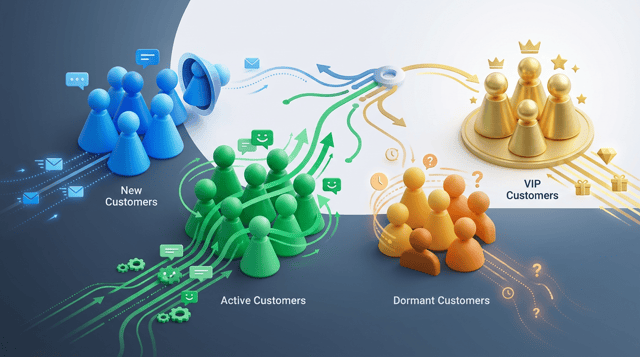
Driving results with CRM campaigns requires choosing the optimal approach for each customer segment—not applying the same playbook to everyone. To recap, for new customers use personalized welcome emails, onboarding sequences, and post-purchase follow-ups (Campaigns 1–3). For existing customers, deploy purchase-based cross-sells, renewal upsells, and early churn detection (Campaigns 4–6). For dormant customers, run segment-specific re-engagement and win-back campaigns (Campaigns 7–8). For VIP customers, offer exclusive experiences and NPS-driven proactive outreach (Campaigns 9–10).
Start by reviewing your CRM data, pick the segment with the highest potential impact, and run one campaign. Stacking small wins is the fastest path to advancing your overall CRM campaign maturity.

How to run pipeline management, focused on stage design. Covers why stages must be defined by the customer's state rathe...

How smaller companies should choose a CRM when nobody can be assigned to it full time. Covers five criteria — setup time...

A clear explanation of what advocacy means. Covers its two senses ('customers recommending a brand' and 'advocacy market...


