How to Decline a Job Offer in Japan: Email and Phone Examples
Published:
Last Updated:
Published:
Last Updated:
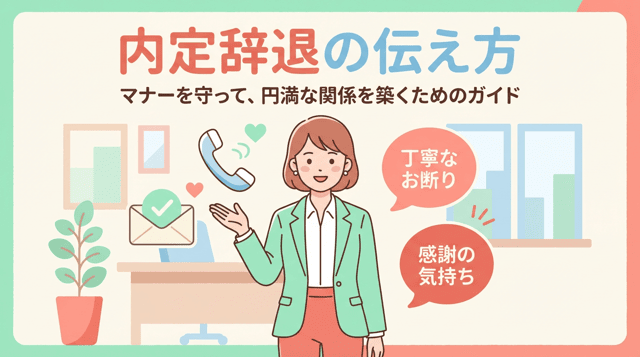
Category: Job Search Preparation & Interview Tips
Authors: Shusaku Yosa
Once you decide to decline a job offer, communicate promptly and make the decision clear. Check the employer's requested channel and the recruitment contact you have been using. Email can be appropriate; a phone call is not a universal requirement.
Start with the templates below, then review phone wording and points to consider after acceptance or near the start date. These are original, general examples. Replace the brackets with accurate details and do not invent a reason. English wording is suitable when English is an accepted communication language with the recipient; use the Japanese version of this article for Japanese templates.
Subject: Declining the offer for [role] — [name]
Dear [contact name],
Thank you for offering me the [role] position at [company]. After careful consideration, I have decided to decline the offer.
I appreciate the time you and the team spent with me during the selection process. I am sorry that I will not be joining you, and thank you for your consideration.
Best regards,
[name]
[contact details]
Subject: Withdrawal from accepted offer — [name], planned start [date]
Dear [contact name],
I am writing about the [role] position that I accepted, with a planned start date of [date]. After reconsidering, I have decided not to join the company and am notifying you of my withdrawal.
I apologize for changing my decision after accepting and for the disruption to your preparations. Please let me know about any necessary steps, including returning items already provided.
Thank you for your time and support during the process.
Best regards,
[name]
[contact details]
Sending this email does not necessarily complete every legal step. Review the agreement, start date, and any items to return, along with the contract notes below.
Subject: Declining the job offer — [name]
Dear [contact name],
I tried to reach you by phone and am following up by email. After careful consideration, I have decided to decline the offer for [role].
Thank you for your time throughout the selection process. I am sorry that I will not be joining the team. I would appreciate an acknowledgment that you have received this message.
Best regards,
[name]
[contact details]
Remove the reference to a phone call if you did not make one. You do not need to withhold written notice while repeatedly trying to reach someone by phone.
Subject: Declining [company]'s offer — [name]
Dear [agent name],
After considering the offer from [company], I have decided to decline it. My reason is [brief, accurate explanation you are comfortable sharing].
My decision is final. Please inform the company. The response deadline is [date]; could you confirm when the message has been passed on and whether any direct action is needed from me?
Thank you for supporting me through the process.
Best regards,
[name]
[contact details]
Agree who will contact the employer and by when. Whether you also need to communicate directly depends on the process. Avoid sending inconsistent messages through different channels.
Situation | Practical approach |
|---|---|
Before acceptance, with email-based recruitment | Email the recruitment contact with your name and clear decision |
The employer specifies a channel | Use that contact route and retain your message |
After acceptance or close to a deadline or start date | Keep a written record and consider calling during business hours to speed communication |
Phone contact fails or is difficult for you | Send the decision in writing first and discuss any follow-up needed |
Through an agent or school recommendation | Promptly contact the responsible adviser and agree how to notify the employer |
These are communication suggestions, not rules that make a particular channel sufficient to resolve every contractual issue.
Prepare your name, role, contact person's name, and decision in advance. Call during the employer's business hours and ask whether the person has time. There is no universally best time of day for every company.
“Hello, my name is [name]. I received an offer for the [role] position. May I speak to [contact name]?”
“Do you have a few minutes? Thank you for the offer. After careful consideration, I have decided to decline it. I appreciate the time you spent with me during the selection process, and I am sorry that I will not be joining the team.”
If you already accepted, add an apology for changing your decision after acceptance. Record the date, contact, message, and any procedures discussed. When useful, follow up with the same information by email.
If the decision is final, avoid wording that suggests you are still asking whether to decline. You do not need to invent illness or a family problem to avoid discussing details.
There is no need to volunteer the other company's name or a comparison of compensation. If you would accept with different conditions, discuss those conditions first rather than mixing negotiation with a final withdrawal.
Check the actual response deadline and proposed start date. Those dates matter more than a generic recommendation such as replying within a week. If you need more time, request an extension and propose a specific answer date before the deadline; an extension is not guaranteed.
Check the recipient address, sent folder, and delivery errors. If the situation is not urgent, one or two business days can be a practical follow-up interval. If a deadline or start date is close, use phone or another appropriate contact route sooner. Silence alone does not establish receipt or agreement.
This section provides general information for Japan based on official sources checked on September 15, 2026. The effect of an individual agreement depends on the offer, acceptance process, contract duration, and other facts.
An employment contract may already have formed at the offer stage. You can consider withdrawal after signing, but should not treat the arrangement as an informal promise requiring no review. See the Ibaraki Labour Bureau's explanation of job offers (Japanese).
Kyoto's graduate-support Hello Work guidance (Japanese) discusses withdrawal after acceptance in relation to Civil Code Article 627. Fixed-term contracts can involve different rules; see the Osaka Labour Bureau's explanation of indefinite and fixed-term contracts (Japanese).
Nor should you assume withdrawal is entirely impossible when fewer than two weeks remain. Communicate without delay, review the documents, and seek individual advice where necessary.
Labour Standards Act Article 16 prohibits agreeing in advance on penalties or predetermined damages for breach of an employment contract. This does not mean every claim about actual loss is automatically invalid. Ask for the demand and its basis in writing and seek advice before paying or signing. See the Kumamoto Labour Bureau's offer and withdrawal guidance (Japanese).
If your decision is final, keep the response short: “Thank you for the suggestion. I have considered it carefully, and my decision to withdraw remains unchanged.” You do not need to keep adding reasons.
If you face intimidating behavior, a payment demand, or uncertainty about the agreement, collect the offer, acceptance document, emails, and dated call notes. Contact a General Labour Consultation Corner (Japanese) or a lawyer as appropriate. Students can also ask their school's career office. A polite message cannot guarantee a calm response or the absence of a dispute.
That depends on the company's recruitment policy. Courteous withdrawal does not guarantee eligibility or selection in a later application. Check the relevant vacancy information.
Yes, but check each company, contact, role, name, and date, and send messages separately. Do not expose other companies' contact details in CC fields.
If you have already decided, one message can express thanks and decline. If you are still considering the offer, see our job-offer thank-you email guide.
Before deciding, our guide to checking an offer letter can help you review conditions. Once you decide, communicate clearly and address the necessary follow-up steps.
Find more of our articles on Google
A certificate of resignation in Japan must be issued by your employer on request, and is distinct from the separation no...
Under Japanese civil law, employment with no fixed term ends two weeks after you give notice, regardless of whether you ...
Japanese resident tax is charged on the previous year's income and deducted from June to May. Leaving between January an...


