What Is a Letter of Identity Guarantee? How to Write It, Fill-in Examples, and FAQs
Published:
Published:
Last Updated:
Category: Job Search Preparation & Interview Tips, Job Change
Authors: Shusaku Yosa
When you're asked to submit a "letter of identity guarantee" upon joining a company, it's common to be puzzled: "What is this document?", "Who should I ask?", and "How do I write it?" A letter of identity guarantee is a document in which a guarantor promises to bear a certain responsibility if the employee causes damage to the company. This article explains, in an easy-to-understand way, from the basics of what a letter of identity guarantee is, to how to write it and fill-in examples, and frequently asked questions such as its validity period and what to do if you have no guarantor.
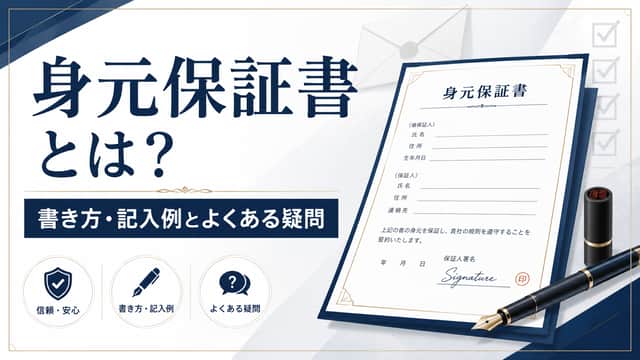
A letter of identity guarantee is a document in which an identity guarantor promises to bear a certain responsibility on behalf of (or together with) a newly joining employee, in cases such as when the employee causes damage to the company. As part of the onboarding procedure, it is requested for the purpose of confirming the person's identity and preparing for the company's risk. In most cases, the person and the guarantor each sign and seal it and submit it to the company.
A letter of identity guarantee is mainly requested in situations such as the following.
Whether submission is required and the format differ by company. Generally, a company-designated form is handed to you, so fill it in according to that form.
An identity guarantor is assumed to be an adult who is independently making a living, and it is common to ask a parent or relative. Depending on the company, there may be specifications such as "two are required," "one of them must be a non-relative," or "certain age or income conditions." First, check the conditions the company requires, and ask someone you trust who will take it on.
A letter of identity guarantee is generally divided into a section the person fills in and a section the identity guarantor fills in. Let's look at the fill-in items for each.
As a fill-in example, in the person's section you would write "Name: Taro Yamada / Address: ___ Prefecture, ___ City... / Date of birth: ___ / Joining date: ___," and in the guarantor's section "Name: Ichiro Yamada (signature) / Address: ... / Relationship: father / Maximum amount: ___ yen." Follow the company-designated form and make sure there are no blanks or omissions.
First, consult the company's HR representative. There are cases where a non-relative is accepted, or where the number of guarantors can be adjusted. Depending on the circumstances, submitting a letter of identity guarantee may not be mandatory, so rather than carrying it alone, consulting is recommended.
Under the law concerning identity guarantees, when a period is set, it is at most five years, and when no period is set, it is in principle three years. Depending on the company, renewal may be requested at regular intervals.
It depends on the company's instruction. In some cases a personal seal is sufficient, while in others a registered seal and a seal-registration certificate are required to be attached. Before submitting, confirm the company's instructions.
Submission depends on company rules, but it is often required for onboarding procedures, and refusing may affect your joining. If you have concerns about the content or the maximum amount, rather than refusing, consult the HR representative and confirm the content.
A letter of identity guarantee is an onboarding document in which a guarantor promises to bear a certain responsibility if the employee causes damage to the company. Keep in mind that the 2020 Civil Code revision made stating the maximum amount necessary, and fill in the person's section and the guarantor's section correctly according to the company's form. It is important to explain the content well to the guarantor and have them sign and seal it with understanding. Confirm any unclear points with the company's HR representative, and proceed with the onboarding procedure with peace of mind.
* The handling of identity guarantee contracts differs depending on the company and individual circumstances. If you are unsure about a decision, we recommend consulting the company's HR representative or a specialist.

A certificate of resignation in Japan must be issued by your employer on request, and is distinct from the separation no...

Under Japanese civil law, employment with no fixed term ends two weeks after you give notice, regardless of whether you ...

Japanese resident tax is charged on the previous year's income and deducted from June to May. Leaving between January an...


