Authors: Shusaku Yosa
"I want to change jobs, but I don't know where to start" or "My current workplace doesn't feel right, but I don't want to repeat the same mistakes" — ISFPs (Adventurers) often find themselves wrestling with these concerns.
While ISFPs possess a delicate sensitivity and strong empathy, they also tend to struggle with self-promotion and procrastinate on decisions. This means that standard career change advice doesn't always work for them. ISFPs need an approach tailored to their unique personality.
In this article, we cover the common pitfalls ISFPs face during career changes, tips for choosing jobs that leverage their strengths, and a practical step-by-step guide to navigating the job search process smoothly.
To make a successful career change, ISFPs first need to understand how their personality type affects the job search process. ISFPs are an MBTI type with four traits — Introverted (I), Sensing (S), Feeling (F), and Perceiving (P) — known as the "Adventurer" on 16Personalities.
ISFP career change strengths include the ability to instinctively sense when an environment isn't right, strong adaptability to new settings, and a talent for reading people's energy. On the flip side, weaknesses like difficulty articulating strengths for self-promotion, decision paralysis when facing too many options, and choosing based on feeling rather than facts can become barriers. With these traits in mind, let's look at specific strategies.
By understanding where ISFPs typically stumble, you can avoid repeating the same mistakes. Here are five common pitfalls.
ISFPs are highly sensitive to their environment, which means they feel workplace discomfort intensely. As a result, they may decide to leave based solely on the desire to escape, without clarifying what they actually want next. While leaving a bad situation isn't inherently wrong, moving without defining what matters in your next role increases the risk of landing in another poor fit.
ISFPs have excellent intuitive judgment, but sometimes choose a new employer based purely on feelings like "the interviewer seemed nice" or "the office had a great atmosphere." While valuing workplace vibes is a genuine ISFP strength, neglecting objective factors like salary, job responsibilities, and career growth can lead to post-hire disappointment.
ISFPs struggle to verbalize their strengths and achievements. Their belief that "good work should speak for itself" can result in resumes that don't adequately convey their value. Instead of simply listing tasks, focus on communicating the value you delivered.
ISFPs' Perceiving nature makes them think "there might be something better out there," leading to indefinite postponement. Reviewing multiple listings, comparing them, then searching for more — this cycle can easily consume six months or longer. Rather than searching for the perfect company, clarify your non-negotiable criteria and adopt a rule like "move forward when you're 80% satisfied."
ISFPs' conflict-avoidant nature can lead them to give agreeable answers in interviews even when they have concerns. For instance, when asked "We have a lot of overtime — is that okay?" an ISFP might say "That's fine" despite feeling uneasy. This creates post-hire mismatches. Remember that interviews are not just about selling yourself — they're also your chance to assess whether the workplace suits you.
For ISFPs to succeed in career changes, choosing workplaces that align with their personality traits is essential. Here are key principles for strengths-based job selection.
The first priority for ISFPs should be work style rather than job title or duties. The same role can vary dramatically between companies in terms of autonomy, communication frequency, and team size. ISFPs thrive in environments that offer reasonable autonomy and let them work at their own pace. Look for keywords like "high autonomy," "remote work available," and "small team" in job listings.
ISFPs sometimes find it difficult to articulate what they want. In that case, start from the opposite direction — list what you absolutely want to avoid. Items like "can't stand repetitive daily tasks," "frequent large-audience presentations would be unbearable," or "quota-driven sales isn't for me" create an "avoidance list" that naturally narrows your options and reveals a clear direction.
ISFPs cannot sustain motivation in work that conflicts with their values. When evaluating potential employers, check whether the company's vision and business align with your personal values. Ask yourself: "Do I believe this company's service genuinely helps people?" and "Could I take pride in this work?" For ISFPs, long-term career satisfaction depends not just on salary or brand recognition, but on whether you can wholeheartedly connect with the work.
For ISFPs, compatibility with managers and team members directly impacts job satisfaction. During interviews and informal meetings, go beyond job duties to ask about management style, communication frequency, and meeting culture. An ISFP's performance can vary dramatically depending on whether their manager micromanages or gives them space to deliver results independently.
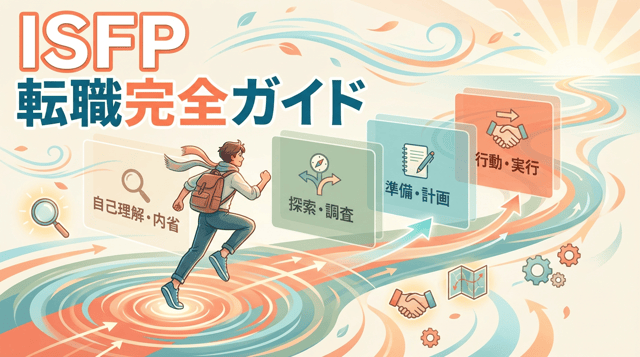
Here's a practical step-by-step guide for ISFPs navigating a career change. Incorporating ISFP-specific strategies at each stage will significantly improve your chances of success.
Rather than a skills inventory, ISFPs should begin with a "values inventory." Write down when you feel fulfilled, what makes you lose track of time, and what environments cause you stress. Since ISFPs struggle with articulation, keep it simple — bullet points in a notebook work perfectly. Don't aim for polished sentences.
As Sensing types, ISFPs often find it hard to judge from job listings and company websites alone. Actively seek out opportunities to experience workplace atmospheres firsthand — informal chats, office visits, and trial employment programs. The feel of the office, the tone of conversations between employees, the expressions on people's faces — these sensory cues are the most reliable decision-making inputs for ISFPs.
Resume writing is one of the biggest hurdles for ISFPs. Instead of listing duties, frame your experience as specific episodes. Write in a story format: "In this situation, I did this, and the result was this." Rather than abstractly stating "strong communication skills," try something like "I drew out a hesitant client's real concerns through casual conversation, which ultimately led them to accept our proposal." Stories resonate far more with hiring managers.
For ISFPs, interviews serve double duty — showcasing yourself and assessing whether the workplace fits you. Prepare thoughtful questions to ask, such as: "What's the communication style like on the team?" "How would you describe the manager's leadership approach?" and "How much autonomy do team members have in their work?" The answers to these questions will help ISFPs make intuitive judgments about compatibility.
When you receive an offer, pay attention to your physical response. Does thinking about the company make you feel excited, or does your stomach tighten? Even if the conditions look great on paper, a persistent sense of heaviness is worth trusting. For ISFPs, incorporating gut feelings alongside logical analysis of terms can dramatically reduce post-hire mismatches.
Given the ISFP personality, certain career change services and programs are particularly well-suited.
Informal chats with companies before formal interviews are extremely valuable for ISFPs. Since they're not part of the selection process, you can relax and be yourself while getting a direct feel for the company's culture and people. This is where ISFPs' strength in "judging by feel" is at its most powerful.
Trial employment programs that let you work at a company before committing are arguably the best-fit service for ISFPs. As experiential learners, ISFPs benefit far more from hands-on experience than written descriptions or verbal explanations. These programs prevent the "it was different from what I imagined" mismatch, so take advantage of them whenever possible.
If using a recruitment agency, choose one that takes time to listen rather than mechanically sending job listings. Since ISFPs struggle to articulate their preferences, agents who draw out latent desires through conversation are the best match. Use the first meeting as a litmus test: "Did they really listen to what I had to say?"
Finally, here are some important mindset principles for ISFPs navigating a career change.
First, accept that "the perfect workplace doesn't exist." ISFPs can get stuck searching for a place that's 100% satisfactory. Every workplace has its downsides. What matters is whether your non-negotiable criteria are met.
Second, stop comparing your career with others'. ISFPs are attuned to their inner values, which means watching friends or colleagues succeed can trigger envy. But someone else's "right answer" isn't necessarily yours. For ISFPs, trusting your own values and sensibilities to find "your right answer" is what matters most.
Third, give yourself permission to "think while moving." ISFPs aren't the type to plan everything perfectly before acting. Start small — attend one informal company chat, update a section of your resume. These tiny actions get the ball rolling naturally. Instead of waiting until everything is ready, course-correct as you go. This approach maximizes the ISFP's natural flexibility.
Most career change struggles for ISFPs stem from trying to follow generic advice that doesn't fit their personality. ISFPs have their own strengths-based approach to career changes.
The ability to assess environments through feeling, values-based decision making, and flexible adaptation to new settings — these are the ISFP's career change superpowers. Trust your ability to "feel," gather information through experience, and start with small actions. When you do, your career change will succeed.
You don't need a perfect plan. Just sign up for one informal company chat, or update a small part of your resume — that small first step is the starting point for a career that's authentically yours.

A comprehensive guide to ISFP (Adventurer) personality traits. Explore the ISFP through all four MBTI indicators, discov...

Discover 15 carefully selected careers ideal for the ISFP (Adventurer) personality type. Learn how to leverage ISFP stre...

An in-depth guide to MBTI compatibility focused on workplace relationships. Learn boss-type strategies, high-compatibili...