Published:
Last Updated:
"I've decided to leave, but I have no idea where to start." "There are so many forms and procedures—I'm worried I'll miss something." "When is the best time to break the news?" If you're starting to think about resigning, these are concerns nearly everyone runs into. Resignation isn't something you go through often, so feeling anxious—especially the first time—is completely natural.
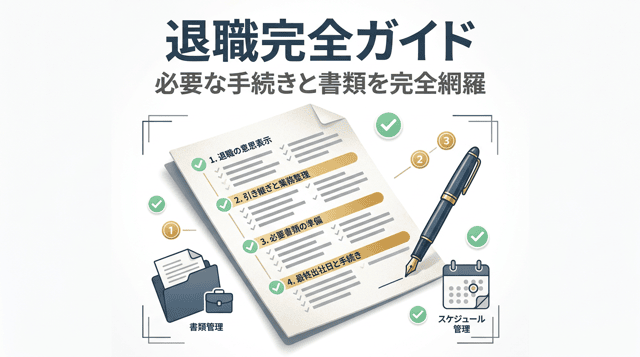
Resignation is roughly a two- to three-month process, from giving notice through your last day at the office and on through the public-side procedures afterward. Get the order wrong, or miss receiving a key document, and you can end up with delayed unemployment benefits, a gap in your health insurance, or other unexpected disadvantages. This article organizes the entire flow of resignation along three axes—"when, what, and where"—presents a checklist of required documents, covers reason-specific cautions, and gives you a single complete guide to resignation.
Before getting into the specific procedures, let's organize the legal rules and basic terminology around resignation. Get this right and you won't get lost in negotiations or document handling later.
Article 627 of the Civil Code provides that, in employment contracts of indefinite term, an employee can resign once two weeks have passed since giving notice. In other words, legally, two weeks' notice is enough for resignation to take effect. That said, many companies' work rules require giving notice "one to three months in advance," and in practice giving one to three months is the norm.
Where work rules and the Civil Code conflict, the Civil Code prevails in the end. Even so, considering handover and replacement hiring, pushing through with two weeks tends to lead to friction, and a realistic target—if you're aiming for an amicable resignation—is at least one month, ideally one and a half to two months.
A "resignation request" (taishoku-gan) asks the company to accept the employee's wish to resign and can be withdrawn until accepted. A "resignation notice" (taishoku-todoke) is a definitive declaration of intent to resign, and once submitted, it cannot in principle be withdrawn. The term "resignation letter" (jihyou) is reserved for officers and public servants; ordinary employees do not use it.
In practice, the common flow is to communicate intent verbally to your manager first, then submit a "resignation notice" once you've reached agreement. For the details of writing and submission, see "How to write and submit a resignation notice—templates, the difference vs. resignation request, and timing," and "How to write a resignation-notice envelope and its etiquette—size, color, and writing style."
Reasons for resignation fall broadly into "voluntary" and "company-initiated" categories, with significant differences in unemployment benefits and severance treatment. Voluntary resignation covers leaving for reasons such as a job change, marriage, or family circumstances and includes a two-month waiting period before unemployment benefits begin. Company-initiated resignation covers bankruptcy, layoff, dismissal-encouragement, and the like; there's no waiting period, benefits start from the eighth day after resignation, and the duration is set longer than for voluntary resignation.
The reason recorded on your separation slip largely shapes the procedures that follow. For details, see "Company-initiated resignation: differences from voluntary, unemployment benefits, and procedures."
Working backwards in time from the day you decide to leave to your last day in the office is the smoothest way through. As a general guide, here's the action schedule starting three months out.
Once your decision to resign is firm, first check your work rules for the deadline to submit notice. Also confirm your remaining paid leave, severance rules, and the items you'll need to return at the end. If you're planning to line up your next role first, this is the period to ramp up the job search and secure an offer. If you're still on the fence, the article "When you start thinking 'I want to quit'—self-check the cause and choose your next action" can help you organize the decision.
Verbally, to your direct manager first—that's the etiquette. Telling colleagues or a different team first lets the news reach your manager indirectly and undermines trust. The standard approach is to set up a calendar appointment, find a private space such as a meeting room, and start with "I'd like to discuss something with you." For specific phrasing and how to handle pushback, see "How to tell your manager you're leaving—how to bring it up, timing, and examples for an amicable resignation."
Once you and your manager are aligned, lock in the resignation date and submit the resignation notice. Begin building the handover plan in earnest from this point.
Build out handover documentation and start transferring duties to your successor or to colleagues. Greetings to clients and partners should also be planned with your manager from this point. The plan for using up remaining paid leave is also coordinated with your manager during this window. Legally, you can take paid leave freely up to the last day; the etiquette is to choose periods that don't disrupt operations.
From around two weeks out, start sending resignation greetings internally and externally. Internal greetings are typically sent the day before or on your last day; greetings to external partners go out two to three weeks before your last day. For wording, see "Resignation greetings—examples of internal email, in-person speeches, and partner email, with etiquette."
In parallel, check your list of items to return—company-issued PC, ID badge, business cards, health insurance card, etc.—and make sure none have gone missing. Preparing the document-receipt checklist (covered later) at the same time keeps the last day from becoming hectic.
On the last day (your final day in the office), in most cases the work itself is wrapped up, and the focus is on administrative formalities and goodbyes. Return everything without omission, receive your documents, and make time for direct goodbyes to those who supported you. There are documents you'll receive on the last day and others that arrive by mail later, so confirm your address and contact details on file are current.
"When you give notice" significantly shapes whether your resignation goes amicably. Beyond the legal constraints, take the workload calendar and the company's evaluation cycle into account when picking your moment.
Closing periods, fiscal year-end, and the climax of major projects—giving notice during peak workload tends to make handover insufficient and worsens manager and colleague sentiment. If possible, the best moments are right after a peak settles down—a quieter window—or aligning with the wrap-up of a major project.
Bonuses depend on the company's rules, but most commonly the eligibility condition is "being on the roster on the payout date." Setting your resignation date to the day after the bonus payout date makes it easier to receive the full or rule-based amount. Note that some work rules include clauses such as "resignation submitted within X months of the payout date triggers a reduction," so always check in advance.
Whether your last day falls at month-end or mid-month changes your social-insurance burden. Resigning on the last day of the month means staying enrolled in the company's social insurance through that month before losing coverage, and switching to National Health Insurance and the National Pension from the next month. Mid-month resignation means you have to pay National Health Insurance premiums yourself starting from the resignation month. If your next role isn't lined up immediately, choosing a month-end resignation can sometimes save you a month of switchover handling.
If you want to fully use up paid leave by the last day, design your last day in the office and your formal resignation date as different dates. For example, your last day in the office is mid-month; you then take paid leave through to the end of the month, which is the official resignation date. Stack the remaining days against the work schedule and align with your manager early. For when negotiations and pushback don't go smoothly, see "A complete guide to amicable resignation—how to handle pushback, with steps to your last day."
Make a list of everything to return on your last day, with no omissions. Failing to return something can lead to mailing back and forth later, and in the worst case to liability for damages. Run through everything once the day before, just in case.
Employee ID, ID card, lapel pin, building-access security card, desk and locker keys—anything that identifies you as a member of the company or that you used for entry should all be returned. Cards used for the company cafeteria or staff store fall in this group as well.
Health insurance cards issued via the company are returned on the last day in principle. Don't forget cards for any dependents covered under your plan. They become unusable from the day after resignation, so if you'll see a doctor after the last day you'll need new coverage in place.
Work PC, smartphone, tablet, mobile Wi-Fi, USB drives, paper documents, uniforms, stationery, bags, leftover business cards—anything provided by the company is in scope. For remote-work setups where equipment is at your home, either come into the office before your last day to return it, or coordinate a courier return with your manager.
Hand over to your successor everything related to the work—internal documents, customer lists, contracts, in-flight project data. Be sure to delete any work data you'd downloaded onto a personal PC after handover. Information leakage can incur liability even after you've left.
The documents the company issues you at resignation are required for procedures at your next employer, applying for unemployment benefits, switching health insurance and pension, filing taxes, and so on. Understand the timing and use of each, and collect them all.
Required to file for unemployment benefits (basic allowance). After your resignation the company applies to Hello Work; once issued, the slip is mailed to you. The typical arrival window is 10 days to two weeks after resignation, but some companies don't issue it unless you ask, so tell HR before you leave: "I'd like to receive the separation slip." If you've already secured your next role and don't need it, getting it anyway helps if you re-resign quickly or if it factors into childcare-leave-benefit calculations later.
A document certifying enrollment in employment insurance—your next employer needs it to register you. Many companies hold onto it for you, so be sure to ask for it back when you resign.
Lists your salary and income tax from January through your last day; used at year-end adjustment at your next employer or in your own tax filing. The law requires issuance within one month of your last day. If you start a new role within the year, hand it to that employer; otherwise (or if your new role isn't decided by year-end), use it for your own tax filing the following year.
A document certifying enrollment in the public pension system. If your company was holding onto it, be sure to ask for it back. Since April 2022 the pension book has been discontinued for new issuance and replaced by the "basic-pension-number notice." Many situations now accept My Number as well, but it's safer to receive whatever the company has on file.
Certifies that you left your previous employer and is used when your next employer or a public agency asks for proof. Article 22 of the Labor Standards Act obligates the company to issue it on request. The contents are employment period, reason for leaving, last role, employment type, and so on; you can ask to omit fields you'd rather not include. Even if you don't need it right after resignation, getting it at the time saves trouble later.
Proves you've left the company's health-insurance plan; required when joining National Health Insurance. The company can issue it, or you can get it at the pension office. If you start your next role right after resignation, your new employer handles enrollment so you won't need this; if there's any gap, it's required.
After resignation you handle health insurance, pension, taxes, and unemployment benefits yourself. Each has a deadline, so move on a plan starting the day after your last day.
There are three options for post-resignation health insurance. First, voluntarily continue your previous plan (up to two years). The application must be filed within 20 days of resignation, and you bear the full premium. Second, enroll in your municipality's National Health Insurance. The procedure is at your local government office within 14 days of resignation. Third, become a dependent on a family member's plan. Income-eligibility conditions apply and the family member's employer handles the procedure.
Premiums vary substantially across the three options, so pick the one that fits your expected income and family situation. If you're not sure, talking to your company's HR or your local office gives you a confident answer.
Switching from Employees' Pension to the National Pension (Category 1 insured) is done at your local government office within 14 days. To enter your spouse's dependent plan, you become a Category 3 insured and the spouse's employer handles the procedure. If your next role is set, the new employer handles Employees' Pension enrollment, so you don't switch yourself.
If unemployment makes paying premiums difficult, you may qualify for premium exemption or grace measures. Ask the pension office or your local office about it.
The eligibility window is in principle one year from the day after resignation. Once your separation slip arrives, register as a job seeker and file for benefits at your local Hello Work. Required documents include the separation slip, ID, My Number documentation, two photos, and a passbook or bank card in your own name.
For voluntary resignation, benefits begin after a two-month waiting period (two months for the first two voluntary resignations within five years; three months from the third). For company-initiated resignation, no waiting period—benefits start from the eighth day, and the duration is longer. While receiving benefits, you must report to Hello Work on a recognition date once every four weeks and report your job-search activity.
Resident tax is calculated on the previous year's income and paid from June of the following year through May of the year after. While employed, it was deducted from payroll (special collection), but resignation changes the collection method. For resignation in January through May, the remaining year's tax is collected in lump sum from the resignation-month payroll or severance; for June through December, it switches in principle to ordinary collection (you pay yourself with a payment slip mailed to your home).
If you start a new role right after resignation, you can also choose to continue payroll deduction (continuation of special collection) at the new employer. The previous and new employers exchange a "transfer notice for income earner under special collection," so consult HR early.
If you resign mid-year and don't start a new role within that year, you'll need to file taxes yourself. The deadline is around March 15 of the following year; submit to the tax office along with your withholding-tax slip, premium-deduction certificates, medical-expense receipts, and so on. In many cases, the year-end adjustment that didn't happen would have produced a refund, so make sure you file.
Beyond the standard flow, there are extra cautions depending on your situation. Here are four common cases and how to handle each.
The basic rules during probation are the same as after probation. Two weeks' notice is enough by law, but you must check the work rules. The worry about a short tenure is real, but enduring a misfit and dragging it out can be worse for your next career than leaving early. For details, see "Quitting during probation: steps, how to tell, and the impact on the job search."
It's not uncommon to be strongly urged to stay when you give notice. A salary bump, promotion, or department change can shake your resolve. But pushback comes from the company's needs, and staying without resolving the original reason often leads to wanting to leave again over the same issue. For specific tactics, see "A complete guide to amicable resignation—how to handle pushback, with steps to your last day."
If you're being let go on company terms or being encouraged to leave, you receive more favorable treatment than voluntary resignation in unemployment benefits, severance, and social-insurance reductions. What's recorded in the reason field of the separation slip is critically important. If something that should be company-initiated gets logged as voluntary, a waiting period kicks in and you're financially worse off. For confirmation methods and how to file an objection, see "Company-initiated resignation: differences from voluntary, unemployment benefits, and procedures."
Harassment, severe stress that makes going to the office impossible, or a refusal to accept your resignation—there are situations where direct negotiation isn't realistic. In those cases, a resignation-agency service is a viable option. Whether the operator is a private company, a labor union, or a lawyer changes the scope of what they can do (negotiation rights, claiming unpaid wages, paid-leave negotiation), so the right pick depends on the situation. For details, see "Resignation-agency services compared—fees, reviews, how to choose."
Knowing the common mistakes during the resignation process drastically reduces the risk of a non-amicable exit. Here are the five most frequent NG actions.
Wanting to confide in a colleague is natural, but rumors spread shockingly fast. If the news reaches anyone before your manager, you damage their trust, and negotiations get much harder. The order of who hears first must always be: direct manager.
"I'm leaving anyway" is a tempting attitude that leads to sloppy handover, follow-up calls after you've left, or—at worst—damages claims. Build your handover documentation to a level where the work runs even if your successor isn't around, and prepare answers for likely questions. That's a professional finish.
"The relationships were toxic," "the pay was too low"—turning grievances directly into your stated reason hands the company material for pushback negotiations and sours your standing internally. Tighten the reason into something pushback-resistant, like "for a career step" or "for family circumstances." The same applies in interviews; for the wording, see "How to talk about your reason for changing or leaving—examples that play well in interviews."
There are multiple documents to receive at resignation—separation slip, withholding-tax slip, employment-insurance enrollee certificate, and more. Missing any of them delays unemployment-benefit applications or trips you up at tax-filing time. Build a checklist before you leave and verify both at your last day and again when post-resignation mail arrives.
The relief of having left can lead some people to vent on social media about their previous employer or manager—a major risk. Posts can be seen by people connected to your next employer, and your reputation in the industry can suffer. After resignation, keep public messaging in a tone of "I'm grateful for the experience." That's the rule.
Civil Code: two weeks after the notice. In practice many work rules require one to three months, and aiming for an amicable exit, one month is the floor and one and a half to two months is realistic. Considering handover and paid-leave use, giving notice early often turns out to be in your own interest.
A resignation notice is a definitive declaration of intent at the moment of submission, so in principle once submitted it cannot be withdrawn. Withdrawal requires the company's agreement. By contrast, a resignation request can be withdrawn until accepted. If you're not fully resolved, talking through it verbally first or submitting a request rather than a notice is the safer route.
The Labor Standards Act recognizes paid leave as the worker's right, and using up the remainder by your last day is possible. The company has a right to shift timing, but it cannot push it past your last day, so paid-leave use just before resignation effectively gets recognized. The amicable-exit point is to coordinate with your manager early so operations don't break.
Severance timing depends on the company's rules, but it's commonly paid within one to two months after resignation. Some companies pay three to six months later; check work rules and the severance regulations. If your company offers a choice between lump-sum and annuity-style payouts, factor in the tax implications when you decide.
The daily allowance for unemployment benefits (basic allowance) is roughly 50–80% of your average daily wage over the prior six months, with a higher percentage for lower wage levels. The number of days depends on length of employment-insurance enrollment, reason for resignation, and age—roughly 90–150 days for voluntary resignation and 90–330 days for company-initiated. Hello Work can confirm your specifics individually.
It's possible, but understand the income gap and the self-paid health-insurance and pension contributions. Searching while still employed has time constraints but the financial calm to negotiate; searching after resignation gives you free time, but a long search drives anxiety. Weigh living-cost reserves, the job-market climate, and whether continuing in your current role is viable.
The separation slip, withholding-tax slip, and certificate of resignation are subject to issuance obligations on the company. If they don't respond when contacted, take it to the relevant authority—Hello Work (separation slip and employment-insurance items), the tax office (withholding-tax slip), the Labor Standards Inspection Office (certificate of resignation). These agencies have authority to direct the company, and you can usually get the documents issued.
Resignation is roughly a two- to three-month process, from giving notice to wrapping up post-resignation procedures. Map the entire process in time order and prepare the document checklist early, and you can step into the next career without omissions or trouble. To recap the points: legal notice is two weeks, but realistic for an amicable exit is one to two months; manage both items to return and documents to receive with checklists; deadlines on health insurance, pension, resident tax, and unemployment benefits mean you act on a plan from the day after resignation; and depending on the situation, resignation-agency services or the Labor Standards Inspection Office are external options worth using.
If you'd like to dig into individual themes, the related articles are linked below. For how to bring up resignation, see "How to tell your manager you're leaving—how to bring it up, timing, and examples for an amicable resignation." For the resignation notice itself, see "How to write and submit a resignation notice—templates, the difference vs. resignation request, and timing." For the path to an amicable resignation, see "A complete guide to amicable resignation—how to handle pushback, with steps to your last day." For greetings, see "Resignation greetings—examples of internal email, in-person speeches, and partner email, with etiquette." For company-initiated resignation, see "Company-initiated resignation: differences from voluntary, unemployment benefits, and procedures." Prepare carefully and step into the next role with confidence.

A certificate of resignation in Japan must be issued by your employer on request, and is distinct from the separation no...

Under Japanese civil law, employment with no fixed term ends two weeks after you give notice, regardless of whether you ...

Japanese resident tax is charged on the previous year's income and deducted from June to May. Leaving between January an...


