Published:
Last Updated:
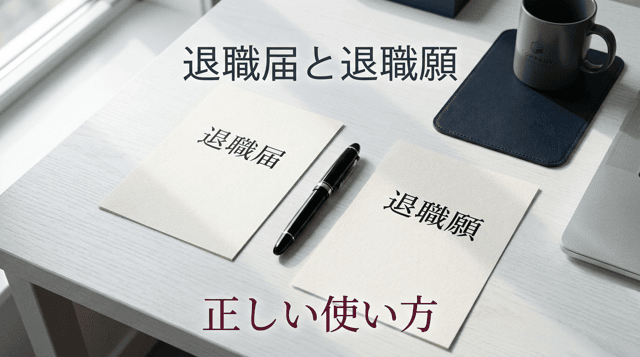
When you decide to leave your job in Japan, one of the first hurdles is knowing the difference between a taishoku-negai (resignation request) and a taishoku-todoke (resignation notice). The names are similar, but they differ in legal meaning, timing, and whether they can be withdrawn. Submitting the wrong one can derail an amicable exit or cause unexpected trouble.
This article explains the fundamental difference between the two documents, the correct way to write each, submission etiquette, and ready-to-use templates. Even first-time resigners will be able to handle the process with confidence.
Both are documents you submit when leaving a company in Japan, but their nature is quite different. In short, a taishoku-negai is a document that requests resignation, while a taishoku-todoke is a document that notifies the company of your resignation. Without understanding this difference, you may find yourself unable to withdraw your request, or unable to communicate your intent clearly.
A taishoku-negai is a document used to ask your company to accept your resignation. Since it is positioned as a 'request,' your resignation is not finalized until the company accepts it. Conversely, you can withdraw the request after submitting it, as long as the company has not yet accepted it.
It is generally chosen when you want to leave room for negotiation, such as 'there's still a chance I'll stay depending on the conditions,' or when you want to maintain a good relationship with your supervisor for an amicable departure.
A taishoku-todoke is a document that unilaterally notifies the company of your resignation. It is a definitive expression of intent from the employee and does not require the company's acceptance. Once submitted and received, it generally cannot be withdrawn.
Under the Japanese Civil Code, for employment contracts with no fixed term, an employee can leave two weeks after giving notice. So if you want to show a strong intent to resign, or if you're facing strong attempts to retain you, submitting a taishoku-todoke is an effective approach.
A jihyo is a similar document, but it is generally not submitted by regular employees. A jihyo is used by company executives (such as presidents or directors) who do not have an employment relationship with the company, or by public servants resigning from their position.
Since regular salaried workers almost never submit a jihyo, be careful not to mistakenly write 'jihyo' as the title.
To make your departure smooth, timing is crucial. Here is the general flow from the moment you decide to leave to your final day at work.
The basic steps from deciding to resign to completing the process are roughly as follows:
Many companies specify in their internal regulations how many weeks of notice you must give. Check your company's rules first. Realistically, giving 1–2 months of notice is considered the norm.
The taishoku-negai is typically submitted after you have verbally communicated your intent to your direct supervisor and discussed the situation. Some companies don't require it at all, so check your company's rules and confirm with your supervisor.
Rather than submitting a taishoku-negai out of the blue, the ideal flow is to first ask for a moment to talk ('I'd like to discuss something'), communicate your intent, and then formalize it in writing.
The taishoku-todoke is submitted as the final administrative step after your resignation date has been officially agreed upon through discussion with your supervisor. If your company has a designated form, use it.
In cases where the company refuses to accept your resignation or strongly pushes back, you can also choose to submit a taishoku-todoke from the start to firmly establish your intent to leave.
Here we explain the specific way to write a taishoku-negai. The legal effect is the same whether handwritten or typed, but custom favors handwriting in vertical format as a more polite gesture. If the company instructs you to type it or provides a template, follow their lead.
Below is a basic example for a vertically-written taishoku-negai. On actual letter paper, the text would be written vertically.
─────────────────────────
Taishoku-negai (退職願)
Watakushigi (私儀)
Due to personal circumstances, I hereby respectfully request to resign from the company effective [Date] of [Month], Reiwa year [Year].
Reiwa [Year], [Month] [Date]
[Department] [Section] [Full Name] [Seal]
[Company Name] Co., Ltd.
President and Representative Director [Name] Dono (殿)
─────────────────────────
The taishoku-todoke is very similar in format to the taishoku-negai, but the closing wording and document title differ. The key difference is that it uses definitive 'I am resigning' language rather than 'I respectfully request to resign.'
A basic structural example for a taishoku-todoke is as follows.
─────────────────────────
Taishoku-todoke (退職届)
Watakushigi (私儀)
Due to personal circumstances, I will resign from the company effective [Date] of [Month], Reiwa year [Year].
Reiwa [Year], [Month] [Date]
[Department] [Section] [Full Name] [Seal]
[Company Name] Co., Ltd.
President and Representative Director [Name] Dono (殿)
─────────────────────────
The taishoku-negai and taishoku-todoke differ not just in title but in the decisive closing language. A taishoku-negai uses a request expression like 'I respectfully request to resign,' whereas a taishoku-todoke uses a declarative expression like 'I will resign.'
Legally, the nature of the document is judged by the content rather than the title, so be very careful not to mix up the wording.
Beyond the content itself, there are etiquette rules for choosing paper and envelopes. These details may seem small, but handling them carefully helps convey your sincerity.
Choose a plain white envelope without postal-code boxes. Brown envelopes are considered office stationery and are not suitable for a document as important as a resignation. A 'double envelope' with internal lining so the contents don't show through gives a more formal impression.
Choose an envelope sized to fit your tri-folded letter:
Write the document title ('Taishoku-negai' or 'Taishoku-todoke') vertically in the center of the front of the envelope. On the back, write your department's official name and your full name in the lower-left area.
Once the document is ready, it's time to submit it. There is also etiquette around who to give it to, when, and how. Get this right to avoid leaving a bad impression on the way out.
Hand-delivering to your direct supervisor is the basic rule. Skipping your direct supervisor and submitting directly to their boss or HR is considered poor business etiquette and can complicate negotiations. Always hand it to your direct supervisor first.
That said, if your relationship with your direct supervisor is extremely poor and they refuse to engage with your resignation, you may need to consider consulting a higher-level manager or HR.
Avoid busy work hours and choose a time when your supervisor is available. Booking time in advance with 'Could I have a moment of your time?' lets them prepare and makes the conversation smoother.
The location should be a private space such as a meeting room or office where other employees can't overhear. Avoid handing it over abruptly in an open workspace.
Hold the envelope with both hands and offer it to your supervisor. Make sure the front of the envelope faces them correctly, and add a brief comment such as 'Thank you for everything. I've brought my taishoku-negai (or taishoku-todoke).'
Hand delivery is the rule, but mail or email may be acceptable in unavoidable circumstances such as illness, injury preventing you from coming in, or working overseas. Even then, don't just send it unilaterally – consult your supervisor first and get their agreement before sending.
When mailing, use trackable methods such as registered mail ('Kan'i Shoryu') or 'Tokutei Kiroku Yubin' to avoid loss. Double-envelope it with the recipient's address on the outer envelope, and include a cover letter for added courtesy.
With the rise of remote work, more companies are accepting email submissions for resignations. Legally, written form isn't required, but check your company's rules before deciding.
To repeat: once a taishoku-todoke is submitted and accepted, it generally cannot be withdrawn. 'I changed my mind, please pretend it never happened' will not work.
A taishoku-negai, on the other hand, can be withdrawn before the company accepts it. Submit a taishoku-negai first if you want to leave room for negotiation or counter-offers.
Legally, the nature of the document is judged by its content, not by whether you titled it 'Taishoku-negai' or 'Taishoku-todoke.' Even if you write 'Taishoku-negai' but use definitive language like 'I am resigning,' it may be treated as a taishoku-todoke.
To avoid unintended consequences, make sure the title and content match.
For voluntary resignations, writing 'due to personal circumstances' (一身上の都合により) is standard and sufficient. You don't need to provide specific reasons. While you'll need to explain verbally to your supervisor, on the document itself, keep it concise.
However, for employer-initiated separations (layoffs, bankruptcy, etc.), write 'due to company circumstances' (会社都合により). The reason can affect eligibility for unemployment benefits, so be accurate.
When you communicate your intent to resign, your supervisor may try to retain you. To stay firm, prepare positive and hard-to-refute reasons such as 'for career advancement' or 'to challenge myself in a new field.'
If they still won't accept your resignation, you can submit a taishoku-todoke as a unilateral expression of intent. Under the Civil Code, indefinite-term employment contracts terminate two weeks after notice, so resignation is ultimately possible without the company's consent.
If you're aiming for an amicable exit, submitting a taishoku-negai first is the norm. It leaves room for negotiation and makes a better impression on your supervisor. If the company refuses to accept your resignation or your resignation date is already fixed, submit a taishoku-todoke.
Both have the same legal effect, but custom favors handwriting in vertical format. If the company instructs you to type it or provides a template, follow their guidance. If you're unsure, check with your supervisor.
Yes, it's standard to stamp your personal seal below your name. A 'shachihata' (pre-inked stamp) is often not accepted as an official seal, so use a 'mitomein' that requires red ink paste. A registered seal (jitsuin) is not required.
Legally, resignation takes effect two weeks after notice, but realistically, allowing 1–2 months for handover and finding a successor is preferable. Follow any specific notice period stated in your company's internal regulations.
If they refuse to receive it, you can send it by certified mail (Naiyo Shomei Yubin) with delivery confirmation. This creates an official record of 'when, who, and what was sent,' which serves as evidence if needed. Even without the company's consent, the Civil Code allows resignation two weeks after notice.
The taishoku-negai and taishoku-todoke look similar but differ significantly in legal meaning and role. Remember: taishoku-negai is a 'request,' taishoku-todoke is a 'notice.' Keeping this distinction in mind makes it easier to choose the right one.
From timing and writing to envelope choice and hand-delivery etiquette, attending to each detail makes resignation negotiations much smoother. Maintaining a sincere attitude until your final day is the shortest path to an amicable departure.
Resignation is also the first step toward a new career. Use the templates and etiquette in this article as a reference, and step confidently into your next chapter.

A certificate of resignation in Japan must be issued by your employer on request, and is distinct from the separation no...
Under Japanese civil law, employment with no fixed term ends two weeks after you give notice, regardless of whether you ...

Japanese resident tax is charged on the previous year's income and deducted from June to May. Leaving between January an...


