Published:
Last Updated:
Category: Work Styles
Authors: Shusaku Yosa
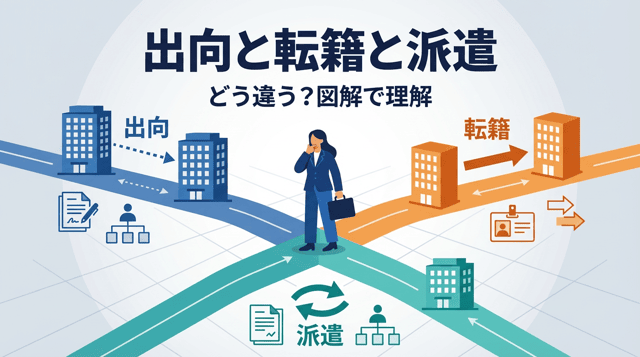
Shukko (出向), a uniquely Japanese form of personnel transfer, is an arrangement in which an employee continues to work for another company (the host company) while either maintaining or terminating their employment contract with their original employer. While similar arrangements like 'tenseki' (permanent transfer) and 'haken' (worker dispatch) exist, shukko differs significantly in terms of who holds the employment contract, the duration, and which company is responsible for salary and social insurance.
This article provides a comprehensive guide to shukko, covering the definition, the difference between in-service secondment (zaiseki shukko) and transfer secondment (tenseki shukko), comparisons with worker dispatch and other personnel transfers, the typical period, salary treatment, social insurance handling, paid leave, retirement benefits, and the legal framework around secondment orders—essential knowledge for both employees receiving such orders and HR professionals administering them.
Shukko refers to a personnel transfer in which an employee works under the direction of a different company (the host company), either while remaining employed by their original company (the home company) or after terminating that employment. Unlike a normal internal transfer (ido) or a relocation (tenkin) that only changes the workplace location, shukko changes the company where the employee actually performs work.
Shukko comes in two main forms: in-service secondment (zaiseki shukko) and transfer secondment (tenseki shukko). When the term 'shukko' is used without qualification in everyday Japanese business context, it typically refers to in-service secondment. This article will assume in-service secondment unless otherwise specified.
Shukko is commonly used for the following purposes:
In recent years, particularly during and after the COVID-19 pandemic, the Japanese Ministry of Health, Labour and Welfare has actively promoted in-service secondment through the Industrial Employment Stabilization Subsidy (Sangyo Koyo Antei Joseikin), positioning it as a key tool for preserving employment.
Shukko is broadly divided into two categories based on whether the employment relationship with the home company is maintained or terminated.
In-service secondment is an arrangement where the employee maintains their employment contract with the home company while also entering into an employment relationship with the host company, working under the host company's direction. The employee is in a 'dual employment' state with both companies.
Key characteristics of in-service secondment include:
Transfer secondment terminates the employment contract with the home company and establishes a new employment contract with the host company. In substance, this is closer to 'group internal transfer' or even resignation and rehire, as the employee's status under the original employment contract is fully extinguished.
Key characteristics of transfer secondment include:
Hybrid forms also exist between these two extremes: 'time-limited transfer' (shiki tsuki iseki) where transfer is automatic after a set period; 'selection transfer' (selection iseki) where the host company can choose to convert in-service secondment to transfer; and 'trial transfer' (shiyo iseki) where the employee experiences the host company before formal transfer.
Several similar concepts are often confused with shukko, including tenseki (permanent transfer), haken (worker dispatch), ido (internal transfer), tenkin (relocation), and sasen (demotion). Let us clarify the differences.
'Tenseki' and 'transfer secondment' are nearly synonymous in everyday Japanese usage. Since 'shukko' alone typically refers to in-service secondment, understanding the difference between in-service secondment and tenseki is the most useful framing.
Haken (worker dispatch) resembles shukko in that the employee works at a company other than their employer, but the structure of the employment contract is fundamentally different. In haken, the worker has an employment contract only with the dispatching agency, while the receiving company has only the right of direction. In contrast, in-service secondment creates an employment contract with both the home and host companies.
If a secondment is nominally shukko but in substance amounts to labor supply, it may be treated as 'disguised secondment' (giso shukko) and could violate the prohibition on labor supply business under the Employment Security Act. Money exchanged between the home and host companies should be limited to the secondee's salary cost-equivalent, with no profit margin built in.
'Ido' refers to a transfer between departments within the same company, and 'tenkin' refers to a relocation that changes the work location within the same company. In both cases, the employer remains the same. Shukko fundamentally differs because the company where the employee works actually changes.
'Sasen' is a colloquial term referring to a personnel move to a lower-ranked position or department. Shukko is not synonymous with sasen; many secondments serve positive purposes such as talent development or strategic placement. Whether the position is downgraded is the key determinant of whether something qualifies as sasen.
There is no statutory minimum or maximum duration for shukko; the period is set in the secondment agreement based on business goals and employment circumstances. In practice, the following ranges are common:
Compared to haken (which is generally capped at 3 years per organizational unit), shukko is typically set in medium- to long-term increments of one year or more, on the assumption that the secondee will be deeply involved in the host company's business.
The secondment agreement should clearly state the treatment at the end of the period, conditions for renewal, and reasons for early return. If a secondment continues for an extended period without review, it may be treated as a 'de facto transfer,' creating legal risk—periodic review is therefore important.
Salary treatment during in-service secondment is determined by the secondment agreement between the home and host companies. The principle is to ensure that the employee's pre-secondment terms are not significantly worsened. In practice, salary payments fall into four patterns:
The most common pattern is for the home company to continue paying the employee's salary as before, with the host company transferring a 'salary cost-share' to the home company. Because the employee receives the salary from their familiar home company, the lifestyle impact tends to be minimized.
If the host company's salary level is lower than the home company's, the home company typically pays a 'shukko allowance' to make up the difference. For secondments to group companies, the home company may pay an in-service supplement to maintain the home salary level while the host company pays its standard wage.
Pay raises, bonuses, and retirement benefits are also subject to negotiation between the home and host companies. For retirement benefits, it is standard to count the secondment period as years of service, and the home company's regulations are typically applied.
Because in-service secondment creates an employment relationship with both the home and host companies, social insurance and labor insurance handling becomes complex. The general principles are as follows.
Employment insurance is handled by the workplace where the employee receives the principal wage. If salary is received from both companies, the company paying the higher amount registers the employee. Salary processing should be consolidated at one company; otherwise, the employee may be disadvantaged when receiving unemployment benefits, as the basic benefit calculation may be based on a smaller amount.
Workers' accident insurance applies to the host company, where the employee actually performs work under direction. Any work-related accident is treated as occurring in the host company's business, and the host company bears the insurance premium.
In principle, the company that pays the salary handles health insurance and employees' pension. If both companies pay salary, the employee can submit a 'multiple workplace employment notice' and become an insured person at both, with premiums prorated according to the monthly remuneration at each company.
Treatment of benefits (cafeteria, company housing, health checkups, asset formation, employee stock ownership, etc.) varies by secondment agreement. Benefits tied to the workplace (cafeteria, housing) typically follow the host company, while benefits tied to the personnel system (retirement plans, stock ownership) typically continue under the home company's program.
In in-service secondment, the employment contract with the home company continues, so unused paid leave does not expire and carries over, with the secondment period counting as continuous service. Whether leave granted by the home company can be used at the host company is a contractual matter and should be clearly stated in the secondment agreement.
In transfer secondment, the home company employment ends, so paid leave generally expires. At the host (transfer) company, new paid leave is granted after 6 months of continuous service with at least 80% attendance, following standard rules.
In in-service secondment, the home company's retirement benefit rules apply, and years of service include the secondment period. The contract should specify who pays if the employee resigns during the secondment, and how the period is treated upon return.
In transfer secondment, the contract determines whether retirement benefits accrued at the home company are settled or carried over to the host. If no carryover is arranged, the home company typically pays out retirement benefits at the time of transfer.
Because shukko involves a significant change in working conditions, the Labor Contract Act sets certain rules on whether a company can unilaterally order it.
Article 14 of the Labor Contract Act provides that, "Where an employer can order an employee to undertake a secondment, if the order is found to be an abuse of right in light of its necessity, the criteria for selecting the worker, and other circumstances, the order shall be invalid."
In other words, all of the following conditions must be met for a secondment order to be valid without individual consent:
If any of these are missing, the order may be invalidated as an abuse of rights. When the disadvantage to the employee is significant—major salary reductions, large changes in living location, or significant changes in job content—a formal clause in the work rules alone may be insufficient to justify the order.
Transfer secondment, which terminates the home company contract, is a major change. Even with a clause in the work rules or collective agreement, individual specific consent is required. Court precedent consistently holds that tenseki without individual consent is invalid, and companies must provide thorough explanation and obtain written agreement.
While shukko often carries a negative image, it offers many career-building advantages. Let us look at both sides.
When receiving a shukko order, employees should review the secondment notice (shukko tsuchi-sho) carefully, ask HR about anything unclear, and confirm agreement before deployment to prevent later disputes.
Key takeaways from this article:
Shukko can broaden careers significantly but also has substantial impacts on working conditions. Carefully reviewing the secondment notice and resolving any questions before deployment is the first step toward making the new environment work for you.
Find more of our articles on Google
What psychological safety means at work, signs of a low-safety environment, ways to improve it, and points for deciding ...
How many days before must you apply for paid leave in Japan? This article explains law vs. work rules, same-day requests...
Is a medical certificate required to return to work in Japan? This article explains what to ask your doctor to write, ty...


