Published:
Last Updated:
Category: Job Search Preparation & Interview Tips
Authors: Shusaku Yosa
"I want to resign, but will I be able to leave without causing problems for my workplace?" "How should I respond if they try to convince me to stay?" — Many people who have decided to change jobs feel anxious about achieving an amicable resignation.
An amicable resignation means leaving while maintaining good relationships with the company, your boss, and colleagues. This isn't just a matter of etiquette — it's an important process that directly impacts your future career. If you're switching jobs within the same industry, your reputation at your previous company may follow you, and there's always the possibility of reconnecting as business partners down the road.
This article provides a chronological guide to the specific steps for achieving an amicable resignation, covering how to handle counteroffers, actions to avoid, and tips for a successful handover.
Why should you strive for an amicable resignation in the first place? Some might think "I'm leaving this company anyway," but how you resign has a significant impact on your subsequent career.
When changing jobs within the same industry, the way you left your previous company travels farther than you might expect. Through HR networks, industry communities, and mutual acquaintances, information like "that person left suddenly" or "they left without doing a proper handover" spreads easily. Conversely, a reputation for "being thorough and professional until the very end" can help build trust at your new workplace.
Former bosses and colleagues can become valuable professional connections after you leave. Whether meeting again as business partners, finding opportunities for collaboration, or having people to consult when you're in a pinch — the good relationships built through an amicable resignation can prove unexpectedly useful in the future. How you handle your departure determines whether this network is maintained or severed.
Leaving unresolved tensions during your resignation can cast a shadow over your start at a new workplace. The regret of thinking "I wish I had handled my departure better" can linger longer than you'd expect. By achieving an amicable resignation, you can step into your next career chapter with a clean conscience.
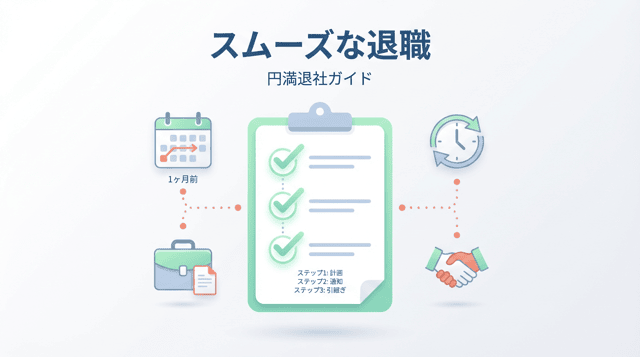
Achieving an amicable resignation requires careful scheduling. Work backward from your desired departure date to organize when each task should be completed. Here's a chronological overview from two months before your departure to your last working day.
Two months before your desired departure date, firmly commit to your decision and review your company's resignation policy in the employment regulations. Many companies require notice periods of one to two months. While civil law technically requires only two weeks, following your company's rules is the standard for an amicable exit. During this time, also prepare your reason for leaving. Have a positive, concise explanation ready for when your boss asks. If you're unsure about how to communicate your resignation, we've compiled specific scripts and examples in a separate article for reference.
Always communicate your intention to resign to your direct supervisor first. If colleagues hear about it first, rumors may spread and damage your boss's trust. Set up a private meeting, start with words of gratitude, clearly state your intention to resign, and propose your departure date along with a handover plan. It's crucial to use language that shows firm resolve — not "I'm thinking about resigning..." but rather "I'd like to resign as of the end of [month]."
Once your boss has approved, formally submit your resignation letter. Use your company's designated format if one exists; otherwise, use a standard template. Simultaneously, create a handover plan and start preparing a task list and handover documents. From this point, begin informing colleagues as well, in consultation with your boss.
Starting two weeks before your departure date, intensify the handover process. If a successor has been appointed, spend this time working together on actual tasks. Also proceed with introducing your successor and saying goodbye to clients and customers. Don't forget to make the rounds with related departments within the company.
During your final week, complete the final handover checks, tidy up your desk and digital files, and return any company-issued equipment. On your last day, personally greet everyone who helped you along the way. Bringing small gifts like sweets to express gratitude is a common practice. Sharing your post-departure contact information shows professionalism and leaves a thoughtful impression, as it allows for follow-up on any work-related questions.
Being asked to stay when you announce your resignation is not unusual. Especially for highly valued employees or understaffed teams, the pressure to stay can be intense. To achieve an amicable departure, you also need the skill to gracefully navigate counteroffers. Here are common counteroffer patterns and how to handle them.
You may be offered a raise or promotion as an incentive to stay. While it may seem appealing, agreeing too easily carries risks. Employees who retract their resignation are often labeled as "someone who tried to leave," which can affect subsequent evaluations and workplace relationships. Moreover, even with a higher salary, if the fundamental reason for your decision to leave isn't resolved, you'll likely face the same frustrations again. Respond by saying something like "I greatly appreciate the offer, but this isn't just about compensation — it's a decision based on a comprehensive view of my career," politely conveying that there are reasons beyond financial terms.
If the company suspects dissatisfaction with relationships or job duties, they may propose a department transfer. While it's worth considering if the proposed department truly appeals to you, in most cases this is a temporary tactic to retain you. Whether the transfer will actually happen is also uncertain, so clearly communicate that your goal is to pursue opportunities outside the company: "I truly appreciate the thought, but my desire to take on new challenges outside the company remains unchanged."
While consideration for the handover is important, you should avoid indefinitely postponing your departure. Not finding a replacement is a company staffing issue, not something that's resolved by you delaying your exit. Present a specific departure date paired with a handover plan: "I'll prepare thorough handover documents. If I can resign by the end of [month], I believe that provides sufficient time for a complete transition." If you already have a confirmed start date at your new company, mentioning that can also be effective.
In rare cases, a boss may react emotionally when you announce your resignation. You might hear things like "This is a betrayal" or "After everything I've done for you." However, responding emotionally is absolutely unacceptable. Calmly repeat: "I'm sorry. I understand your disappointment, but this is a decision I made after careful consideration," and ask for some time to let things settle. Most bosses will come around once they've had a chance to cool down. If the situation doesn't improve, consulting with the HR department is another option.
As a general rule, if your decision to leave is firm, you should not accept a counteroffer. However, if the proposal clearly addresses the specific reason for your resignation, it may be worth calm consideration. For example, if excessive overtime was your reason and a concrete workload reduction plan is presented. The key is whether what's being offered is a "specific, actionable improvement" rather than just a "verbal promise." Avoid relying on vague assurances, and if the conditions are clear, ask for a few days to think it over rationally.
The quality of your handover is a major factor in whether your resignation is truly amicable. No matter how politely you communicate your departure, a sloppy handover undermines the whole effort. Here's how to conduct a handover that won't leave your successor or boss struggling.
Your handover documents should comprehensively cover the full scope of your responsibilities. Start by organizing all routine tasks with their procedures, frequency, and deadlines. For ongoing projects, compile current progress, next actions, relevant contacts, and notes of caution. Information about tools, system accounts, file locations, and access permissions is also essential. Furthermore, details about past issues and how they were resolved, as well as client or customer-specific traits and considerations — the tacit knowledge you've accumulated — are precisely what's most valuable to document in handover materials.
If a successor has been identified, don't just hand over documents — ideally set up an on-the-job training period where you work together. A smooth approach involves three phases: first, you perform the work while the successor observes; next, the successor takes the lead while you provide support; and finally, the successor works independently while you're available for questions. Ideally, all three phases should be completed before your departure date, but if time is short, compensate by making the documentation more comprehensive.
It's not uncommon for a successor to not be identified by your departure date. In this case, creating even more detailed handover documents becomes critical. Aim for a level of completeness where someone could manage the work just by reading your materials. It's also important to share the documents with your boss and team members and have them check for any unclear points. Additionally, offering to answer work-related questions by email for a period after your departure makes an excellent impression.
External stakeholder transitions are also a crucial element of an amicable resignation. Ideally, visit clients and customers together with your successor one to two weeks before your departure. If communicating by email only, clearly include the successor's name and contact information, and assure them of continued support. There's no need to explain your reasons for leaving in detail; a simple statement like "I'll be departing due to personal reasons, but my colleague [Name] will be taking over as your point of contact" is sufficient.
To achieve an amicable departure, there are certain behaviors you must avoid. These actions can not only damage your post-departure reputation but in some cases lead to legal complications.
It's natural to feel a sense of relief once your resignation is confirmed, but maintaining your normal work quality until your very last day is the cardinal rule of an amicable departure. Changes in attitude — arriving late, leaving early, becoming quiet in meetings, or showing disengagement — will be noticed by everyone around you. An attitude of "I'm leaving so it doesn't matter anymore" can destroy the trust you've built in an instant. If anything, work even more diligently after your resignation is confirmed.
Once your resignation is decided, you may feel tempted to voice your frustrations. However, spreading negativity about the company or your boss while still employed does nothing but harm. It lowers the morale of remaining colleagues and can complicate your resignation negotiations. Furthermore, posting complaints about your former employer on social media after leaving is something to be strictly avoided. Such posts are easily traced and risk critically damaging your reputation within the industry. Even if you have complaints, holding them back during your departure is the mark of professional maturity.
Copying work data or materials to personal USB drives or cloud storage when leaving is a serious compliance violation. Taking customer information or trade secrets could violate the Unfair Competition Prevention Act. Even materials you created yourself generally belong to the company if they were produced as part of your work duties. Before departing, clearly separate personal items from company assets and ensure you take absolutely no company data with you.
Soliciting colleagues to join your new company — so-called "poaching" — while still employed can lead to serious problems. It's often prohibited by employment regulations and may even result in damage claims. Even after departure, agreements made while still employed fall into a gray area. While it's fine to offer career advice to colleagues who come to you, avoid active recruitment and limit yourself to supporting decisions they make on their own.
For an amicable resignation, it's important to complete all administrative procedures without oversight. Let's organize what needs to be done.
There are more items to return than you might expect, so create a checklist early. Key items include: health insurance card, employee ID/badge, business cards (both yours and those received from contacts), company-issued PC/smartphone/tablet, commuter pass, uniforms or work clothes, keys and security cards, and any other work-related equipment. It's common to return everything on your last day, but if you have a large number of items, start returning them a few days in advance.
Also confirm the documents you need to receive from the company when leaving. Key documents include: employment insurance certificate, pension handbook (if held by the company), withholding tax certificate, and certificate of separation (needed if your next job isn't secured). The withholding tax certificate is often mailed after departure, but contact your former company if it doesn't arrive. If you don't have a new job yet, be sure to request the certificate of separation, as it's required for unemployment benefit applications.
Post-departure social insurance procedures vary depending on when you start your next job. If you're joining a new company the day after leaving, your new employer handles the paperwork, so no action is needed on your part. However, if there's a gap between departure and your new start date, you'll need to enroll in National Health Insurance (or use the voluntary continuation program) and switch to National Pension. Resident tax handling — whether it's collected in a lump sum or switched to individual payment — depends on the timing of your departure, so check with HR beforehand for a smooth transition.
Here are key points for properly using your remaining paid leave while achieving an amicable resignation.
Taking paid leave is a right guaranteed under Japan's Labor Standards Act, and using it before resignation is legally unproblematic. Companies cannot, in principle, refuse your request to use paid leave. However, for an amicable departure, rather than unilaterally declaring "I'm using all my remaining days as paid leave," the best approach is to consult with your boss and plan your leave around the handover schedule.
The ideal approach is to schedule a paid leave period after the handover is complete. For example, if your departure date is March 31, you could complete the handover by March 15 and use the remaining two weeks for paid leave. Proposing this plan when you communicate your resignation helps your boss understand the full timeline and makes them more likely to support your leave request. Attempting to take leave before the handover is complete will work against your goal of an amicable departure, so always prioritize the handover when planning.
A resignation request (taishoku negai) asks the company for approval to resign and can be withdrawn before it's approved. A resignation notice (taishoku todoke) is a definitive declaration of intent that generally cannot be withdrawn after submission. For an amicable resignation, the typical process is to first verbally communicate your intention, get your boss's approval, and then submit the resignation notice. Follow your company's designated format if one exists.
In rare cases, a boss may refuse to accept a resignation letter. However, legally, acceptance is not a requirement for resignation. Under Article 627 of Japan's Civil Code, employment contracts without a fixed term end two weeks after the resignation request. If your boss won't accept it, you can submit it directly to HR or send it via certified mail. That said, these should be last resorts — try to resolve the situation through discussion with your boss or HR first.
For an amicable resignation, the golden rule is to reframe your reasons in positive terms. Even if the real motivation is dissatisfaction with relationships or compensation, use positive language like "I want to take on challenges in a new field" or "I want to broaden my career." Voicing complaints about the company only complicates the resignation process with no upside. That said, you don't need to fabricate a reason either — think of it as giving a positive spin to part of the truth.
You're under no obligation to disclose your next employer. If asked, a gentle deflection like "I'm not yet at a stage where I can share the details" works well. Especially if you're moving to a competitor, sharing the information can complicate negotiations or even trigger discussions about non-compete clauses. Keep it to "I'm looking to take on new challenges in a different environment" and leave out the specific company name.
While not required, bringing small gifts to express gratitude to those who helped you is a common practice. Individually wrapped sweets that can be shared across the department are standard, with items costing roughly 100-200 yen per person being appropriate. Avoid anything too expensive, as it may make people uncomfortable. Going around with the sweets and personally thanking each person leaves a positive lasting impression.
An amicable resignation is achieved through consistent, planned action from the moment you decide to leave until your final working day. Let's review the key points.
First, check your employment regulations and proceed with ample time in your schedule. Next, tell your direct supervisor first in a face-to-face setting, and give a concise, positive reason for leaving. When faced with counteroffers, show gratitude while maintaining a firm stance. And above all, pour your energy into the handover and demonstrate responsible work until your very last day. Follow these principles, and you can maintain good relationships with former colleagues and bosses long after you've left.
Resignation marks the end of one career chapter and the beginning of another. Departing with gratitude toward your former workplace is an act that elevates your own professional worth. Use the steps and strategies outlined in this article to achieve your amicable resignation with confidence.
Find more of our articles on Google

A certificate of resignation in Japan must be issued by your employer on request, and is distinct from the separation no...

Under Japanese civil law, employment with no fixed term ends two weeks after you give notice, regardless of whether you ...

Japanese resident tax is charged on the previous year's income and deducted from June to May. Leaving between January an...


