Trial Job Changes: How to Test-Drive Your Next Career Move Without Quitting \u2014 Services, Benefits & Step-by-Step Guide

Related Service
Go to お試し転職Table of Contents
- What Is a Trial Job Change? Understanding the Basics
- How Trial Job Changes Differ from Similar Programs
- 5 Benefits of Trial Job Changes
- Drawbacks and Considerations
- Comparison of Major Trial Job Change Services
- How to Start a Trial Job Change: 5 Steps
- Tips for a Successful Trial Job Change
- Who Is (and Isn't) a Good Fit for Trial Job Changes?
- Conclusion: Make Your Next Career Move Without Regrets
"I want to change jobs, but I'm afraid of discovering a mismatch after joining" or "I want to know the real workplace atmosphere before making a decision" — these are concerns shared by many job seekers.
"Trial job changes" (otameshi tenshoku) have emerged as a way to address these mismatches. This approach lets you experience real work at a potential employer through side jobs or freelance contracts — without leaving your current position.
This article comprehensively covers how trial job changes work, their pros and cons, a comparison of major services, and step-by-step instructions for getting started.
What Is a Trial Job Change? Understanding the Basics
A trial job change is a system that allows someone considering a career move to experience real work at a company for a set period through side jobs or freelance contracts — all without quitting their current job.
In a typical job search, you must decide to join based only on limited information from interviews and company presentations. With a trial job change, you can spend one to three months experiencing the actual work firsthand.
During the trial period, both the candidate and the company can assess compatibility. Candidates experience the actual work content, team dynamics, and company culture, while companies evaluate skills and cultural fit over time.
How Trial Job Changes Differ from Similar Programs
Several programs are easily confused with trial job changes. Let's clarify the key differences:
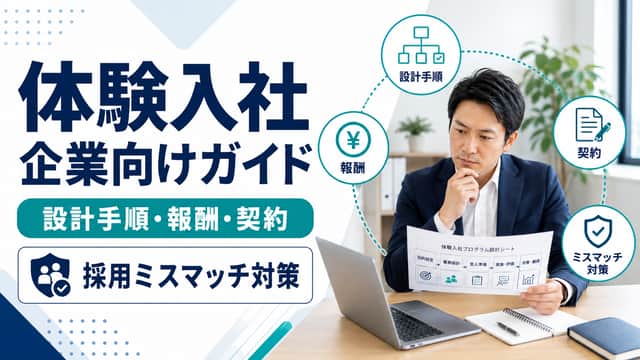
Difference from Job Shadowing (Taiken Nyuusha)
Job shadowing is a company-led process offering candidates a one-to-several-day workplace experience as part of the hiring process. It is typically unpaid, and candidates don't get to engage deeply with actual work.
Difference from Temp-to-Perm Staffing
Temp-to-perm staffing involves up to six months of temporary work with the intent to convert to permanent employment. It operates through a staffing agency as a three-party arrangement, unlike the direct two-party relationship of trial job changes.
Difference from Government Trial Employment
Government trial employment is a program promoted by Japan's Ministry of Health, Labour and Welfare that provides a three-month probationary period for assessing mutual fit. Companies receive subsidies for participation, and the candidate is officially employed from day one.
5 Benefits of Trial Job Changes
Prevent Job Mismatches Before They Happen
The biggest advantage is getting to know a company before officially joining. You can assess the workplace atmosphere, management style, and day-to-day tasks — things impossible to gauge from interviews alone.
Explore Without Quitting Your Current Job
Since participation is through side jobs or freelance work, you can explore new career paths while maintaining your current income. This eliminates the financial stress of quitting before having a new position secured.
Experience New Industries and Roles
This is particularly valuable for major career changes — like moving from a large corporation to a startup or switching industries entirely. Trial experiences let you test the waters before committing.
Hit the Ground Running from Day One
By learning workflows and building relationships with team members during the trial, you can perform at full capacity from your very first official day. This benefits both you and the company.
Build Trust with the Company in Advance
Interviews only allow brief communication, but trial job changes involve working together for weeks or months. This builds genuine mutual understanding and trust that interviews simply cannot achieve.
Drawbacks and Considerations
Significant Time and Energy Commitment
You'll be managing both your current job and the trial position simultaneously, temporarily increasing your workload. Evenings and weekends are typically when trial work happens, so maintaining work-life balance requires careful planning.
Check Your Employer's Side Job Policy
Since trial job changes take the form of side jobs or freelance work, your current employer must permit outside work. If your company prohibits side jobs, participation may be difficult.
Limited Scope of Work During the Trial
During the trial period, you may not have access to confidential projects or core decision-making processes. This can limit your ability to see the full picture of the company's operations.
No Guarantee of a Job Offer
Completing a trial doesn't guarantee employment. Since the evaluation runs deeper than a standard interview, there's always a possibility the company may decide not to extend an offer.
Comparison of Major Trial Job Change Services
Several services facilitate trial job changes. Here's a comparison of the major options:
Shigoto Ryokosha "Otameshi Tenshoku"
Run by Shigoto Ryokosha, this service enables short-term trial experiences of one to several days. Its unique "work tourism" concept lets candidates explore potential employers through brief, immersive experiences.
Fukugyo Cloud (Anotherworks)
Fukugyo Cloud is one of Japan's largest side job matching platforms. Companies post side job opportunities, and workers can apply for roles that interest them — with many positions essentially serving as trial job change opportunities.
Kasooku
Kasooku is a side job matching service with a strong focus on startup and venture company opportunities. Positions start from just 1–2 days per week, making it accessible even for those with demanding primary jobs.
Anycrew
Anycrew is a matching service for freelancers and side workers. It offers both agency-supported and direct matching options, allowing candidates to choose their preferred approach to finding trial opportunities.
Re-katsu "Social Intern"
Social Intern is an internship program for working professionals offered by Re-katsu, a job site focused on people in their 20s. It bridges the gap between standard recruiting processes and hands-on work experience.
How to Start a Trial Job Change: 5 Steps
Step 1: Check Your Employer's Side Job Policy
First, confirm whether your current employer allows side work. Review the side job and dual employment clauses in your company's work regulations, and consult HR if anything is unclear.
Step 2: Clarify Your Career Direction
Define your career objectives: what industries interest you, which skills you want to leverage, and what your non-negotiable conditions are. Having clear criteria helps you choose the right trial opportunities.
Step 3: Register on Services and Browse Opportunities
Sign up for the platforms that match your goals. Registering on multiple services increases your chances of finding the right opportunity.
Step 4: Give Your All During the Trial Period
The trial period is not a passive observation — it's hands-on work where you're being evaluated. The company is assessing your skills and work attitude, so treat every task with professionalism and initiative.
Step 5: Reflect and Make Your Decision
After the trial ends, organize your impressions. Did the work suit you? Was the team atmosphere comfortable? Were there growth opportunities? Make your final decision based on these real experiences rather than assumptions.
Tips for a Successful Trial Job Change
Here are key points to maximize the value of your trial job change:
First, limit yourself to one or two companies at a time. Taking on too many trials simultaneously makes it hard to balance with your main job and reduces the quality of each experience.
Second, establish clear evaluation criteria before starting. Document what you want to verify — work content, compensation terms, hours required, communication methods, and the possibility of conversion to full-time employment.
Third, look at both the positives and the challenges during your trial. Every company has issues. What matters is whether those challenges are ones you can accept and work with.
Finally, deciding not to switch jobs is also a valuable outcome. Many people gain a renewed appreciation for their current role through the trial process — and that clarity is just as worthwhile.
Who Is (and Isn't) a Good Fit for Trial Job Changes?
Trial job changes work best for those who want to take a cautious approach to career moves — especially people considering transitions to different industries or startups, or those who've experienced job mismatches in the past.
On the other hand, this approach isn't ideal for those who need to switch jobs immediately. Trial job changes take longer than standard job searches, so if you need a new position urgently, traditional methods may be more appropriate.
Conclusion: Make Your Next Career Move Without Regrets
Trial job changes are an innovative solution to the long-standing problem of post-hire mismatches. By experiencing a new environment while keeping your current position, both you and the company benefit from more informed decisions.
With the spread of side job permissions and remote work, trial job change services are expanding year after year. Platforms like Shigoto Ryokosha, Fukugyo Cloud, and Kasooku offer growing numbers of opportunities.
Start by registering on a service that interests you and browsing available opportunities. If changing jobs feels like a big risk, a trial job change lets you take that first step with minimal downside.
Share
Related Articles

Trial Employment: The Complete Guide \u2014 How It Works, Companies Offering It, Adult Career Experience Services & 7 Tips for Success
"It turned out to be nothing like I imagined." "The workplace culture just wasn't a fit." Post-hire regret is more commo...

30 Best Questions to Ask in a Casual Interview: Category-Based Guide with Templates & Tips for Making a Great Impression
You've been invited to a casual interview, but you're unsure what questions to ask or what the company might ask you. Un...

What to Wear to a Casual Interview: Dress Code Guide for In-Person & Online — With Examples by Gender, Industry & Season
When invited to a casual interview, many people wonder, "How casual is too casual?" Even though it's not a formal screen...