What Is a Work History? Differences from a Resume and Writing Basics
Published:
Last Updated:
Category:
Published:
Last Updated:
Category:
Authors: Shusaku Yosa
When you start a job search, you are asked to submit a work history (shokumu keirekisho) along with your resume. Many people are puzzled, wondering "What is a work history?", "How is it different from a resume?", and "How should I write it?" This article explains the meaning and purpose of the work history, how it differs from a resume, and the structure and formats that form the basics of writing it, in a way that's easy to understand for those preparing one for the first time.
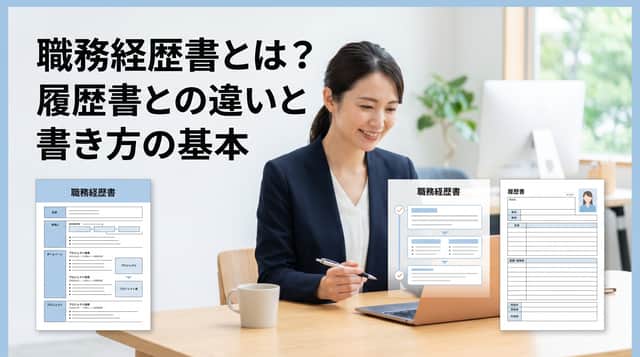
A work history is a document that summarizes the content of the work you have experienced, your achievements, and the skills you have acquired, in order to convey how you can contribute at the company you're applying to. Through the work history, recruiters judge whether the applicant's practical ability and experience match the type of person their company is looking for. A feature is that there is no fixed format, so you can tailor the content and structure so your strengths come across.
A resume and a work history are documents often submitted as a set in a job search, but their roles differ. Let's organize the differences.
A resume is a document that conveys the applicant's basic profile, such as name, education, work record, and qualifications. The work history, on the other hand, is a document that concretely shows your work experience, skills, and achievements, and appeals "what kind of things you can do." It's easy to understand if you think of the resume as "the person's basic information" and the work history as "proof of practical ability."
A resume records, in a fixed format, items such as name, address, education, work record, motivation for applying, and the personal request field. The work history is written concretely in your own words, covering the details of the work you've handled so far, your achievements and the points you devised, the skills you can apply, and a personal appeal.
A resume uses a somewhat fixed format, such as the JIS standard or a job-change version. A work history has no fixed format, and it's common to fit it onto one or two A4 sheets. Because the format is free, devising how you present it leads to a better evaluation. Note that the paper size should be unified to A4 for both the resume and the work history. For details, please also refer to our article on resume size.
A work history has no fixed format, but it is generally composed of the following elements.
The detailed way to write each item and templates are explained in our work history writing manual article. For how to create the personal appeal field, please also see our article on the work history personal appeal, and for job-type-specific examples, our work history examples article.
A work history mainly has three formats depending on how you present your career. Choose the one that suits your career.
In a job search, you are generally asked for both a resume and a work history. Because a resume alone makes it hard to convey practical ability and concrete achievements, you need the work history to supplement "what you can do."
It is common to create a work history on a PC. It's easy to edit and adjust the layout, and it's also advantageous in terms of readability. Fit it onto A4 with Word or a template, and submit it as a PDF.
One or two A4 sheets is the guideline. Even if your career is long, narrowing it to the key points and keeping it to about two pages makes it easier to read. Don't cram in too much information; organize it by prioritizing the content the employer wants to know.
A work history is a document that summarizes your work experience, skills, and achievements so far, to appeal how you'll contribute at the company you're applying to. Its role differs from a resume, which conveys basic information, and its feature is that it shows your practical ability. It's important to keep the basic structure of career summary, work history, applicable skills, and personal appeal, and to summarize it readably on A4. First grasp the overall picture, then, referring to related articles for the detailed writing, create a document that conveys your strengths.

A certificate of resignation in Japan must be issued by your employer on request, and is distinct from the separation no...

Under Japanese civil law, employment with no fixed term ends two weeks after you give notice, regardless of whether you ...

Japanese resident tax is charged on the previous year's income and deducted from June to May. Leaving between January an...


