Content Marketing vs. SEO: How to Build a Strategy That Leverages Both
Published:
Last Updated:
Published:
Last Updated:
Category: Media Strategy, Web Analytics
Authors: Shusaku Yosa
"What's the difference between content marketing and SEO?" "Which should we prioritize?" "If we need to do both, how do we combine them effectively?"—these are common questions from marketers and executives. The two terms are easily confused, yet they have distinct goals, scopes, time horizons, and primary KPIs. They are not opposing concepts but rather complementary disciplines that reinforce each other. In 2026, the spread of AI Overviews, the phase-out of third-party cookies, and rising advertising costs have made dependence on a single channel riskier than ever. Combining SEO—which builds organic traffic as a stock-type asset—with content marketing—which nurtures prospects across the entire funnel—has become the foundation of sustainable customer acquisition and business growth.
This article first clarifies the differences between content marketing and SEO at a definitional level, then maps the areas where they overlap versus where they remain independent, and finally walks through a 6-step framework for building an integrated strategy that leverages the strengths of both. We also cover common pitfalls, KPI design, and measurement methodology so that executives and marketing leaders searching "content marketing seo" can use this as a practical guide when reviewing their channel strategy.
Content marketing and SEO are often used interchangeably, or one is referenced as if it covered the other. In reality, they are different concepts. Understanding the distinction is the starting point for sound strategy design.
Content marketing is the practice of consistently delivering valuable information and content to build trust with prospective customers and ultimately drive business outcomes such as purchase, repeat purchase, and advocacy. Distribution channels are not limited to search engines—they include social media, email newsletters, webinars, white papers, video, podcasts, and offline events. Rather than pushing one-way advertising messages, content marketing aims to consistently provide the information that customers actively seek, building brand trust and affinity, and ultimately maximizing long-term customer lifetime value (LTV).
SEO (Search Engine Optimization) is the umbrella term for activities that help your site and pages rank highly on search engines such as Google, maximizing organic traffic. SEO is further divided into "content SEO," which optimizes the substance of the content itself, and "technical SEO," which optimizes the technical foundation of the site. Technical SEO includes page speed, mobile readiness, structured data, internal linking, Core Web Vitals, and crawlability. The goal of SEO is straightforward: increase organic traffic from search engines and turn that traffic into prospect acquisition.
Content marketing and SEO differ along four clear axes. First, the breadth of the goal: content marketing covers the entire funnel from brand awareness to post-purchase engagement, whereas SEO focuses specifically on top-of-funnel acquisition through search. Second, the scope: content marketing uses many channels including social, email, and webinars, while SEO concentrates on visibility within search engines. Third, content format: content marketing handles diverse formats such as articles, video, white papers, and case studies, whereas SEO centers on web pages that can be evaluated by search engines. Fourth, primary KPIs: content marketing tracks broad metrics like engagement, LTV, branded search, and loyalty, while SEO focuses on search-driven metrics such as rankings, impressions, organic sessions, and conversions.
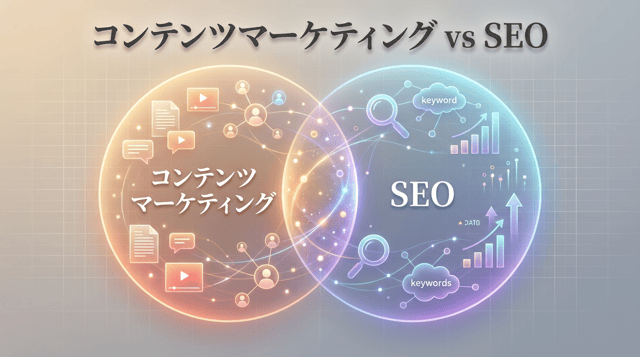
Although they are distinct concepts, in practice the two overlap significantly. Mapping the overlap and the independent areas reveals where your current activities are duplicated and where there are gaps.
Content SEO sits at the intersection of content marketing and SEO. It refers to publishing high-quality articles that meet user search intent on an ongoing basis, capturing organic traffic while simultaneously building relationships with prospects. For example, providing in-depth, problem-solving articles for consideration-stage queries like "how to do X" or "X comparison" generates organic SEO traffic while accumulating trust in a content-marketing sense. Most owned-media activities at most companies fall within this overlap.
Content marketing activities that don't go through search engines lie outside content SEO. Examples include email newsletters to existing customers, webinars and offline seminars, live streams on social media, white paper and industry-report downloads, podcasts, and video content. These work independently of search rankings, deepening relationships with existing leads and customers, driving post-purchase engagement, upsell and cross-sell, and advocacy. Relying solely on SEO leaves a significant gap in the middle and lower funnel and in post-purchase loyalty building.
Activities that optimize the technical foundation rather than the content itself are SEO's independent territory. These include Core Web Vitals optimization (LCP, INP, CLS), site structure and breadcrumb design, XML sitemap and robots.txt configuration, structured data (JSON-LD) implementation, HTTPS migration, mobile-friendliness, pagination, canonical tags, and 404/redirect management. These are technical optimization tasks separate from content quality and are typically not part of the content marketing remit. No matter how excellent the content, if the site is slow or hard for crawlers to navigate, search performance will stall—so investment in SEO's independent territory is indispensable.
The "either content marketing or SEO" debate no longer holds up in the 2026 market environment. Three factors make an integrated approach necessary.
With AI Overviews now built into Google Search and AI Mode (conversational AI search) rolled out in Japan, more queries are resolved on the search results page itself, fueling the rise of zero-click searches. Roughly 18% of commercial queries are now handled by AI Overviews, weakening the traditional "rank #1 → click" model. In this environment, you need to maintain visibility in search while pursuing GEO (Generative Engine Optimization) to be cited within AI Overviews, and at the same time build content touchpoints outside search via social, email, and community. An SEO-only strategy increasingly just rides the zero-click wave downward in traffic.
The customer journey moves through several stages: awareness, interest, consideration, decision, and post-purchase loyalty. SEO mainly captures users who have already recognized a problem and are searching for solutions—the middle and lower funnel. Reaching latent prospects who haven't yet articulated their problem requires discovery-oriented contact via social media and educational content via newsletters. For continued use, upsell, and advocacy after purchase, dedicated customer content, case studies, and user communities work well. Content marketing covers all of these stages, and only by combining it with SEO can you design consistent communication from latent prospects through existing customers.
SEO is a stock-type asset: once a page ranks well, it can generate stable traffic for months or years. Social posts, newsletters, and webinars are flow-type tactics that peak immediately after publication and then decay. Used together, you can publish a new article, distribute it on social and email to capture initial traffic and engagement, and then transition naturally to ongoing search-driven traffic. Flow tactics generate short-term reach and reaction; stock SEO assets generate long-term recurring traffic. This combination maximizes the ROI of your finite content production resources.
Below is a 6-step process for designing and operating content marketing and SEO together.
Start by clearly defining the business objectives and the KGIs (key goal indicators) and KPIs (key performance indicators) that content marketing and SEO must deliver. For BtoB SaaS this might be "X qualified leads per month" or "opportunity rate of Y%." For e-commerce, "organic-driven monthly revenue of Y yen" or "repeat-purchase rate of Z%." For publishers, "X million monthly PVs" or "Y new member registrations." Working backward from KGIs lets you assign organic-traffic and ranking targets to the SEO team and engagement and LTV targets to the content marketing team, keeping both teams aligned on the same business goal. Vague directives like "just grow traffic" or "keep publishing articles" waste time and money without leveraging either discipline's strengths.
Next, develop concrete target personas and design a customer journey that maps the persona's full purchase path in time order. Capture role, industry, age, problems faced, information-gathering behavior, and decision criteria, then identify what information the user needs at each stage (awareness, interest, consideration, decision, post-purchase), which channels they use, and which content formats fit. For example: blog articles and social posts about industry challenges at the awareness stage; comparison articles and webinars at the consideration stage; case studies and pricing pages at the decision stage; newsletters and dedicated communities post-purchase. Visualizing the entire journey is the blueprint that integrates content marketing with SEO.
Match each stage of the customer journey to the right channel and content format. SEO and owned media are best for capturing users who are actively searching, both at the awareness-of-problem stage and the comparison-of-solutions stage. Social media (X, LinkedIn, Instagram, etc.) is well suited to discovery-oriented contact with latent audiences, distributing industry trends, and building brand personality. Newsletters work for ongoing contact and education with existing leads and customers; webinars and white papers are effective for converting deep-consideration prospects into qualified leads; video and podcasts deepen engagement and expand awareness. Always design how each channel hands off to the next—for example, an SEO article triggers a white-paper download, which is followed by an email nurture sequence.
Once goals and the journey are set, build the actual content plan. Run SEO keyword research and evaluate keywords on four axes: search volume, competitive difficulty, search intent, and proximity to conversion. At the same time, surface the latent needs of your personas that haven't yet been turned into search queries. Combine these into a topic cluster with pillar pages (the central themes) and cluster articles (deep dives), and document in a single sheet which SEO keyword each article targets and which persona stage it serves in content-marketing terms. This delivers both search visibility and full journey coverage.
Translate strategy into execution by setting up a production and distribution workflow. Define the stages from article ideation, outline, drafting, editing, SEO check, and publishing, and clarify the responsibilities of editors, writers, SEO leads, and subject-matter reviewers. After publication, distribute immediately through social and email to capture flow-type reach. AI writing tools speed up drafting, but raw AI output cannot meet E-E-A-T requirements; the 2026 standard is an "AI + human" workflow in which subject-matter experts add fact-checks and original insight. Articles whose ranking falls short of expectations after 3–6 months should be updated through rewrites that refine search intent, add information, and implement structured data—nurturing them into stock assets.
While continuing to publish and distribute, regularly measure performance and run an improvement cycle. Use Google Search Console for SEO queries, rankings, and clicks; Google Analytics 4 for post-arrival behavior and conversions; and the native insights of each social platform for engagement. Hold a monthly review to identify which content is growing as expected and which is stalling, and create a prioritized rewrite plan. In Search Console, queries with "high impressions but low CTR" and articles with average position 7–20 are top candidates for rewrites. Continuous PDCA is the heart of an integrated content marketing and SEO strategy.
Below are typical failure patterns we see at companies that pursue both content marketing and SEO.
Prioritizing organic traffic above all else can lead to targeting only consideration- and decision-stage queries while completely abandoning latent audiences who haven't yet recognized a problem. You may capture conversion-ready traffic in the short term, but new prospects stop entering the top of the funnel, capping growth in the medium to long term. The fix is to deliberately reserve capacity for discovery-oriented content that doesn't depend on search queries—social, video, and trend-led blog articles. A common ratio is 70/30 to 60/40 between SEO-targeted articles and awareness-building content.
You're producing creative, high-quality articles, yet rankings don't move and organic traffic doesn't grow. The usual causes are insufficient analysis of search intent, the absence of an SEO-keyword-driven outline, and underinvestment in technical SEO (Core Web Vitals, structured data, internal linking). Even outstanding content cannot become a stock asset if search engines don't surface it. The fix is to require articulation of the target keyword and search intent at the planning stage and build an SEO review of the outline into the workflow.
SEO, social, email, and paid media owners each operate independently and don't know what the others are doing. The same customer receives contradictory messages, an SEO article gets buried because no one amplifies it on social, and email-list nurturing isn't connected to lead acquisition from search. The fix is a monthly integrated review that brings every channel onto a single dashboard and designs cross-channel collaboration at the content and campaign level. An integrated dashboard like NeX-Ray, where multi-channel data sits on one screen, dramatically accelerates silo prevention and holistic decision-making.
Because the impact of an integrated content marketing and SEO strategy is distributed across multiple channels and stages, sound KPI design and analytics methodology are essential to surface results.
At the top of the funnel, track SEO impressions, search rankings, and AI Overviews citation counts; reach, impressions, and engagement rate on social; and the trajectory of branded search volume. In the 2026 search environment, impression value matters in addition to clicks. Even on zero-click queries, repeated exposure of your brand builds awareness assets that convert later into branded searches and direct visits.
In the middle funnel, track article CTR, time on page, scroll depth, pages per session, newsletter open and click rates, webinar attendance, white-paper downloads, and saves and shares of social posts. These reflect the depth of interaction between content and users and signal both content quality and alignment with search intent. In Search Console, queries with high impressions but low CTR are clear signs that titles and descriptions need work.
At the bottom of the funnel, measure article-driven inquiries, document downloads, free-trial signups, and purchases, content-level CVR, and lead quality (opportunity rate, win rate, LTV). Distinguish high-PV-but-low-CV articles from low-PV-but-high-CVR articles and replicate the patterns of the latter across other content—"horizontal expansion of conversion contribution"—to lift the ROI of your integrated strategy. Define micro-conversions in GA4 events such as "scroll to a specific section" or "CTA button click" to make pre-conversion engagement visible too.
With third-party cookies being phased out and privacy regulation tightening, last-click attribution is losing accuracy. To correctly evaluate activities like content marketing and SEO that don't tie cleanly to direct conversions but indirectly raise brand awareness and branded search, marketing mix modeling (MMM) is highly effective. MMM statistically models aggregated data to estimate each channel's contribution and works even under cookie restrictions. An integrated dashboard environment such as NeX-Ray lets you implement MMM analyses across SEO, content, social, paid media, and email, and report the true ROI of an integrated content marketing and SEO strategy in a way that resonates with executives.
Content marketing builds relationships with prospects through valuable content and drives business outcomes across the entire funnel. SEO is the discipline that focuses specifically on top-of-funnel acquisition through search, and the two overlap heavily at the intersection called content SEO. They are not opposing concepts but complementary disciplines: content marketing covers the full funnel, while SEO generates organic traffic as a stock-type asset, each filling the gaps the other cannot.
In the 2026 market, the combination of zero-click search driven by AI Overviews, declining attribution accuracy under cookie regulations, and rising advertising costs has pushed single-channel risk to historic highs. Neither SEO's stable traffic alone nor content marketing's awareness reach alone is sufficient any more—integrated operations have become a precondition for sustainable customer acquisition.
The strategy that leverages both is built in six progressive steps: defining business goals, designing the customer journey, assigning channel roles, integrating the content map with SEO keywords, constructing the production workflow, and operating the measurement-and-PDCA loop. Be deliberate about avoiding the three pitfalls—SEO bias, content bias, and channel silos—and visualize impact with stage-appropriate KPIs across awareness, consideration, and conversion, with MMM capturing the holistic contribution.
An integrated dashboard like NeX-Ray unifies data across SEO, content marketing, social, paid media, and email, enabling you to demonstrate the true contribution of an integrated content marketing and SEO strategy in a form that resonates with executives. Start by inventorying your current content and channels and identifying where the funnel has gaps. Combined correctly, content marketing and SEO build a sustainable, ad-independent foundation for customer acquisition and relationship building over the long term.
Find more of our articles on Google

A guide to using GA4 Explorations (data exploration), following its difference from standard reports, the main technique...

A guide to GA4 permission settings—the two levels of account and property, the differences between the Administrator, Ed...

A guide to web marketing strategy through the role division and combination of channels (the channel mix)—SEO, web adver...