How to Write a Career Summary: Templates and Examples to Stand Out at the Top
Published:
Last Updated:
Category:
Published:
Last Updated:
Category:
Authors: Shusaku Yosa
The first thing a hiring manager looks at when opening a resume is the "career summary" (or "professional summary") at the very top. Busy hiring managers are often said to decide whether to read further within the first three or four lines. In other words, the quality of your career summary can make a significant difference in your screening pass rate.
However, many people share concerns such as "I am not sure how much I should write" or "I have written one but lack confidence." Because the career summary is short, the structure and the way you incorporate numbers must follow clear rules. This article gathers ready-to-use templates, examples by job type and situation, the writing process, and NG examples to avoid. By the time you finish reading, you should be able to write your own career summary with confidence.
First, let's clarify the role of the career summary and what hiring managers are actually looking for. Once your purpose is clear, deciding what to include and what to leave out becomes much easier.
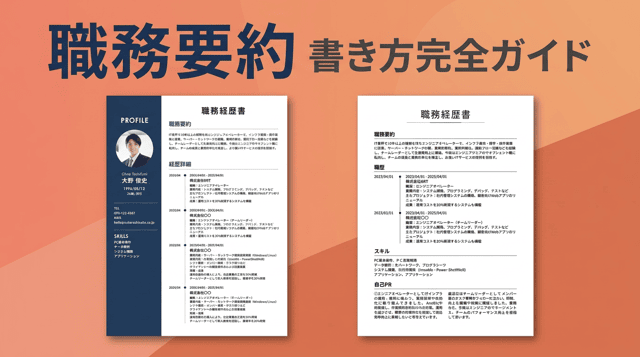
A career summary is a 200-to-300-character (or roughly 2-to-4-sentence) snapshot placed at the top of your resume. It compresses the overall picture of your career and your strengths to help the hiring manager decide whether the rest of the document is worth reading. Since busy hiring managers cannot spend much time on each application, a weak summary at the top can mean that the detailed career history that follows is not read carefully.
Hiring managers are essentially trying to read three aspects from your career summary. First, whether you have experience and skills that match the job requirements. Second, whether your past achievements and strengths can be reproduced at the new company. Third, whether you have the writing and communication skills to summarize key points concisely. The third point is often overlooked, but for any business role, "the ability to summarize clearly" is itself part of what is being evaluated.
In Japanese resumes, you may see "職務要約 (career summary)," "職務概要 (career overview)," or "職歴サマリー (career history summary)." All three refer to the same thing. You can use any of these labels — pick whichever matches the template you are working with or your personal preference. What matters is the substance, not the heading. In this article, we use "career summary" throughout.
Because the career summary is short, breaking the formal rules can make it instantly hard to read. The following three basic rules help establish a solid foundation.
The optimal length is 200 to 300 characters. This is roughly the volume that a hiring manager can read in 30 seconds to 1 minute. In terms of lines, 3 to 5 lines is the standard. Even with a long career or many past employers, anything longer than 500 characters can no longer be called a summary. The essence of "summarizing" is leaving things out — you should not try to cram everything you want to say into this section.
Use a polite tone such as "I have been responsible for" or "I am currently in charge of." Aligning the tone with the rest of the resume is critical. Also, the content should be based on facts and achievements rather than passion or motivation. Avoid subjective language like "I have worked hard" or "I have made every effort," and instead build the summary from objective facts such as job content, duration, results, and skills.
The career summary is not always read by people in your industry. In particular, HR teams often handle multiple job types in parallel. Replace abbreviations and jargon that sound natural inside your industry with phrasing that anyone outside it can understand, or add brief explanations. For example, instead of writing only "MQL," write "MQL (Marketing Qualified Lead)" the first time it appears.
A career summary is straightforward to write when you combine the following four parts. Use it as a fill-in-the-blank template.
The standard structure is built from four steps. First, state "your past employer(s), years of experience, and job type" in one sentence. Second, briefly state "your main responsibilities and the areas you covered." Third, present "your key results or achievements" with concrete numbers. Fourth, conclude with one line on "your current role and the direction you wish to pursue." Building your summary in this order naturally communicates "what you have done, what you can do, and what you want to do next."
Concretely, the template looks like this: "I have spent [years of experience] years at [company name / industry] as a [job type], being responsible for [main duties]. I have particular strengths in [area of strength] and have achieved [quantitative result]. Most recently, I have been working on [current role or recent initiatives], and going forward I aim to realize [desired direction]." Using this as a starting point and substituting your own experience naturally produces a 200–300 character summary.
Numbers immediately raise the credibility of a career summary. Try to include at least one figure — sales, count, headcount, percentage, period, etc. For sales roles, examples include "120% of annual quota" or "annual booking value of 50 million yen." For engineers, "sub-leader on a 10-person project" or "40% reduction in processing time." For administrative roles, "500 transactions per month" or "reduced workload from 8 hours to 1 hour per month." Choose units that allow third parties to grasp the scale and result without needing context.
Here are 10 job-type-specific examples that apply the template above. Use the example closest to your own situation as a base, and substitute the proper nouns and numbers with your own.
I joined ABCDE Co., Ltd. as a new graduate and have spent five years in corporate sales for IT equipment. I have been responsible for both new business development and existing-account management, focusing on mid-sized companies, and have achieved 120% of my annual quota for three consecutive years. Most recently, I have also been responsible for the OJT of two junior staff members, and I am pursuing a position in which I can also contribute in a management capacity. (about 180 characters)
I have spent eight years at OO Real Estate Co., Ltd. providing detached housing sales to individual customers. I have handled the entire flow from greeting visitors at the housing display sites to estimates, contracts, and handovers, and have achieved 20 or more sales per year for five consecutive years. I have received four internal awards and currently also handle new-hire training. Going forward, I would like to take on higher-value housing proposals as well. (about 220 characters)
I have spent four years at OO Co., Ltd., a web development company, working on backend development of consumer-facing web applications. I have used Ruby on Rails as the main framework, along with PostgreSQL, AWS, and Docker for development and operations. In a recent EC site renewal, I served as the lead for API design and reduced the average response time from 1.2 seconds to 0.4 seconds. Going forward, I would like to contribute as a tech lead. (about 230 characters)
I have spent seven years at a telecommunications carrier and a financial-system SIer, handling the construction and operation of server and network infrastructure. I led five cloud migration projects using AWS and Azure, and reduced infrastructure construction effort by an average of 40% through Infrastructure as Code (IaC) using Terraform and Ansible. I hold the CCNP and AWS Solutions Architect Professional certifications, and I would like to contribute as a lead engineer for large-scale cloud architectures. (about 230 characters)
I have spent five years in sales administration at OO Co., Ltd. in the manufacturing industry. I have been responsible for order processing (about 500 orders per month), invoice issuance, inventory management, and phone reception, focusing on accurate and speedy work. I taught myself Excel functions and macros, and reduced the order data aggregation task from 8 hours per month to 1 hour. Going forward, I would like to contribute in a position related to overall back-office efficiency. (about 220 characters)
I have spent six years in the accounting department of a Tokyo Stock Exchange Prime-listed company, handling monthly, quarterly, and annual closings. I have broad experience including consolidated accounting support, IFRS-related work, and disclosure document preparation, and I hold the JCCI Bookkeeping Level 2 certification. In a recent earnings-acceleration project, I contributed to shortening the monthly closing from 10 to 5 business days. Going forward, I would like to expand my career toward IPO preparation and accounting management. (about 220 characters)
I have spent four years at OO Co., Ltd., a staffing service company, handling everything from candidate pool building to post-offer follow-up for both new graduate and mid-career hiring. By introducing operations that define and monitor KPIs at each funnel stage from application to offer, I improved the offer acceptance rate from 65% to 85% and reduced the cost per hire by 20%. I am seeking a position in which I can drive data-driven recruiting design across the organization. (about 215 characters)
I have spent four years on web marketing at OO Co., Ltd., which operates an EC business. I have been responsible for SEO, paid advertising, SNS operations, and CRM measures, growing our own EC's monthly revenue from 15 million yen to 38 million yen. I am skilled at building dashboards using Google Analytics 4 and Looker Studio, and have a strong track record of running PDCA cycles based on data. Going forward, I would like to contribute in a role responsible for marketing strategy as a whole. (about 230 characters)
I have spent six years on the sales floor of a domestic apparel brand. During my first three years as a sales staff member, I achieved the top individual sales position in the store for two consecutive years. I subsequently served as deputy store manager and store manager. After becoming store manager, I exceeded the monthly sales target for 24 consecutive months and have maintained a top-three position in the area-wide sales ranking. I also handle shift management and development for 12 staff members, and I would like to contribute as an area manager candidate. (about 230 characters)
I have spent ten years as a project manager for system development at OO Co., Ltd., a domestic SIer. I have covered the finance, distribution, and manufacturing sectors, leading more than 20 projects ranging from 5 to 30 members. For the past three years, I have led a 100-million-yen-class core system replacement project, meeting the targets for delivery, budget, and quality. Going forward, I would like to contribute as a leader of DX initiatives, with greater involvement in the early-stage proposal and execution. (about 230 characters)
Beyond job type, the right approach also depends on situational factors such as the number of past employers and years of experience. Here are four representative cases.
I joined OO Co., Ltd. as a new graduate after university, and have spent about two years in the sales planning department working on sales promotion support tasks. I have been responsible for planning sales measures based on data analysis, verifying their effectiveness, and managing the planning and production of in-store promotional tools. I have proactively proposed new measures since my first year. Although my career is short, I have received recognition from my supervisor for my speed of business understanding and my approach to running PDCA. (about 190 characters)
Since graduating, I have consistently worked in development roles in the IT industry across four companies. At my first company, a major SIer, I worked on core system development using Java and Oracle. At my second, a custom development company, I worked on business application development with PHP and Vue.js. At my third, a SaaS company, I worked on web application development with React and TypeScript. In my current role, I serve as a tech lead. My strength is consistent experience working from the upstream phases of development. (about 230 characters)
I joined OO Co., Ltd. as a new graduate and spent five years in corporate sales. As I made improvement-support proposals to small and mid-sized companies, I encountered many situations in which structuring customer issues and solving them through IT was required, which led me to aspire to a career change to engineering. While employed, I learned JavaScript and React at a programming school, and I have released two web applications through personal development. I would like to apply the problem-solving skills I cultivated in sales to the engineering field. (about 240 characters)
After joining OO Co., Ltd. as a new graduate and spending six years in PR/communications, I took two years of leave for childbirth and parenting, and I am now actively job-seeking. While employed, I was responsible for media relations, press release writing, and internal communications operations, and I increased the number of media placements per year from 40 to 110. During my leave, I continued to follow industry news and pursued certification as a PR Planner, and I am ready to contribute as an immediately deployable resource upon returning to work. (about 230 characters)
Finally, here are four NG patterns that can lower your screening pass rate. Use these as a final check to make sure none of them apply to your own draft.
The most common NG pattern is "trying to write down every job without leaving anything out, until the section becomes too long." Anything beyond 500 characters becomes indistinguishable from the body of the career history. Counterintuitively, the more information you cram in, the more your key points blur, and the less the hiring manager retains. The more content you have, the more courage is needed to narrow it down to experiences relevant to the role you are applying to.
A summary made up of abstract aspirations like "I have worked with sincerity, putting customers first" or "I always strive to improve" simply does not function as a career summary. The career summary is the synopsis of your work history; self-PR belongs in a separate section. Move your motivation and feelings to the self-PR section, and build the career summary out of facts and numbers.
The career summary is not the place to copy your résumé's job history line by line. Lining up experience unrelated to the role at the top can give the hiring manager the impression that you may not be applying with their company in mind. Even with multiple past jobs, restructure the summary around experience that can be applied to the role, and either touch lightly on or move less relevant experience to the body of the career history.
Reusing the same career summary across multiple applications without modification is also a behavior to avoid. Different companies have different ideal candidates, so the experience and numbers worth highlighting also change. Even small adjustments — such as changing proper nouns and tuning the language to each application — visibly improve the persuasiveness of the document.
A career summary is the few lines that determine your "first impression" in job searching. By following the basic rules and the templates, and by tuning the numbers and keywords to each application, you can reliably improve your screening pass rate. Use the templates and examples in this article to craft a career summary that makes hiring managers want to keep reading.

A certificate of resignation in Japan must be issued by your employer on request, and is distinct from the separation no...

Under Japanese civil law, employment with no fixed term ends two weeks after you give notice, regardless of whether you ...

Japanese resident tax is charged on the previous year's income and deducted from June to May. Leaving between January an...


