What Is Omnichannel Strategy? Difference from Multichannel and Implementation
Published:
Last Updated:
Category:
Published:
Last Updated:
Category:
Authors: Shusaku Yosa
"We have physical stores and an e-commerce site, but they operate separately and the customer experience isn't connected"—the way of thinking drawing attention as a solution to this challenge is omnichannel strategy. With the spread of smartphones, customers now move freely among stores, e-commerce, apps, and social media as they decide on purchases. This article organizes, from a practical standpoint, the meaning of omnichannel strategy and why it's gaining attention, how it differs from the easily confused multichannel, cross-channel, O2O, and OMO, its benefits and challenges, and the five implementation steps along with representative success stories.
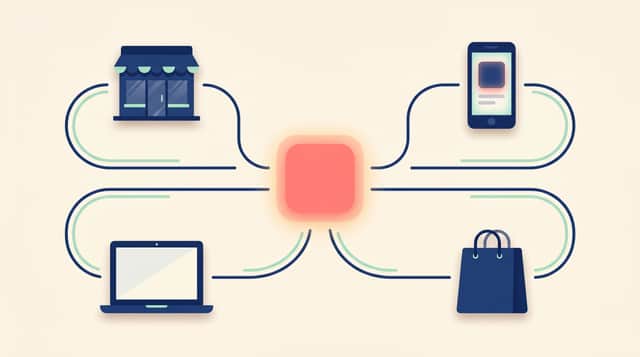
Omnichannel strategy is a strategy that integrates every touchpoint (channel) connecting a company and its customers—physical stores, e-commerce sites, apps, social media, call centers, and more—so that customers can obtain a consistent purchasing experience no matter which channel they go through. "Omni" is a prefix from Latin meaning "all," expressing the idea of "integrating all channels."
Its greatest feature lies in aiming to make customers "unaware of channel differences." For example, ordering a product seen in a store on the spot via an app and receiving it at home, or picking up a product purchased online at the nearest store—it provides a seamless experience that erases the boundary between online and offline. What underpins this is a mechanism that centrally manages customer data and inventory information on a single platform.
Behind the growing importance of omnichannel lies a major change in consumer behavior.
What is most easily confused with omnichannel is "multichannel." Multichannel refers to a strategy of having multiple sales channels—physical stores, e-commerce, catalogs, social media, and so on—but the decisive difference lies in the fact that each channel is operated independently.
In multichannel, even if a store is out of stock, that information is not reflected in e-commerce, and customer information and purchase history are fragmented by channel. Customers have multiple options, but experiences across channels don't connect. By contrast, omnichannel integrates those multiple channels and centralizes inventory and customer data, realizing a state where the same experience is possible no matter where you enter. In other words, while multichannel emphasizes "providing multiple options," omnichannel differs essentially in aiming for the "creation of a seamless customer experience."
Beyond multichannel, there are other easily confused related terms. Let's organize them by the degree of channel integration and the goal of the strategy.
Integrating channels generates the following benefits for both customers and the company.
On the other hand, realizing omnichannel also involves challenges to overcome.
Omnichannel tends to stall if you try to integrate all channels at once. It is realistic to proceed in stages from a small start, in the following order.
To get a concrete picture, let's look at some representative success stories.
MUJI (MUJI passport)
Ryohin Keikaku's MUJI is known as a pioneer of omnichannel. At its core is the app "MUJI passport," which functions as a digital membership card and manages purchase history and mileage spanning stores and e-commerce in common. It also features store inventory checks, a check-in function, and more, serving as the central tool that integrates customer touchpoints through the app.
Yodobashi Camera
Electronics retailer Yodobashi Camera unified prices and return methods between its stores and its e-commerce "Yodobashi.com," creating an experience where users can shop under the same conditions on either. Its stance of operating stores and online as one rather than pitting them against each other is praised as a representative success story in the industry.
Starbucks
Starbucks offers "Mobile Order," where you complete ordering and payment via a mobile app and pick up at a store, and made its loyalty program usable in common online and in stores. Centered on the app, it is a fine example of realizing a consistent experience from ordering to rewards.
Omnichannel strategy is a strategy that integrates every customer touchpoint so customers can obtain a consistent experience without being aware of channel differences. Unlike multichannel, which merely holds multiple channels in parallel, its essence lies in moving customer data and inventory on a single platform. For implementation, the path to avoid failure is to proceed in the flow of inventorying channels and identifying priority paths, centralizing customer IDs and inventory, setting company-wide common KPIs, selecting platform tools, and expanding in phases from a small start. As the MUJI and Yodobashi Camera examples show, the key is a shift in thinking from "product-centric" to "customer-centric." Start by mapping how your own customers move among multiple channels, and take the first step toward integration.

Twelve decisions to settle in a marketing leader's first 90 days, organised by period. Days 1–30 for understanding the c...
How to allocate a marketing budget and track it against actuals, built around a quarterly reallocation cycle. Covers spl...

What a CMO decides in the age of AI, split into decisions that can be automated and decisions that cannot. Covers the di...


