What Is OMO Strategy? Design Frameworks and Adoption Steps
Published:
Last Updated:
Category: Marketing Strategy
Authors:
Published:
Last Updated:
Category: Marketing Strategy
Authors:
"We want to take on OMO, but we don't know where to start" or "we built an app, but it isn't translating into sales"—these are common concerns heard in the field of OMO. OMO is not something that becomes a reality just by introducing tools; it is a strategy that should be designed with the customer experience as the starting point and advanced through a step-by-step process. In this article, we organize the meaning of OMO strategy and the approach to its design, the frameworks you can use, and five adoption steps along with common failure patterns—all from a practical standpoint.
OMO (Online Merges with Offline) strategy is a strategy for removing the boundary line between online and offline and providing a consistent experience no matter which channel a customer makes contact through. Its defining feature is that it is not merely a collection of measures but a "design philosophy for customer experience" that redesigns customer behavior as a single customer journey.
With the spread of smartphones and the expansion of the EC market, purchasing behavior that crosses channels—such as "see it in store, then buy it online" or "find it online, then try it in store"—has become commonplace. Thinking of online and offline as separate is itself becoming a cause of weakened competitiveness. OMO strategy is the effort to redesign, with the customer as the starting point, the organization, data, and measures that presuppose this divide.
The most important principle in building an OMO strategy is to think from a "customer experience starting point" rather than a "technology starting point." When introducing the latest AI or apps becomes the goal in itself, you tend to fall into self-satisfied measures that leave the customer out.
Successful OMO always starts from the question, "How can we make the customer more comfortable and more convenient?" Tools are merely the means to realize the customer experience you have designed. The posture of working backward from "depicting the customer's ideal experience" rather than from "introducing tools" is the foundation that runs through the entire OMO strategy.
Frameworks that visualize and structure the customer experience are useful for designing an OMO strategy. You combine the representative ones below.
When you identify pain points, it is important to base them on surveys, interviews with churned customers, and data analysis, rather than drawing them from imagination alone in a meeting room. The mindset of design thinking is also effective for finding where customers stumble.
Building on the frameworks, let us organize the procedure for actually advancing an OMO strategy into five steps.
OMO strategy is an effort that easily becomes a hollow shell if the design is wrong. Knowing the representative failure patterns makes them easier to avoid.
To advance an OMO strategy smoothly from planning to operation, you need talent who can understand multiple sales channels and digital measures across the board and command and manage them. In addition to knowledge of digital marketing, the ability to design measures with customer experience (CX) at the center and the coordination skills to connect multiple departments are required.
If there is no suitable person in-house, it is also realistic to proceed while using external talent and accumulating know-how internally. In any case, keep in mind that OMO is not a matter for the marketing department alone, but an organization-wide effort that involves management, information systems, and store operations.
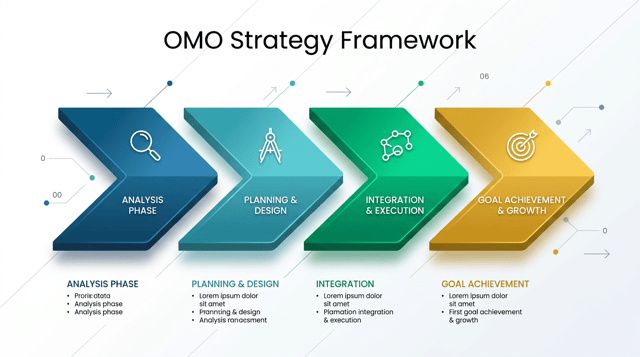
OMO strategy is an effort to remove the boundary between online and offline and redesign a consistent experience with the customer experience at its core. The starting point of design is always a customer experience first approach, and it begins with identifying pain points using frameworks such as personas, customer journeys, and touchpoint maps. On that basis, advance in stages through five steps—organizing the current state → designing the ideal experience → building the data foundation → verifying with a small start → PDCA—and avoiding failure patterns such as departmental silos and tool-adoption-as-goal is the key to success. With a mid-to-long-term perspective, keep accumulating customer-first improvements.

Twelve decisions to settle in a marketing leader's first 90 days, organised by period. Days 1–30 for understanding the c...

How to allocate a marketing budget and track it against actuals, built around a quarterly reallocation cycle. Covers spl...

What a CMO decides in the age of AI, split into decisions that can be automated and decisions that cannot. Covers the di...