What Is a Customer Journey? How to Build and Visualize One with Data [Practical Template]
Published:
Last Updated:
Category:
Published:
Last Updated:
Category:
Authors: Shusaku Yosa
"We're running ads and posting on social media, yet conversions aren't growing"—answering this question requires a customer journey perspective that tracks buyer behavior over time. This article systematically covers everything a marketer needs: from core customer journey concepts, to a step-by-step data-driven journey map, to real-world visualization examples using the NeX-Ray dashboard.
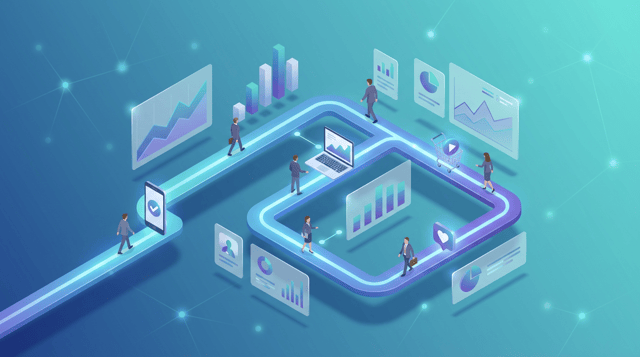
A customer journey refers to the entire experience a customer goes through—from first becoming aware of a product or service, to purchasing it, using it, and ultimately recommending it. The term combines "Customer" and "Journey," likening the path to purchase to a trip or voyage.
A customer journey map is the visual representation of this process. It organizes customer actions, thoughts, emotions, and touchpoints in chronological order, enabling teams to share a single view of what happens at each stage. When marketing, sales, and customer support teams all look at the same map, it maintains strategic consistency and prevents siloed optimization.
Advances in digital technology and social media have made buying behavior non-linear and complex. Customers interact across search engines, social media, ads, reviews, and comparison sites—a traditional linear funnel no longer captures reality.
Against this backdrop, frameworks like Philip Kotler's 5A model—Aware, Appeal, Ask, Act, Advocate—have become mainstream, acknowledging non-linear purchase processes. Customers move back and forth across these five stages, making it essential to map all touchpoints and deliver the right information at the right time.
In 2026, the expectation is that journey maps should not be created and forgotten. Instead, they must be designed as living assets—integrated with data updates and operational execution. Connecting them with MA/CRM tools and presetting journey triggers and distribution rules prevents operations from becoming dependent on specific individuals.
An effective customer journey map should incorporate these five core elements.
Every customer journey starts with persona definition. Specify age, role, challenges, and information-gathering habits to ground the entire journey in reality. Involve members from sales and customer support—not just marketing—to avoid a one-sided perspective.
Start with a standard framework—Awareness, Interest, Consideration, Purchase, Retention/Advocacy—then customize it for your business model. For B2B, you might use stages like Research, Internal Approval, Trial, and Decision.
Map specific customer behaviors at each phase: searching keywords on Google, checking reviews on social media, comparing prices on review sites. The more granular, the better. GA4 user-flow and event data serve as effective quantitative backing.
Articulate the questions, anxieties, and expectations customers have at each phase—"Will this product actually solve my problem?" or "Is it worth the cost?" Visualizing these emotions helps shape content and messaging. User interviews and surveys are especially valuable here.
Identify every channel where customers interact with your brand—website, social media, email, ads, customer support, and physical stores. Include both online and offline touchpoints to see which ones drive decisions and where drop-offs occur.
Traditional journey maps were often hypothesis-based, created on whiteboards or spreadsheets. Today, a data-driven approach is the standard. Follow these five steps to build a journey map backed by real data.
Start by gathering customer behavior data broadly: GA4 event data, ad platform performance (Google Ads, Meta Ads, Yahoo Ads), SNS engagement data, and CRM deal data. Consolidating scattered data in one place is the starting point. A marketing data integration tool like NeX-Ray lets you auto-collect data from multiple platforms with just account linking, dramatically streamlining this step.
Use collected data to define realistic customer profiles. Analyze GA4 user attributes and conversion data to identify which customer segments follow which routes to purchase, then set 2–3 primary personas. Data-backed personas make team alignment smoother.
Define purchase-process phases per persona and map key touchpoints to each. The critical step is tying performance data to each touchpoint—for example, SNS reach and display ad impressions in the Awareness phase, or article page views and whitepaper downloads in the Consideration phase.
Supplement quantitative data with qualitative insights from user interviews and surveys. Form hypotheses—"What barrier prevents customers from moving from awareness to consideration?" or "What was the deciding factor for purchase?"—and validate them with data. High-bounce or low-CVR phases warrant deeper qualitative investigation.
From the completed map, pinpoint the highest-impact bottleneck and design specific improvements. The key is not to treat the map as a one-time deliverable. Pre-define update frequency (monthly or quarterly) and update triggers (LP redesign, product changes, campaigns) to cultivate the map as a living operational asset.
A dashboard tool that consolidates multiple marketing channels is indispensable for data-driven journey visualization. Here are practical examples using the NeX-Ray dashboard.
NeX-Ray integrates data from multiple ad platforms (Google Ads, Meta Ads, Yahoo Ads, TikTok Ads, LinkedIn Ads), GA4 access data, and social media engagement into a single dashboard. This lets you track every journey phase on one screen—from SNS reach in the Awareness stage, to ad clicks in Interest, site engagement in Consideration, and conversions in Purchase.
For instance, one e-commerce company built a NeX-Ray dashboard and discovered a dominant journey pattern: customers first became aware through Instagram Reels, then searched the brand name on Google, visited comparison sites, and finally converted on the official site. Armed with this insight, they increased Instagram posting frequency and strengthened brand-search listing ads, resulting in improved CVR.
NeX-Ray includes template features for cross-platform data comparison. Aligning each journey phase with platform-specific KPIs intuitively reveals which platform performs best at which stage. Cross-platform campaign-level comparisons are available on Professional plans and above, supporting detailed analysis at the ad group and creative levels.
To keep a journey map as a living asset, regular data updates are essential. NeX-Ray's automated reporting feature compiles weekly or monthly KPI trends for each journey phase and shares them across your team. Setting up a custom dashboard with journey-phase KPIs lets you spot deteriorating metrics in real time and act quickly.
Use the framework below to build a customer journey map tailored to your business. Linking each cell to a data source transforms a hypothesis-based map into a data-driven one.
The "KPI" and "NeX-Ray Metrics" rows are the key. Monitoring each phase's quantitative indicators in real time via the NeX-Ray dashboard turns a hypothesis-based map into a living, data-backed journey map.
Personas shaped by marketers' wishful thinking tend to diverge from reality. Always include GA4/CRM data and user interviews as inputs, set data-backed personas, and review them regularly.
A journey map starts aging the moment it's created. Market conditions, customer behavior, and competition constantly change, so establish update rules from day one. NeX-Ray's automated reports let you build a low-cost monitoring system for ongoing data tracking.
Splitting into 10+ phases makes the map too complex to use in practice. Start with 3–5 simple phases and add granularity as needed—a phased approach is recommended.
Maps built solely by the marketing team miss perspectives from sales and customer success. Ideally, create maps in cross-functional workshops. Using the NeX-Ray dashboard as a shared screen enables productive, data-grounded discussions.
A customer journey is your compass for understanding the buying process and delivering the right initiatives at the right time. However, maps built on intuition alone have limits. Combining quantitative data (GA4, ads, social media) with qualitative data (interviews, surveys) is what produces a truly actionable journey map.
With a unified dashboard tool like NeX-Ray, you can monitor every journey phase across channels, detect bottlenecks early, and iterate improvements at speed. Start with a simple map using this article's template, then refine it continuously with data.

A guide to using GA4 Explorations (data exploration), following its difference from standard reports, the main technique...

A guide to GA4 permission settings—the two levels of account and property, the differences between the Administrator, Ed...
A screen-by-screen guide to reading GA4 standard reports: the snapshot, realtime, the life-cycle reports (acquisition, e...


