What Is Data-Driven? Meaning, How to Practice, and Success Stories Explained
Published:
Last Updated:
Category: Web Analytics
Published:
Last Updated:
Category: Web Analytics

Authors: Shusaku Yosa
"Data-driven management" and "data-driven marketing" — these terms have become increasingly common in business settings. Yet many professionals still wonder: what exactly does data-driven mean, and how should our organization get started?
This article provides a comprehensive guide — from the basic definition of data-driven to concrete implementation steps, and real-world success stories from companies like Netflix, Amazon, Hoshino Resorts, and JT. Whether you are a marketer or executive looking to deepen your data utilization, this guide is for you.
Data-driven refers to the approach of making decisions and taking actions based on collected and analyzed data, rather than relying on experience or intuition. The word "driven" means "propelled by," so the literal translation is "data-propelled" or "data-powered."
For example, if analysis of an e-commerce site's sales data reveals that online purchases concentrate on weekday afternoons, issuing time-limited coupons for that window is a data-driven decision. The key distinction is that objective data — not personal gut feeling — serves as the starting point for action.
In practice, the concept is often expressed as "data-driven management" or "data-driven marketing," and it applies across every business function — from corporate strategy and marketing campaigns to HR, recruiting, and manufacturing operations.
Traditional data usage typically starts with a problem or objective, then collects and analyzes data to validate it — for example, investigating why a new product's sales are sluggish. Data-driven, on the other hand, continuously collects and accumulates data, discovers new insights and issues from the analysis, and reflects them in strategy and execution. In other words, the starting point is "data" rather than a "problem." That said, there is no need to rigidly separate the two in practice. Combining traditional data usage with a data-driven approach enables higher-quality decision-making.
The spread of the internet and social media has caused an explosion in the information sources consumers access. With comparison sites, reviews, and social media posts creating channels companies cannot control, understanding purchasing behavior through experience and intuition alone has become nearly impossible. Accurate customer understanding now requires data-based analysis.
Cloud computing now makes it possible to store and process large volumes of data at low cost. Furthermore, advances in AI and machine learning mean that sophisticated analysis no longer requires dedicated data scientists. The widespread adoption of tools like GA4 (Google Analytics 4) and BI platforms has also made data utilization accessible at the operational level.
As digital transformation (DX) becomes an urgent priority for businesses, data-driven is positioned as the core enabler of DX. Transforming business processes with digital technology requires first understanding the current state through data and then continuously running improvement cycles.
Decisions based on experience and intuition are person-dependent, creating risk when team members change. With a data-driven approach, success and failure factors are recorded as data, making it easy to accumulate and reproduce know-how. Being able to explain "why it worked" or "why it failed" in numbers dramatically accelerates organizational learning.
By analyzing individual purchase histories and behavioral data, you can deliver individually optimized marketing campaigns. Delivering the right information at the right time — such as upsell proposals for high-spending customers and case studies for those still in the consideration phase — improves both conversion rates and customer satisfaction.
Because campaign effectiveness can be measured and evaluated in near real-time, you can run PDCA cycles at high speed. Comparing purchase rates between campaign-exposed and non-exposed users, for example, allows you to objectively visualize impact and make data-informed decisions to quickly halt underperforming campaigns or double down on winners.
The first step is clarifying what you want to achieve. Set concrete business goals such as "increase revenue by 10%" or "double website inquiries," then define KPIs to measure progress. When the objective is clear, the types of data you need to collect become obvious. Work backward from the goal rather than collecting data aimlessly.
Collect data from multiple angles aligned with your objectives. Common data sources include website access logs, purchase histories, CRM customer attributes, ad delivery and click data, and social media engagement data. The key is to manage these sources in an integrated fashion using customer IDs as the key, rather than in silos. Building a foundation that prevents data silos and enables cross-cutting analysis is what determines the success of a data-driven initiative.
Visualize collected data using BI tools and dashboards. Raw numbers alone are hard to interpret, so converting them into graphs and charts that make trends and anomalies intuitively visible is essential. From the visualized data, form hypotheses, conduct deep-dive analysis, and extract actionable insights for business challenges. Data professionals such as data analysts and data scientists play a crucial role in this process.
Plan and execute specific initiatives based on analytical insights, then verify the results with data and feed them into the next action. By continuously running the cycle of data collection, analysis, execution, and verification, the accuracy of your initiatives gradually improves and a data-driven culture takes root across the organization.
Netflix is perhaps the most iconic example of data-driven. The company tracks granular behavioral data — viewing history, playback patterns (pauses, rewinds, drop-offs), search history, time of viewing, and device used. Its recommendation engine is so precise that roughly 80% of content played is selected via recommendations rather than search. Netflix also uses viewing data analysis to identify what genres, casts, and themes are in demand, feeding these insights into the planning and production of original content.
Amazon analyzes vast customer data — browsing and purchase histories, search behavior, review ratings — with AI to deliver individually optimized product recommendations. The "Customers who bought this item also bought" feature is a hallmark of data-driven commerce. Beyond the storefront, Amazon leverages data for warehouse inventory management and logistics optimization, using demand-based pre-positioning (Anticipatory Shipping) to minimize delivery times.
A notable domestic Japanese example, Hoshino Resorts built an integrated customer data management system using Zoho CRM and Zoho Analytics for its bridal business. Before the implementation, customer data scattered across nationwide sales offices had to be aggregated manually, making timely situational awareness and rapid response difficult. The new data infrastructure enabled visualization and analysis of the sales process, dramatically reducing venue reservation cancellation rates.
Japan Tobacco (JT) previously relied on limited data — customer age group and current brand — for its direct mail campaigns, leaving brand recommendations to individual marketers' experience and intuition. By introducing AI-powered analysis of richer data such as behavioral histories and brand usage transitions, JT achieved personalized brand recommendations based on data, breaking free from intuition-dependent marketing.
Technology is indispensable for implementing data-driven at an organizational level. Combining the right tools for each stage — from collection through analysis to execution — is critical.
Web analytics tools such as GA4 visualize user behavior on websites, providing baseline insight into traffic sources and conversion status. BI tools like Tableau and Looker Studio integrate multiple data sources for visualization and analysis, and are widely used for building executive dashboards. CRMs such as Salesforce and HubSpot centralize customer touchpoint data to optimize sales and marketing activities. Marketing automation (MA) tools handle email delivery, scoring, and other campaign automation. CDPs (Customer Data Platforms) unify online and offline customer data, serving as the foundation for segmentation and personalization.
Finally, ad measurement and attribution tools accurately evaluate the contribution of multiple ad channels and support budget allocation optimization. Leveraging a marketing mix modeling (MMM) tool like NeX-Ray enables integrated measurement that covers not only online ads but also offline initiatives, empowering more precise data-driven investment decisions.
Data-driven is not just a tool deployment — it is a cultural transformation. Leaders themselves must demonstrate a "decide with data" mindset and lead by example for the culture to take hold.
Specialized skills are needed to correctly collect, analyze, and derive business-relevant insights from data. Beyond hiring data scientists and analysts, equipping marketers and sales staff with foundational data literacy raises the organization's overall data capability.
You do not need to roll out a company-wide initiative from day one. A realistic approach is to start small with a specific department or project, accumulate quick wins, and then expand to other areas. Small successes are the most persuasive material for gaining organization-wide buy-in.
Data-driven is the practice and philosophy of basing business decisions on objective data rather than experience or intuition. Against the backdrop of increasingly complex consumer behavior, rapid technological advancement, and the wave of DX, it has become an essential approach for every company regardless of industry or size.
What companies like Netflix, Amazon, Hoshino Resorts, and JT share in common is not just collecting data, but running a cycle of thinking, acting, and verifying based on data across the entire organization. Data-driven cannot be achieved through tool adoption alone — it must take root as an organizational culture.
Why not start by evaluating just one of your marketing initiatives with data? That small first step can become a major turning point on the road to a data-driven organization.

A guide to using GA4 Explorations (data exploration), following its difference from standard reports, the main technique...

A guide to GA4 permission settings—the two levels of account and property, the differences between the Administrator, Ed...
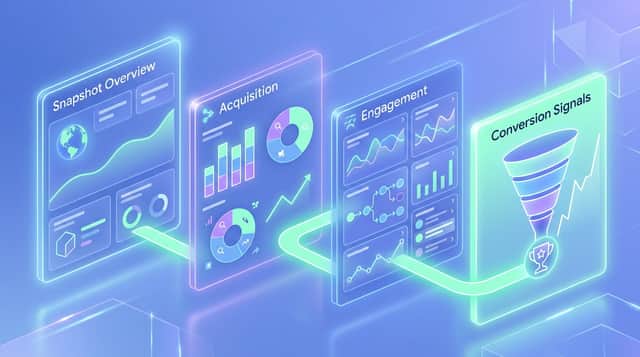
A screen-by-screen guide to reading GA4 standard reports: the snapshot, realtime, the life-cycle reports (acquisition, e...


