The LP Optimization Playbook | Analysis Methods and Improvement Checklist to Boost Conversion Rates
Published:
Published:

Last Updated:
Category: Web Analytics
Authors: Shusaku Yosa
You're spending on ads to drive traffic to your landing page (LP), yet your conversion rate (CVR) just won't improve. "I don't know what to fix, and I'm stuck" — this is a common frustration heard in marketing teams everywhere.
LP optimization doesn't work with a gut-feel approach like "let's just change the design and see what happens." Repeatable results come only from hypothesis-building grounded in data and objective validation through A/B testing. In this article, we share a systematic LP optimization process we have practiced based on real A/B test data. From selecting analysis methods and prioritizing improvement initiatives to a ready-to-use checklist, this guide gives you a comprehensive view of landing page optimization.
LP optimization refers to the data-driven process of improving elements such as page structure, design, copy, and forms to increase a landing page's conversion rate (CVR). This activity is also known as LPO (Landing Page Optimization) and is positioned as one of the highest-leverage areas in digital marketing that directly impacts advertising ROI.
Between 2025 and 2026, Google Ads has seen the standardization of AI-powered automated bidding and Performance Max (P-Max), narrowing the scope of what advertisers can manually adjust. However, the importance of "creatives" and "landing pages" — areas that AI struggles to optimize — has actually increased. Improving your LP's CVR not only boosts acquisition volume but also improves the "Quality Score" that works favorably in Google Ads' auction algorithm, ultimately helping to reduce cost per click (CPC).
Identifying the right time to start LP optimization is a critical factor in its success. If you observe any of the following three signs, there is likely an issue with your LP.
While the general benchmark for LP bounce rate ranges broadly from 60% to 90%, if approximately 50–70% of users leave at the first view alone, your headline or main visual may not match user expectations. For ad-driven traffic in particular, any gap between the ad copy messaging and the LP's first view will cause a spike in bounce rates.
When your click-through rate (CTR) is healthy but CVR is low, users were attracted by the ad and visited the LP, but likely felt that the information they expected wasn't there or there wasn't enough motivation to take action. In this case, you need to review the LP's content design and CTA (call to action).
This scenario occurs when the LP's messaging successfully drives users to the form, but they don't complete the submission. Common causes include too many form fields, confusing error messages, and privacy concerns — all UX issues around the form. In this case, EFO (Entry Form Optimization) is the primary bottleneck rather than the LP itself.
To succeed in LP optimization, accurate analysis of the current state is essential. Combining the following five analysis methods dramatically improves the accuracy of identifying issues.
GA4 (Google Analytics 4) provides quantitative data such as sessions, bounce rate, conversion rate, time on page, and performance by traffic source. Start by identifying which ads or keywords deliver visitors with the highest (or lowest) CVR to determine whether the issue lies with the LP or the ad itself.
A heatmap is a tool that visually displays where users read, click, and scroll on your LP using color-coded overlays. It is extremely effective for understanding "where on the page users are getting stuck" — something GA4 alone cannot reveal.
There are three key metrics to monitor with heatmaps. First, the "scroll heatmap" shows how far down users reach, and a sharp drop in reach rate indicates where exits are occurring. Second, the "click heatmap" reveals where users are clicking or tapping, providing hints for CTA placement and content additions. Third, the "attention heatmap" shows areas where users spend the most time reading, allowing you to distinguish high-interest content from low-interest content.
Session replays allow you to watch recordings of user interactions — mouse movements, scrolling, and clicks — as if watching a video. They help uncover user "stumbling points" that heatmaps and analytics data alone cannot surface, such as form confusion, unintended clicks, and skipping behavior.
Often overlooked, verifying that the messaging in your ad copy and banner creatives matches the LP's content is the highest-priority first step in LP optimization. If the message promised in the ad is not reflected on the LP, users will feel a disconnect and leave immediately. Use GA4 to check performance by traffic source and verify that ad keywords and banner messaging align with the LP's first view.
Map the conversion journey — LP visit, scroll, CTA click, form start, form completion, and thank-you page — as a funnel with measurable steps. Identifying which step has the largest drop-off lets you focus improvement efforts where the ROI is greatest, and helps determine whether LP modifications or form optimization should take priority.
A/B testing is the most reproducible method for LP optimization. Unlike changes based on intuition, it allows you to improve CVR through objective, data-driven decisions. Here we explain the specific process in five steps.
The starting point of any A/B test is formulating a hypothesis. A test without a hypothesis yields uninterpretable results and cannot lead to reproducible improvements. Use the analysis methods above to estimate why the current LP is underperforming, then articulate a hypothesis such as: "Heatmap data showed high first-view exit rates, so changing the headline to include specific numbers should improve scroll depth."
Prioritize elements with the greatest impact on conversions. Generally, in order of effectiveness: first view (headline, main visual, header), CTA (button color, copy, size, placement), form (number of fields, ease of input, error display), headlines and subheadings, and value propositions and offers (incentives, pricing, testimonials, case studies). The fundamental rule of A/B testing is to change only one variable at a time — modifying multiple elements simultaneously makes it impossible to identify the cause of any improvement.
Create a variant B with one focused change based on your hypothesis, and clearly document the difference from variant A (control). Use an A/B testing tool to randomly split traffic 50:50 between the two variants. During the test period, it is critical not to change any variables outside the LP, such as bid strategies or keywords.
Test duration and sample size design are also critical. Achieving statistically significant results generally requires at least several hundred sessions per variant (ideally 100–200 conversions per variant). For products with low CVR, test periods will be longer, so calculate the required sample size in advance. A minimum of two weeks to one month is generally recommended.
The most important aspect of evaluating test results is confirming "statistical significance" — the probability that the observed difference is not due to chance. The standard threshold is 95% or higher. Even if CVR differs by several points, the result cannot be deemed significant if the sample size is insufficient. Also check for external factors such as seasonality, campaigns, or media exposure that may have influenced results.
Apply the winning variant to the live LP and record the learnings from the test. Accumulate insights such as "users tend to seek reassurance" or "specific numbers drive action more effectively," and reflect them in your next test hypothesis. Continuously running this Plan-Do-Check-Act (PDCA) cycle is the essence of LPO. Don't stop at a single test — embed A/B testing into your ongoing operations as a system for continuous improvement.
Here are six high-impact areas for A/B testing, listed in order of potential effect.
The first view is the only area every LP visitor sees. A high exit rate here means users are deciding at first glance that the page isn't relevant to them. Focus on three elements: headline, main visual, and CTA visibility. In real tests, simply changing a vague headline to one with specific numbers has been shown to improve scroll depth in numerous cases.
The CTA button is the single most important element for driving conversion actions. Focus on button copy, color and size, and placement. User-benefit-oriented copy like "Download the free guide" or "Get a quote in 3 minutes" outperforms generic text like "Contact us." In one case, changing the CTA from "Inquire about the free version now" to "Try the free version" significantly boosted click-through rates. Lowering the psychological barrier is key.
The form is the final gateway to conversion. Key actions include minimizing input fields, implementing real-time validation, adding a progress bar, and optimizing for mobile. An especially notable approach is the "LP-integrated form" — embedding the form directly in the LP rather than on a separate page, which has been shown to increase form completion rates by 1.3x to 1.4x in some cases.
Social proof and authority content are highly effective in alleviating user anxiety and encouraging action. Strategically place specific metrics like customer count and sales figures, testimonials and reviews, expert endorsements, and media coverage on the LP. Identify user drop-off points via heatmap and place trust-building content just before them. In one example, placing UGC (user-generated content) on a new customer acquisition LP improved CVR by 1.22x to 1.66x.
The overall content structure is also a target for improvement. Sections with low attention or high exit rates in heatmaps can be moved lower on the page or removed entirely. Conversely, if a section near the bottom shows high reading rates, moving it to the top can improve CVR. In one financial services LP case, heatmap analysis revealed that users showed strong interest in messaging about "ease of getting started" placed near the bottom, and relocating it to the top resulted in a 110% CVR improvement.
LP load speed directly affects user experience and CVR. For ad-driven LP traffic, the smartphone share is extremely high (exceeding 80% for Facebook ads in some cases), making mobile-first design essential. Image compression, lazy loading, removing unnecessary scripts, and improving Core Web Vitals are prerequisites that should be addressed before any A/B testing.
The following checklist covers everything from initial diagnostics to ongoing optimization. Use it to confirm each item and determine improvement priorities.
□ Does the headline address the user's pain point? □ Does the first view match the ad's messaging? □ Does the main visual intuitively convey the value proposition? □ Is a CTA button placed within the first view? □ Can users understand what the page offers within 3 seconds? □ Does the first view display properly on smartphones? □ Does the page load within 3 seconds?
□ Does the page follow a "problem → solution → trust → action" flow? □ Are specific user benefits clearly stated? □ Is objective evidence such as case studies and data provided? □ Is there social proof (testimonials, reviews)? □ Does an FAQ section address pre-purchase concerns? □ Are competitive differentiators clearly communicated? □ Has redundant text and low-interest sections been removed? □ Are charts, tables, and icons used for visual clarity?
□ Does the CTA copy specifically state user benefits? □ Is the CTA visually prominent in color and size? □ Are CTAs placed at the top, middle, and bottom of the page? □ Have non-conversion external links been removed? □ Are there friction-reducing elements near the CTA ("Free," "Completes in X seconds")? □ Are multiple conversion paths offered (phone, chat, LINE, etc.)? □ Has a sticky/scroll-following CTA been considered?
□ Are form fields minimized (ideally 5 or fewer)? □ Is real-time validation implemented? □ Are input assistants (auto-fill address, auto-convert kana) available? □ Do mobile fields trigger the correct keyboard type (numeric, email, etc.)? □ Is progress visually indicated (progress bar, etc.)? □ Is a privacy policy link provided for reassurance? □ Is the thank-you page properly designed? □ Has an LP-integrated form been considered?
A/B testing is not a silver bullet. For LPs with fewer than 1,000 monthly page views, it can take months to achieve statistically significant results, making the tests themselves inefficient. At this stage, focus first on strengthening traffic acquisition and solidifying the LP's fundamental messaging — clarifying personas, redesigning value propositions, and mapping competitive differentiators.
A full-scale LP redesign makes it impossible to pinpoint what worked (or caused decline). Even running one improvement per week is sufficient — small, continuous improvements are the fastest path to sustained CVR growth. Focus on maintaining a rapid cycle of improve, verify, and learn.
A major obstacle in LP optimization is fragmented data. CPA and clicks are in Google Ads, session duration and bounce rate in GA4, and reading depth and click positions in heatmap tools — but these are separate tools with no data integration. Cross-referencing such as viewing heatmaps for users from a specific ad requires manual parameter setup and spreadsheet matching. By leveraging an integrated marketing analytics platform, you can eliminate these inefficiencies and accelerate your LP optimization PDCA cycle.
LP optimization is not a one-time redesign — it delivers results through the continuous PDCA cycle of data-driven hypotheses, A/B test validation, and implementing findings.
To summarize: combine five analysis methods (GA4, heatmaps, session replays, ad-LP alignment checks, and funnel analysis) to identify current issues. Then follow the five A/B testing steps (hypothesis, test selection, execution, significance check, winner adoption) to drive scientific improvement. Address six key areas in order of impact: first view, CTA buttons, forms, social proof, content structure, and page speed.
In the age of AI-driven automated bidding, LP optimization is the single biggest lever that marketers can actively control. Start by using the checklist in this article to diagnose your current LP. Once data reveals the improvement points, the actions to take will become clear.

A guide to using GA4 Explorations (data exploration), following its difference from standard reports, the main technique...

Compare GA4 roles, add or remove users, understand inherited access, and troubleshoot permission issues when sharing a p...
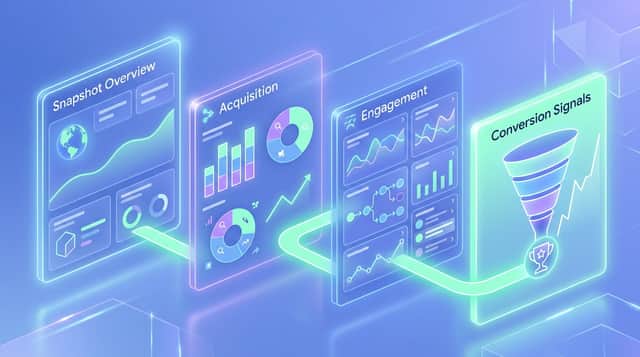
A screen-by-screen guide to reading GA4 standard reports: the snapshot, realtime, the life-cycle reports (acquisition, e...


